

 For the duration of Phil Murphy’s tenure as governor, Elizabeth Maher Muoio has led New Jersey’s Department of the Treasury, a 3,000-employee agency that oversees everything from tax collections and annual spending to public-worker pensions.
Only a handful of women have ever served in such a capacity in New Jersey, and none of their tenures as state treasurer have lasted as long as Muoio’s, which began in 2018.
“I’ve absolutely loved this job,” Muoio said during an interview with NJ Spotlight News that was held as she, like Murphy, is preparing to leave office later this month.
“It’s been a great experience,” she said.
Last week, Gov.-elect Mikie Sherrill, set to take office on Jan. 20, announced she will nominate Aaron Binder, who currently serves in the Murphy administration as deputy treasurer, to succeed Muoio.
While praising Binder’s selection to lead Treasury, Muoio, a former state lawmaker from Mercer County, also looked back on her own tenure during the interview with NJ Spotlight News.
She noted her time as treasurer coincided with steep revenue losses that occurred during the onset of the COVID-19 pandemic, presenting a significant financial challenge amid a health crisis.
Accomplishments
But Muoio has also been at the helm as improvements in the state’s credit rating have come in more recent years. Those improvements occurred as revenues rebounded, but also as the Murphy administration has prioritized pension funding, budget reserves and paying down bonded debt.
“If I had to pick one thing to focus on . . . I think it would be changing the trajectory, the fiscal trajectory, of the state,” Muoio said when asked about her accomplishments as treasurer.
On the rating upgrades themselves, Muoio highlighted their issuance by independent, nonpartisan analysts working at the major Wall Street rating agencies. Prior to 2022, New Jersey had been earning only downgrades from those analysts, going back to the mid-2000s, according to Treasury records.
“It’s like getting a higher grade in school. I don’t mean to simplify it, but from people who do this for a living, they are the experts in the field,” Muoio said about the more recent rating upgrades.
But to earn those upgrades, which can lead to lower costs for the state – and taxpayers – whenever money is borrowed to pay for long-term investments, the rating agencies had to see improvements in several key areas.
Among them is the budget surplus, which is the primary account the state uses to hedge against unforeseen spending needs or revenue losses that can upend the state budget, and the many programs and services it funds.
While overall state spending has gone up dramatically during Murphy’s tenure, the surplus has also increased. A decade ago, state government had less than $1 billion in the surplus, but it is now on course to have nearly $6.7 billion in reserve when the current fiscal year ends June 30, according to budget documents.
“I always say, ‘You don’t have people out on State Street, behind me, picketing for a higher surplus,’ right? But it’s incredibly important,” Muoio said.
Criticism
Still, not everyone has been happy with how state finances have been handled by the Democratic Murphy administration during Muoio’s tenure as treasurer.
Among the critics have been Republican lawmakers, who’ve questioned everything from increased taxes and spending to the handling of a dedicated reserve set up to manage bonded debt. Republicans also went to court and unsuccessfully challenged an emergency borrowing issue the administration floated during the pandemic.
And about that big increase in spending, which has resulted in the size of the state’s annual budget growing from less than $40 billion to a record-high, nearly $60 billion during Murphy’s tenure, Muoio said it’s come as the state has begun to fully fund several big-ticket financial obligations that were not prioritized to the same degree by prior administrations.
Among them has been the employer obligation to public-worker pensions. A more than $7 billion payment was earmarked in the most recent annual budget to keep pace with the latest worker pension obligations calculated by the state’s actuaries.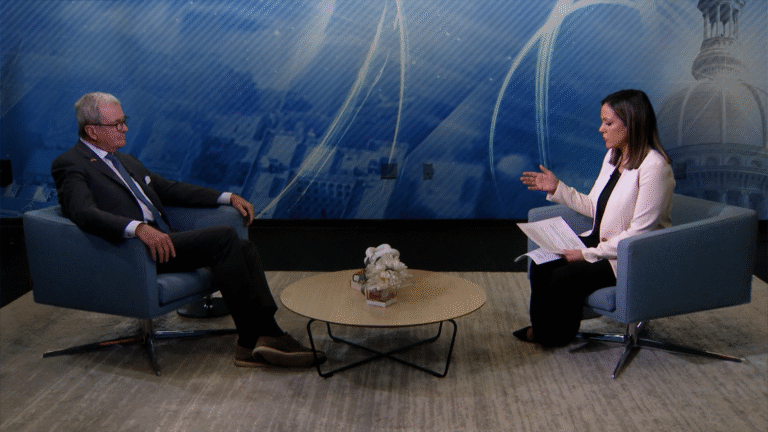
A decade ago, the state was spending a little over $1 billion to cover the annual pension obligations, according to budget documents, representing only a portion of the amount state actuaries were calculating for what should have been a full employer payment at the time.
“Billions and billions of dollars have gone toward that payment,” Muoio said, speaking about her own administration’s handling of the annual pension obligations.
New Jersey is also now fully funding its school-aid law after not doing so for years, and spending on direct property-tax relief programs has grown by 300% over the last decade, according to a NJ Spotlight News analysis of the budget documents.
“Yes, the budget has grown, but let’s look at what the growth is,” Muoio said.
Looking ahead
Still, the treasurer also acknowledged as she prepares to step down that there will be more work to be done by the next administration to keep up the state’s fiscal momentum. And that will come at a time when employee health care costs are rising, and federal policy changes are shifting more costs down to the state level.
“Clearly there will be budget pressures in the coming few years. That’s always a balancing act,” Muoio said.
“Health care costs, generally, our health benefits plans are, clearly, and we’ve seen it at the local level, especially the past few years, are going to continue to be a cost-driver,” she went on to say.
“Another challenge will be trying to figure out federal budget pressures, that’s also a story that continues to evolve,” she said.
Beyond the numbers, Muoio’s time as treasurer has also come at a time when several women and people of color have held key positions within Treasury and have led some of the department’s highest profile divisions. These include the divisions of Taxation and Investment, and the Office of Management and Budget, among others.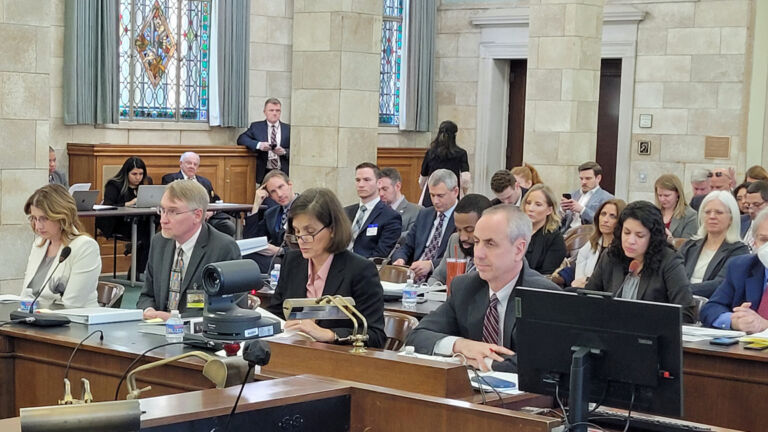
Asked about that part of her record, Muoio quickly pointed to what she called her department’s “great team.”
“They’re very successful at what they do. Extremely competent,” she said.
“We have incredible people in this state, and the more people we can get involved in government service the better,” Muoio went on to say.
“I just think it’s important to get people involved because it’s our state, it’s everybody’s state, you’re representing a diverse, always on the move state, and I think it’s great that our leadership reflects that,” she said.
And when asked about the record she herself has set as the state’s longest-serving woman treasurer, Muoio responded by telling a quick story.
“When I was in the Legislature, I would be on these panels, and I would get these questions, sitting there with men on either side, legislators, and I’d get questions about, how do you juggle it? I have three children, who are all grown now, but at that point they were small. How do you juggle it, being, you know, a mother?,” Muoio said.
“I finally stopped answering the question, and I said, ‘Listen, unless you’re asking all these guys the same question,’ which they were not, ‘every time you ask a woman that question, and not a man, you’re just cementing for some little girl, in some little girl’s head, that this is going to be her issue, that she’s going to need to figure this out, it’s not going to be an issue she takes on with her partner, or spouse,’” Muoio said as she finished the story.
“So I think it’s a great for young women to see a woman treasurer,” she said.
This story is made possible in part by the Corporation for Public Broadcasting, a private corporation funded by the American people.
