Credit: (AP Photo/Bebeto Matthews)
More than 634,000 New Jersey residents already have voted with just a week until Election Day, which features an acrimonious battle between the party nominees for the governor’s seat as well as the entire state Assembly and one open state Senate seat.
Democrats continue to lead in early voting following the first two days of in-person balloting, which buoys the party’s hopes of continuing to hold the governor’s office by electing Rep. Mikie Sherrill (D-11th). While more Democrats voted in person this past weekend, enough Republicans turned out to narrow the gap between Sherrill and GOP nominee Jack Ciattarelli, a former state assemblyman. Democrats continue to dominate mail-in ballots.
While more Democrats are voting earlier than any other registered voters, there’s no guarantee all are voting for Sherrill. And there’s no way to know whether turnout on Election Day will skew Republican.
Campaign funding
The funding contest between the two major party candidates is much closer, according to an NJ Spotlight News analysis of campaign finance reports filed by the Friday deadline with the state’s campaign finance watchdog. More than $90 million had been spent by the campaigns and the independent committees as of Friday. Added to primary spending, the cost of the election now exceeds $133 million.
Both candidates have qualified to each receive the maximum state matching funds of $12.5 million. Sherrill so far raised about $600,000 more than Ciattarelli and has spent $100,000 more. By accepting public funds for their campaigns on a two-to-one basis, each candidate agreed to spend no more than $18.5 million, with a few exceptions for certain expenditures. That means both had about $2 million more they could spend in the final 11 days of the campaign.
But there is no limit on the amount independent groups can raise and spend to influence voters. These groups technically are prohibited from coordinating with candidates, but their spending on ads and get-out-the-vote efforts can make a difference.
Of the committees that filed by last Friday’s deadline, those backing Sherrill reported spending about $29.6 million, while Ciattarelli supporters have spent $27.4 million. Included in those totals are $16.2 million from the Democratic Governors Association backing Sherrill and $12.3 million from the Republican Governors Association backing Ciattarelli.
Voter turnout
Both major party candidates are looking for any advantage as polls appear to show a tight race: Sherrill has about a five-point lead over Ciattarelli in the most recent polls but that is close to the margin of error. Libertarian Vic Kaplan and Joanne Kuniansky of the Socialist Workers Party are also on the gubernatorial ballot.
Larger independent committees are responsible for many of the ads currently airing on television and online. Some of the smaller ones are helping with voter outreach.
Both candidates are making major efforts to engage voters directly during this last week, with both planning bus tours of the state. The goal in these late efforts is to get as many of their supporters to vote in a statewide election in which fewer than half of the state’s registered voters typically participate. In the last gubernatorial election in 2021, just 40% of those registered voted.
If turnout during the first weekend of early in-person voting is any indication, New Jersey residents are not as enthusiastic about the governor’s race as they were about the presidential election, when people in some parts of the state faced long lines to vote early.
More than 163,000 people voted at dozens of early voting locations throughout the state on Saturday and Sunday. That’s significantly higher than in the first three years New Jersey has offered early machine voting – in its first year in 2021, 207,000 voted during the entire nine-day period. But it’s not as many as last year, when a total 1.1 million people voted early in person. So far this year, Democrats outnumbered both Republicans and unaffiliated and third-party voters.
Mail-in ballots continue to pour into county election offices and close to two-thirds of those are coming from Democrats, following the trend this year and in the past.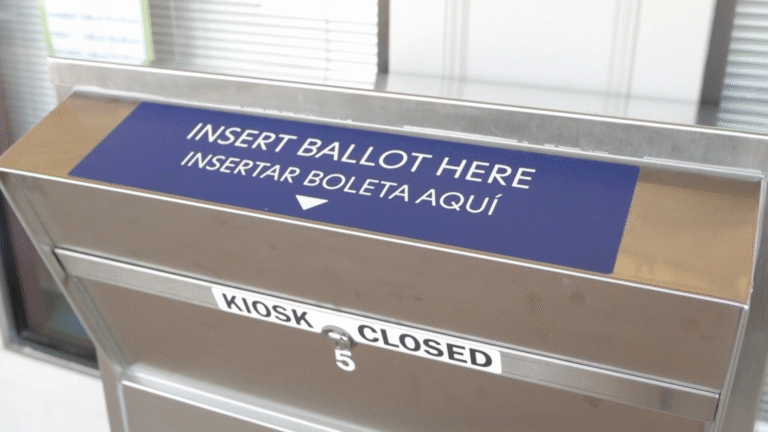
In total, more than 634,000 people had voted early through the end of Sunday, well above the 409,000 who had voted by this time in 2021. Of all the early voters so far, about 365,000 or 57% were Democrats, 163,000 or 26% were Republicans and the rest were unaffiliated or members of the Libertarian, Green or another third party.
How to vote
Early voting continues through Sunday, Nov. 2 at 6 p.m. Polling locations are open every other day from 10 a.m. to 8 p.m.
Mail-in ballots can continue to be returned through close of polls on Election Day. They can be mailed or dropped in one of hundreds of secure ballot drop boxes throughout the state, though a voter using a box must use one in the county in which he lives. All ballots postmarked by Nov. 4 will be counted if received by county election officials within six days after the election.
Polls will be open next Tuesday statewide from 6 a.m. through 8 p.m. Voters can find their local polling site on the sample ballot they should have received or by using the state’s polling locator search.