
 Credit: (New Jersey Department of Corrections)
New Jersey officials and advocates celebrated the start of a new era of women’s corrections at the groundbreaking for a $312 million prison built to encourage the rehabilitation and support the dignity of women while they are incarcerated.
The ceremony, which showcased artist’s renderings of the new campus-like facility in Burlington County, marked the beginning of the end of the Edna Mahan Women’s Correctional Facility, which has been better known for physical and sexual assaults than for the second chance policies espoused by its namesake, a former administrator there.
“When you’re building a new building, there’s real opportunities to think about the architecture of the place and what it can do for the experience of people day to day,” said Terry Schuster, the state’s corrections ombudsman. “Separate from that, there’s the symbolic importance of saying that this thing that the state became known for around the Edna Mahan facility, that’s not who we are, that’s not what we’re about. We’re moving past it intentionally and creating something different.”
Edna Mahan, the state’s only women’s correctional facility, is under federal monitoring due to decades of sexual assault and abuse in the prison. Violent overnight cell extractions in early 2021 left two inmates seriously injured and ultimately led to the forced resignations of the corrections commissioner and ombudsman. A Superior Court judge recently dismissed the indictments of 14 corrections officers and staff charged with assault and misconduct in that 2021 incident and the state attorney general’s office has filed an appeal.
It was five months after those violent extractions that Gov. Phil Murphy called for the closure of the 112-year-old prison, located in Hunterdon County. Two years ago, most of the women were moved to the former William H. Fauver Youth Correctional Facility, a newer prison that had closed, with just maximum-security housing and administrative offices remaining on the original site. The buildings the female inmates had been living in were old and plagued by problems with temperature control and mold, among other issues. Murphy said that building the new prison will save the state $160 million in maintenance and capital costs that would be needed to keep the current Edna Mahan open.
 Credit: (NJ Division of Property Management and Construction)
“For decades, Edna Mahan has stood as a shameful symbol of a deeply flawed status quo,” Murphy said, calling the current site “woefully outdated” and “ill-equipped for protecting the well-being of incarcerated people.”
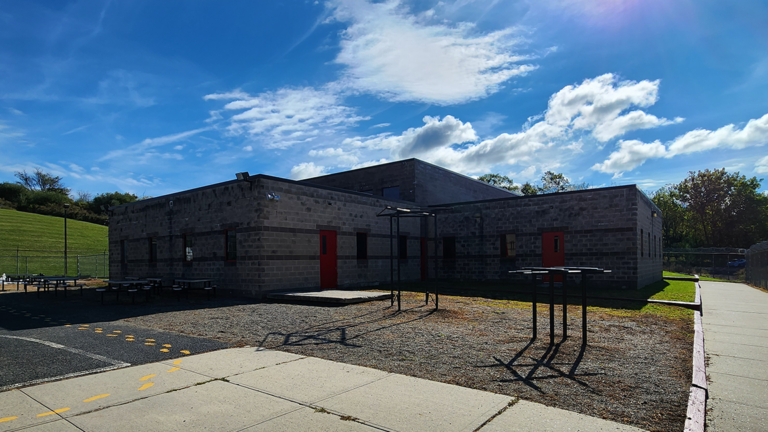
Murphy said that building the prison in Chesterfield will set it in the center of the state, making it more accessible for visits by family and friends. The 33-acre parcel is adjacent to the former Albert C. Wagner Youth Correctional Facility and near the Garden State Youth Correctional Facility. It is being designed for 420 inmates to live in a campus-like setting, with women able to walk from housing to a dining hall, medical care, classes and other programming. Officials expect the new facility will be open in 2028.
Victoria Kuhn, the state corrections commissioner, said the department has been successful in changing the culture at the women’s prison from one that mistreated the women to one that protects, supports and trains them as they prepare to reenter society.
“We have become the gold standard for others to follow,” she said. “When the doors of this new facility open, the foundation for its success will have already been poured with reforms that we have implemented.”
“It’s the way that a campus should be constructed these days for a prison facility,” Kuhn said. “It’s no longer a ‘I’m passing through the gate and they’re advising me where I need to be next.’ There’s a sense of ownership that comes with this campus layout, but because it’s modern, it now gives us the ability to have the number of classrooms we need, the number of vocational training areas we need.”
One flagship program that will move to the new prison campus once it is completed will be the Design Studio fashion design and workforce development program launched last month with Pratt Institute that is one of the first of its kind in the nation. Completion of the 10-month instruction, led by Pratt faculty, will result in a certificate of completion from Pratt Institute’s School of Continuing and Professional Studies, which can help the women in their reentry efforts.
Bonnie Kerness, a longtime advocate for the incarcerated and a member of the Edna Mahan Correctional Facility board of trustees, said the new facility will replace “squalid conditions” and go a long way toward helping the women do their time and prepare to return to their lives and families.
 Credit: Colleen O'Dea
“Instead of metal tables and chairs, instead of the purposeful screeching of cage doors opening and closing, there will be dormitory homes, couches, lamps, a library in each section, the educational component,” she said. “These are all things very large and very small that will make a difference in terms of dignity, self-esteem and feeling safe.”
Myrna Diaz, who spent 14 years incarcerated at Edna Mahan before Murphy commuted her sentence last year, lauded the new facility as “an opportunity for progress and renewal.”
Kuhn said the state has been progressing through the federal monitoring process, with almost half of the changes required by the federal consent decree dismissed due to compliance. She and others said there is still a need for lawmakers to pass legislation requiring the reforms put in place at Edna remain so that there won’t be any backsliding in the future, once the monitoring is complete. Those reforms include body cameras for corrections officers, a system for monitoring officers’ behavior and an overhaul of policies, staffing and training. The court-appointed monitor could move to release the state from the decree as early as next year.
The Incarcerated Women’s Protection Act, S-3530, would enact those reforms into law. It cleared a Senate committee earlier this year and is expected to be considered by lawmakers in the lame duck session that will begin after the general election.
After the ceremony, Murphy declined to comment specifically on the bill, but said it is “conceptually hard to be against” legislation that would seem to support the kinds of criminal justice reforms his administration has put forth, which he characterized as “the notion of being the state for second chances getting the balance right between dignity and respect for those who are incarcerated with public safety.”
He also commented for the first time on the judge’s dismissal of the charges against those allegedly involved in the cell extractions, saying he was “extremely bitter, disappointed and angry, given what I know,” but said he couldn’t say more due to the pending appeal.
According to a spokesman for the Department of Corrections, the final design for the new women’s prison, which does not yet have a name, is to be completed by the middle of next year, followed by the start of construction in earnest sometime in 2026. Final construction is expected to be completed by 2028, with the facility fully open and operational that year.

