
 Credit: (John Mooney/NJ Spotlight News)
 A tax on businesses that generates more than $4 billion annually for the state budget has not been generating as much revenue as it did this time last year.
It’s still very early in New Jersey’s July-to-June fiscal year, but business leaders have begun to sound alarms about the slow start – and the possible trajectory of the state economy.
“While some may dismiss weak, early-year returns as insignificant, the scale of the decline in business taxes cannot be ignored,” wrote Tom Bracken, the president and chief executive officer of the New Jersey Chamber of Commerce, in a recent op-ed.
In all, collections for the state’s corporation business tax were off by more than 50% year over year through the end of August, according to the latest revenue figures released by the state Department of the Treasury.
This comes as President Donald Trump’s administration has been pursuing a series of significant federal policy changes likely to have major economic implications over the long term.
These include a sweeping foreign tariff agenda already hiking costs for many small businesses and consumers, as well as the aggressive targeting of undocumented immigrants, including those participating in key sectors of the workforce.
In his op-ed, Bracken noted the state corporation business tax collections had dropped by more than 250% during the month of August compared to the same month last year. Also lagging were collections for another state business tax, the business alternative income tax, he said.
‘A warning sign’
Bracken’s organization has long raised concerns about the state’s business climate and ways high marginal taxes and stiff regulations can be a drag on the New Jersey economy and, in turn, the state budget.
“These numbers are not just a statistical blip – they are a warning sign that the state’s economic engine is stalling, and that business growth must become a central priority for policymakers,” Bracken wrote in the op-ed.
“If New Jersey’s business tax base continues to erode, future budgets will face growing pressure, forcing tough choices on spending, borrowing, or further tax increases that could worsen competitiveness,” Bracken said.
In a news release issued by New Jersey’s Treasury department along with the latest state revenue figures, officials stressed that the current fiscal year, which began July 1, has only just begun to take shape.
Moreover, they noted closely watched quarterly estimated payments for the corporation business tax, which is often referred to in shorthand as the CBT, don’t come due until September. And those payments can be substantially larger than the collections drawn from businesses during the months of July and August.
“As noted in the monthly press release, revenue collections in July and August are relatively small, without any major quarterly payment due dates,” Treasury spokesman Darryl Isherwood said in an email to NJ Spotlight News.
Treasury’s news release also cited significantly higher refunds as a cause for the big decline in CBT collections that occurred in August.
According to Isherwood, the Treasury spokesman, those refunds were “not attributable to the current economic climate.”
“Rather, throughout the year taxpayers will file amended returns to claim economic development tax credits for prior tax years,” Isherwood explained via email. “The jump in refunds is attributable to such activity and reflects tax credit activity related to tax years 2018 – 2023, not tax years 2024 or 2025.”
He also returned to the issue of it still being very early in the fiscal year.
“Corporation Business Tax collections in September can often be up to five times greater than the first two months of the fiscal year combined, since the 3rd quarter payments for tax year 2025 are due in mid-September,” Isherwood said in the email.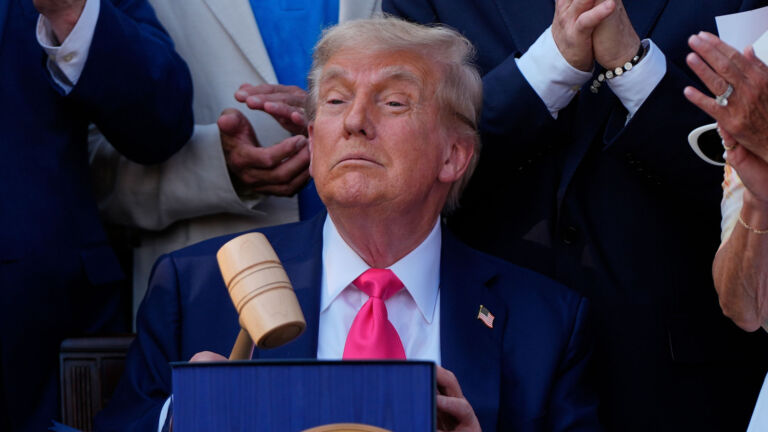
It’s still early
By the time the current fiscal year closes on June 30, 2026, the total CBT collections are projected to grow, by nearly 3% year over year, according to state budget documents.
Meanwhile, overall state tax collections are also projected to grow year over year, by more than 3%, according to projections baked into the nearly $60 billion annual budget adopted by Gov. Phil Murphy and lawmakers at the end of June.
Through the first two months of the fiscal year, overall state tax collections were ahead of last year’s pace, but by less than 2%, according to Treasury’s revenue report.
While much of the revenue from the CBT flows into the state budget’s general fund, a portion is also dedicated to funding environmental programs, including open space preservation and flood protection.
Some of the state’s most profitable companies are also being charged an additional business tax until Dec. 31, 2028, to help bring in more revenue for New Jersey Transit, the state’s perennially cash-strapped bus and rail agency.
On the positive side of the fiscal ledger, Treasury reported a 9.5% uptick in monthly income tax collections in August compared to the same month last year.
The income tax is the largest single source of revenue for the state budget, generating more than $21 billion annually in dedicated funding for things like K-12 public education and direct property-tax relief.
Treasury officials attributed the boost in monthly income-tax collections to increased employer withholdings, and a drop in refunds.
According to the latest jobs report, New Jersey employment also grew in August, by nearly 5,000 jobs.
However, the state unemployment rate ticked up to 5% last month, and it remains to be seen how the federal policy changes will affect the overall economy heading into the remaining months of the fiscal year.
“Some of the major economic forecasting firms are now forecasting downward trends in quarterly corporate profits of 5%-10% into next year compared to their previous forecasts in June, due to federal and international conditions,” Isherwood said.
“That is something we are keeping an eye on,” he said.
— Editor’s note: Tom Bracken of the New Jersey Chamber of Commerce is on the board of trustees for NJ PBS.
This story is made possible in part by the Corporation for Public Broadcasting, a private corporation funded by the American people.
