 Credit: (AP Photo/LM Otero)
As residents across New Jersey were preparing to cast ballots for U.S. president and Congress last fall, a leading public-opinion poll said the economy was the top concern in a state with a notoriously high cost of living.
The poll conducted by Rutgers-Eagleton found the concerns about the economy and fiscal issues easily topped all others among the state’s registered voters, including immigration, reproductive rights and personal character of the candidates.
Now, with Republican Donald Trump sworn in as president alongside a GOP-controlled U.S. Senate and House of Representatives, how new immigration policies championed by Trump will impact businesses and the economy is a key question, including the impact in New Jersey where foreign-born residents make up a significant share of the overall labor force.
A deeper look at the economic impact of President Donald Trump’s immigration policies.
After taking office Monday, Trump issued a series of executive orders, including several that pave the way for more hard-line federal immigration regulations.
Economic impact of immigrants in NJ
During a policy forum hosted by the nonpartisan New Jersey Business Immigration Council earlier this month, several panelists highlighted the role immigrants play in a state with more than $630 billion in gross domestic product.
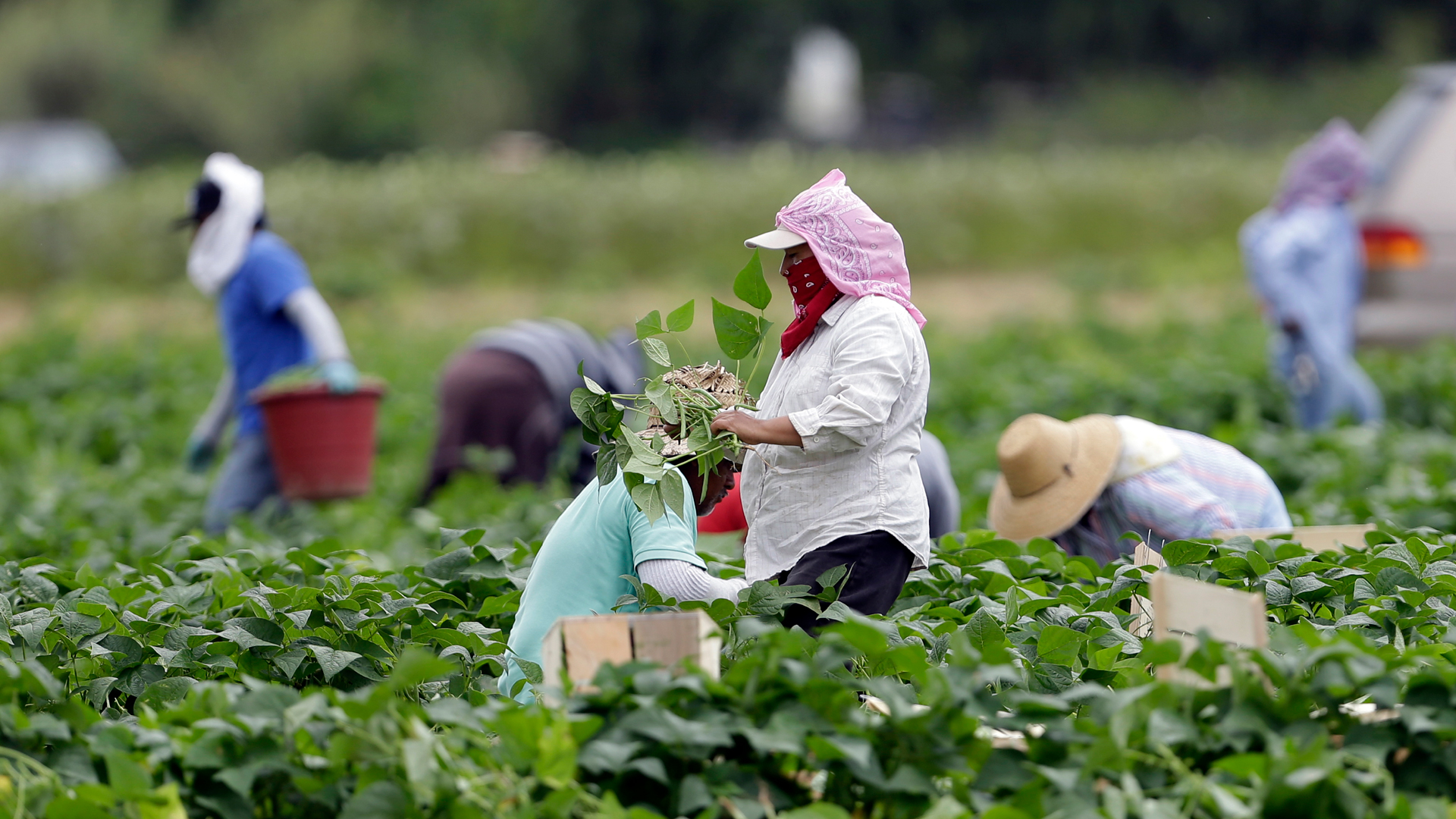
According to Ramya Devan, a professor of economics and global studies at Stockton University, foreign-born workers currently account for nearly 30% of the state’s labor force, which is much higher than the national rate of 18%.
And in some of New Jersey’s northern counties, the portion of the state’s labor force made up of immigrants tops 40%, Devan said during the policy forum.
 Credit: (AP Photo/Lynne Sladky)
“The bottom line is that the New Jersey economy relies greatly on immigrant workers,” she said. “The New Jersey economy would not survive if these immigrant workers went away, suddenly.”
During the same forum, several panelists also pushed back against assertions that immigrants, whether they are in the country legally or not, are taking jobs that otherwise would be held by natural-born citizens.
“If immigrant workers in New Jersey disappeared, somehow, tomorrow, it would be a catastrophe in this state,” said Megan Chambers, president of the New Jersey state council of the Service Employees International Union.
“Hospitals would not be safe for anyone to use [and] nursing-home patients would not be cared for,” added Chambers. “People who rely on nursing homes, on home attendants, on childcare workers to care for their children, or elderly folks in their family, or sick folks in their family, would have to leave their jobs to go care for those folks.”
“It’s completely not the case that immigrants are displacing U.S. workers,” she said.
By the numbers
To be sure, if a mass deportation effort that targets undocumented immigrants is carried out in force, New Jersey is likely to feel the effects.
In all, there are an estimated more than 425,000 undocumented immigrants living in New Jersey, a group that contributes more than $1.3 billion in state and local tax revenue annually, according to a recent study from the Washington, D.C.-based Institute on Taxation and Economic Policy.
‘The bottom line is that the New Jersey economy relies greatly on immigrant workers. The New Jersey economy would not survive if these immigrant workers went away, suddenly.’ — Ramya Devan, professor of economics and global studies, Stockton University
How state and local governments in New Jersey would make up for the lost revenue from deported immigrants, including sizable sales and property-tax contributions, is unclear.
In New Jersey, the sales tax is the largest source of revenue for the state budget’s general fund, while property taxes are raised at the local level and serve as a primary source of funding for K-12 public schools.
Democratic-Republican divide
In the Rutgers-Eagleton poll conducted in the run-up to the election last fall, a little over 10% of the registered voters in New Jersey surveyed identified immigration as their top concern, while more than 20% identified the economy as the top issue.
The poll also seemed to detect a partisan divide when it came to voters’ sentiments about the top issues, including immigration and the economy.
‘The Immigrant Trust Act will not stop all the threats headed our way, but it will help protect immigrant residents from unnecessary exposure to federal immigration officers,’ the letter said.
It was independents, and especially Republicans, who put the economy first and immigration second, said Ashley Koning, an assistant research professor and director of the Eagleton Center for Public Interest Polling at Rutgers University-New Brunswick, when the poll results were released in early November.
The economy came in third place for Democrats, a group that was more concerned about a candidate’s character and reproductive issues, Koning said at the time.
Earlier this month, a group of more than 100 organizations sent a letter to Gov. Phil Murphy and fellow Democrats who control the state Legislature that warned “President Trump has made his intentions clear” when it comes to immigration policy.
Looking for state protection
The same letter also called for the passage of state-level legislation that’s been dubbed the Immigrant Trust Act by its sponsors. Among other goals, the bill would upgrade privacy protections for undocumented immigrants living in New Jersey.
“The Immigrant Trust Act will not stop all the threats headed our way, but it will help protect immigrant residents from unnecessary exposure to federal immigration officers,” the letter said.
Meanwhile, other economic policies favored by Trump have also raised concerns at New Jersey Citizen Action, a group that works with and advocates for the state’s low-income residents.
These include the potential for tax cuts first enacted in 2017, including those benefiting wealthy individuals and corporations, to be extended, even as costly changes could be made to health care coverage through Medicaid and the Affordable Care Act, the group said.
“Giving more tax breaks to big corporations and the very wealthy won’t help New Jerseyans struggling to pay health care bills, make rent or pay a mortgage, and put food on the table,” said Maura Collinsgru, the group’s director of policy and advocacy.