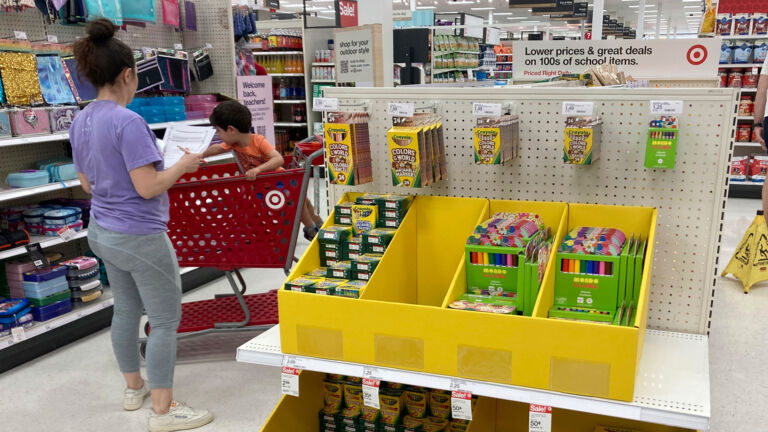
Credit: (AP Photo/LM Otero)
Last year, parents, teachers and other back-to-school shoppers paid an estimated $35 million more in state taxes after Gov. Phil Murphy and majority Democrats in the Legislature repealed a late-summer sales-tax holiday.
Now back-to-school shopping is underway in New Jersey with a new set of concerns that include persistent inflation and the initial effects of President Donald Trump’s aggressive tariff policy.
Under the Republican president’s economic policies, the average tariffs for many school supplies have now more than tripled, from 5% on average last year to 18% this year, according to a recent report from the U.S. Chamber of Commerce.
Among the items hit by this year’s higher tariffs are backpacks, erasers, paper, pencils and pens.
“In just May and June of this year, these higher tariffs resulted in an estimated $73 million tax increase on back to school items,” according to the report.
Families are spending a bit less
So far, there’s been some indication, at least nationally, that people are pulling back their spending on things like clothes, shoes and electronics as they ready for a return to the classroom.
According to data collected by the National Retail Federation, families with students in elementary school through high school were planning to spend about $858 this year on items including clothing, shoes, general school supplies and electronics. That’s down from last year’s total of roughly $875.
The amount of planned back-to-school spending by college students and their families is also trending down from about $1,365 last year to roughly $1,326 this year, according to the data from the Washington, D.C.-based organization.
“Consumers are being mindful of the potential impacts of tariffs and inflation on back-to-school items, and have turned to early shopping, discount stores and summer sales for savings on school essentials,” said Katherine Cullen, the National Retail Federation’s vice president of industry and consumer insights.
In many states, policymakers have a designated period where the sales of certain items used by students and teachers during the school year are temporarily exempt from state sales taxes.
This year, a total of 19 states are offering their residents some form of a sales-tax holiday, according to a recent analysis published by the nonpartisan Tax Foundation, a Washington, D.C.-based organization that closely tracks tax policies.
NJ’s short-lived tax break
However, in New Jersey, that late-summer, 10-day sales-tax break for school supplies previously offered to consumers remains mothballed this year.
When it debuted in 2022, New Jersey’s back-to-school sales-tax holiday was billed as a response to the significant increase in inflation that occurred during the economic recovery that followed the COVID-19 pandemic.
To be sure, the pace of growth in prices has slowed since then. But the annual rate of inflation measured last month by the U.S. Bureau of Labor Statistics was 2.7%, remaining above the Federal Reserve’s goal of 2%.
According to Department of the Treasury estimates, state government saved $35 million by not offering a back-to-school sales-tax holiday last year.
New Jersey’s sales-tax holiday spanned 10 days from late August into early September, in both 2022 and 2023,
In addition to permanent sales-tax exemptions for clothing and footwear that are written into state law, a wide range of additional items purchased both in-store and online were temporarily exempted from the state’s 6.625% sales tax during the 10-day period.
These items included traditional school supplies, including pens, pencils and notebooks, as well as art supplies, such as paint and paintbrushes. Also exempt were computers that cost less than $3,000, as well as equipment used for sports and recreation, such as helmets, shoulder pads, shin guards and mouth guards, among other items.
According to Department of the Treasury estimates, state government saved $35 million by not offering consumers another back-to-school tax holiday last year.
What the experts say about tax holidays
Some research suggests such tax holidays can benefit lower-income families who tend to spend a larger share of their annual earnings on school supplies than more affluent families.
However, some tax experts have questioned whether the tax revenue sacrificed to tax holidays could be better utilized to fund things that more directly aid lower-income families.
In its recent report, the Tax Foundation’s analysts concluded “revenue losses associated with most sales tax holidays are not particularly large.”
“(But) they still have to be offset by revenue generated elsewhere, which is a net negative for states’ overall economic health since other revenue sources are often more economically damaging than sales taxes,” the report said. “States that can consistently cover these holidays out of surplus revenues could better utilize their excess funds on more economically efficient tax reforms, particularly rate reductions.”
Meanwhile, a report from the Institute on Taxation and Economic Policy, another Washington, D.C.-based group that regularly analyzes tax policies, said sales taxes are generally “regressive” because lower-income families tend to spend more of their annual income on taxable items.
The ITEP analysts suggested state policymakers should consider, among other options, establishing a refundable sales-tax credit for low-income families.
“Lawmakers must understand that they cannot resolve the unfairness of sales taxes simply by offering a short break from paying them,” the ITEP report said. “If the long-term consequence of sales tax holidays is a higher sales tax rate, low-income taxpayers may ultimately be worse off because of these policies.”