
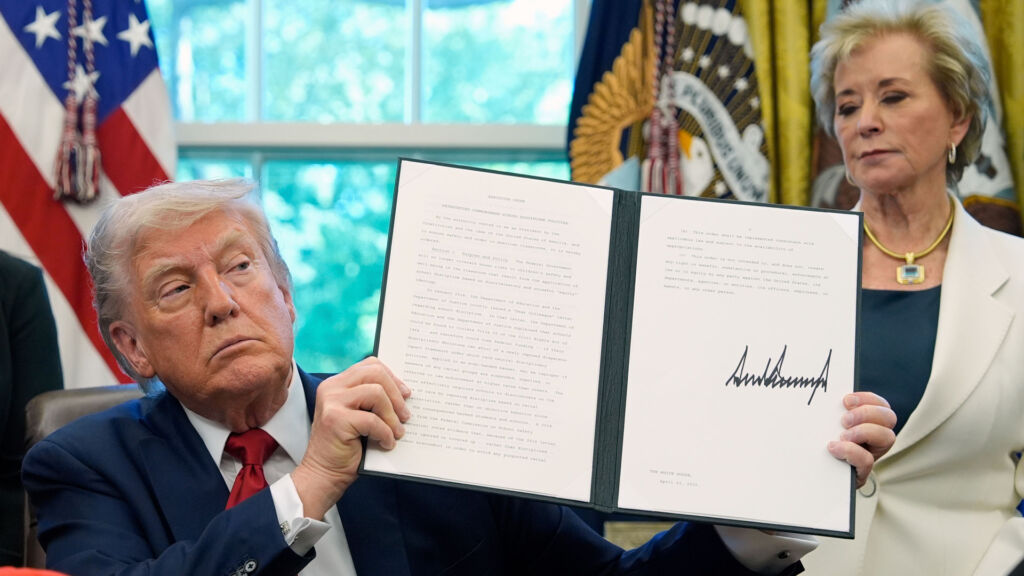
The Trump administration is withholding about $143 million in federal funding for K-12 schools in New Jersey, much of which is used to support English learners, before- and after-school programs and professional development.
New Jersey public school districts finalized their budgets for the 2025-2026 school year in the spring, and a loss of anticipated funds could create sizable holes, especially in high-need districts. State and district leaders are working to come up with plans if the funds don’t come through at all or if the amount is less than they previously budgeted for.
The funds for programs under review by the administration represent 13% of the funding New Jersey schools received from the federal government last year. The Trump administration is withholding this money due to “an ongoing programmatic review and no decisions have been made yet,” according to a spokesperson for the U.S. Office of Management and Budget.
Nationwide, the funds amount to almost $7 billion. The U.S. Education Department did not say if or when funds would become available in an email sent to states Monday and obtained by Education Week.
‘Enormous difference’
“This is an important issue because the programming that’s supported through these funds goes a long way to making an enormous difference for students among our population who need the most support,” said Joseph Ricca, a member of New Jersey’s State Board of Education and superintendent of schools at White Plains City School District.
If the allocations are reduced, it could have negative consequences for public school students, Ricca said at a meeting of the state board on Wednesday. The New Jersey Department of Education is monitoring the status of the funds, he said.
 Credit: (AP Photo/Jeff Chiu)
The withheld funds include money already approved by Congress for migrant education, professional development, English-learner services, academic enrichment and before- and after-school programs. President Donald Trump proposed a federal budget that would eliminate these funding streams, which has not been approved by Congress.
“Initial findings have shown that many of these grant programs have been grossly misused to subsidize a radical leftwing agenda,” a spokesperson for the Office of Management and Budget said in a statement, citing examples in New York and Washington.
The funds are typically available to states on July 1 so districts can begin spending before the school year starts.
How funding loss would hit one school district
In New Jersey, the estimated impact is about $143 million or 12.7% of total federal funding, based on 2024 funding, according to the Learning Policy Institute, which conducts education research. The funding for the 2025-2026 school year is supposed to be similar to the 2024-2025 school year since Congress passed a continuing resolution that extended the 2024-2025 year’s funding levels across federal programs.
The New Jersey and U.S. education departments did not immediately respond to questions about the withheld funds.
New Jersey public school districts finalized their budgets for the 2025-2026 school year in the spring, and a loss of anticipated funds could create sizable holes, especially in high-need districts.
Pittsgrove Township School District anticipated receiving funding for programs that are now frozen when they finalized their budget for the next school year. The district typically used federal funding to pay for most of the district’s professional development. Pittsgrove school officials are considering eliminating professional development they haven’t yet paid for or cutting other projects from their budget to pay for teacher training.
Caught off guard
Pittsgrove is introducing new curriculum for the 2025-2026 school year, and its success is contingent on properly training staff, said Darren Harris, the Pittsgrove business administrator. Some of the professional development is already scheduled for this summer to make sure staff are trained before the school year starts in September, he said.
The withheld funds add up to about $60,000 of the district’s $35 million budget.
“It’s not something we can’t overcome as far as the dollar amounts go, but it is something that did take us certainly off guard,” Harris said.
The impact could be greater on lower-income districts, such as Commercial Township and Woodbine Borough which share services with Pittsgrove, he said. Commercial Township has about 500 students compared to Pittsgrove’s 1,800 but receives almost double the amount of funding for two of the frozen programs, he said.
“Because they have a much higher percentage of low-income population, the impact on their budget is certainly greater,” he said.
Harris had not received any communication from the state or federal education departments as of Wednesday afternoon, he said.
“At this point, we’re going to have to plan as if [the money] is not coming,” Harris said.
