
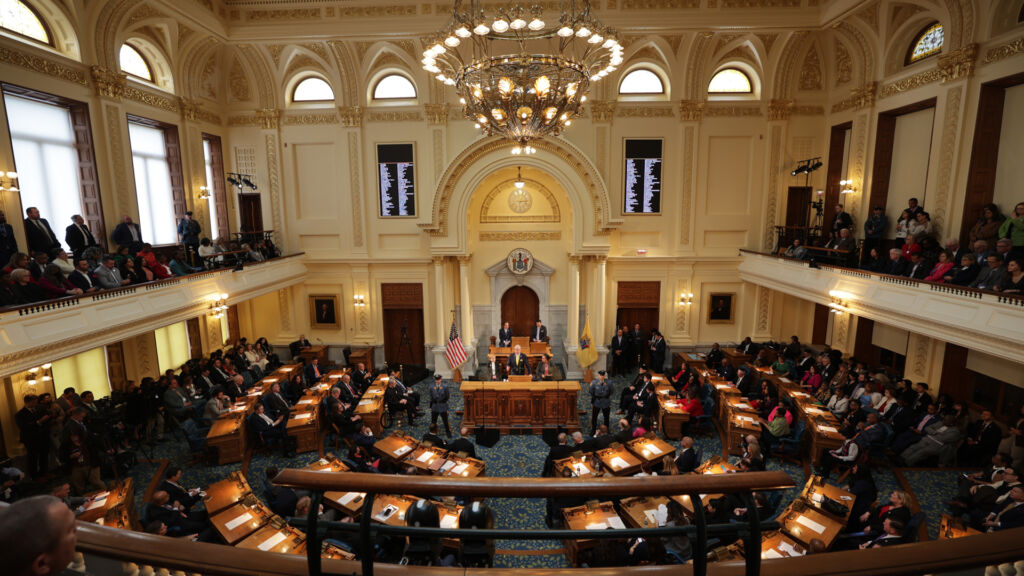
New Jersey lawmakers are set to sign off on the latest round of tax hikes needed to sustain state government’s ever-growing annual budget.
Final votes on proposed tax increases that will hit smokers, gamblers and people selling high-priced properties are scheduled to be cast in both the Assembly and Senate on Monday.
Also on the voting agenda in both houses is a fiscal year 2026 appropriations bill, which now totals a record-high nearly $59 billion after majority Democrats added more than $400 million late last week to Gov. Phil Murphy’s final draft of the proposed annual budget.
However, this year the state budget process is playing out with a new wrinkle of uncertainty due to a series of major spending cuts that are currently up for consideration in the Republican-controlled U.S. Congress.
Among them are significant changes to social safety-net programs like Medicaid that experts say could ultimately shift billions of dollars in unbudgeted costs onto state governments.
With the state’s next fiscal year due to begin Tuesday, Murphy, a second-term Democrat, is expected to approve the proposed tax hikes and sign the budget legislation into law once those bills win final approval from lawmakers.
More for NJ Transit, pensions, property-tax relief and schools
The fiscal year 2026 budget negotiated by Murphy and Democratic legislative leaders calls for increased allocations for mass transit, public-worker pensions, direct property-tax relief and K-12 public school aid, among other areas.
Meanwhile, the Legislature’s last-minute budget add-ons will undo several proposed cuts that were included in Murphy’s first draft of the annual budget, such as slashed operating aid for county colleges.
After last week’s legislative revisions, the structural gap has grown to nearly $1.5 billion according to figures included in a budget score sheet prepared by the nonpartisan Office of Legislative Services.
But Democrats who control the Legislature also continued a practice of inserting into the final budget a number of more parochial line items, such as funding for a community center in Edison and a park in Perth Amboy, according to a budget score sheet prepared by the nonpartisan Office of Legislative Services.
The 375-page annual appropriations bill — which cleared budget committees in the Assembly and Senate late on Friday night — will hike overall annual spending by nearly 4% compared to the annual budget that was approved by the same panels around this time last year.
That easily outpaces the rate of inflation over the last 12 months, which measured less than 2.5% as of last month, according to the federal Bureau of Labor Statistics.
Gap between spending and revenues
At the same, the appropriations bill once again includes a wide gap between what state government is planning to spend over the course of the new fiscal year that begins Tuesday and what the Murphy administration estimates will be collected from taxes and other revenue sources over the next 12 months.
That structural gap measured a little over $1 billion in a final draft of the budget Murphy shared with lawmakers in mid-May.
Meanwhile, more than $550 million in funding from the state’s dedicated debt-relief reserve is also once again being diverted into the general fund to help sustain annual spending, according to budget documents.
After last week’s legislative revisions, the structural gap grew to nearly $1.5 billion, according to figures included in the OLS score sheet.
And that’s after lawmakers have set the stage for hundreds of millions in new revenue to come in from the series of tax hikes up for final approval during Monday’s voting sessions.
Among the tax and fee increases lawmakers are expected to send to the governor’s desk later Monday are measures calling for increased state taxes on online gambling and online sports betting, as well as on packs of cigarettes and liquid nicotine commonly used with vaping devices.
Sellers of high-priced properties to pay more
A separate piece of legislation advancing along with the spending bill calls for increasing state fees levied on properties selling for more than $2 million in New Jersey.
This new batch of tax hikes will follow more than $1 billion in increased levies Murphy and fellow Democratic lawmakers approved last year, tax hikes they said were needed to fund what was then a record-high annual budget.
In recent years, lawmakers have been spending down budget surplus to help sustain spending that has outpaced the rate of annual tax collections, a practice that will continue during the 2026 fiscal year.
However, the closing surplus, which would total more than $6.7 billion, according to figures included in the score sheet, is being viewed this year with increased importance amid the fiscal uncertainty playing out at the federal level.
Meanwhile, more than $550 million in funding from the state’s dedicated debt-relief reserve is also once again being diverted into the general fund to help sustain annual spending, according to budget documents.
And environmentalists have been warning about increased raids on the state’s Clean Energy Fund included in the fiscal year 2026 spending bill, saying it will shortchange much-needed investments in things like energy storage at a time when electricity bills are rising.
