Credit: (Rupixen.com from Pixabay)
 For most people, getting prescription medication means a trip to a nearby drugstore and a pill they take in the privacy of their homes. Many even have medications mailed to them.
Not when the prescription calls for methadone.
People on methadone — a medication used for some 60 years to treat opioid use disorder — must usually travel every day to a special program where they can consume their daily dose in front of clinic staff. It’s a practice shaped by strict federal regulations, long-standing stigma around drug use and what is often limited trust between patients and treatment providers. Most patients must adhere to this strict protocol for many weeks, if not months, before they can get permission to take home multiple methadone doses, usually provided as a drink some call “liquid handcuffs.”
That is starting to change in New Jersey.
Late last year, the Department of Human Services launched a year-long pilot program that will equip and train staff at six of the state’s 41 licensed opioid treatment programs on a web-based platform. That platform is designed to free patients from the time-consuming daily routine of getting their treatment, enabling them to take home multiple methadone doses.
So far, provider and patient feedback has been positive, state officials say, and as of May, more than half of the patients in participating programs are benefiting from take-home doses for the first time. The platform and its technology first came to the state through from a small funding request from a state lawmaker last spring. After health officials took advantage of recent federal and state policy changes, this new option for methadone patients is now having a measurable impact on families around New Jersey.
Barcodes and video
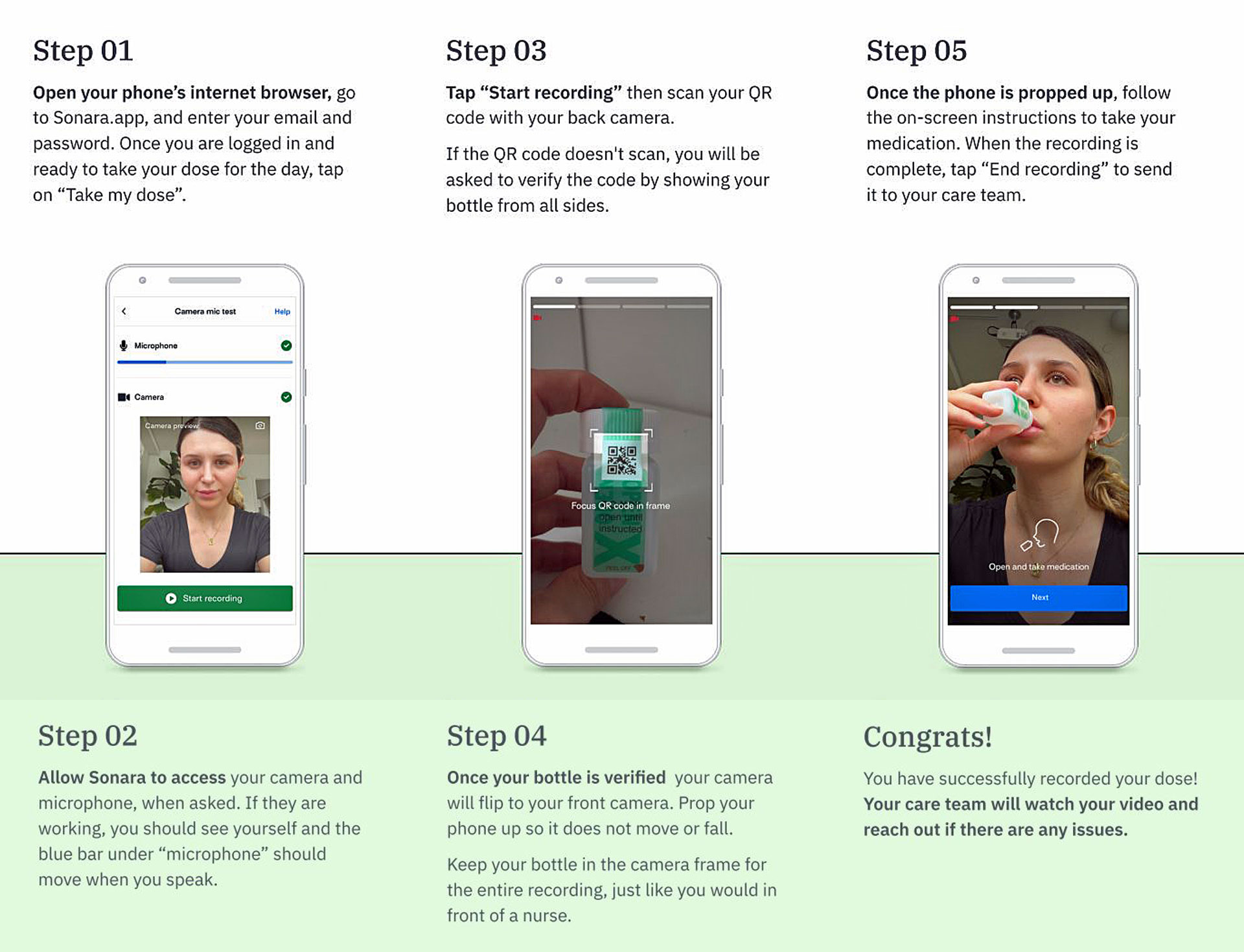
The online program developed by Sonara Health, allows patients to track their medication with a barcode and upload video of them consuming each dose at a scheduled time, which clinic staff can later view to confirm patients are complying with the treatment plan. It’s like telehealth, but designed specifically for methadone use with the necessary monitoring component for that treatment.
“We really want to help modernize the treatment experience and establish a new standard of care in the state of New Jersey. These opioid treatment programs haven’t had the opportunity to do anything new since their inception until very recently,” Sonara CEO and founder Dr. Michael Giles, a psychiatrist based in Dallas, TX, told NJ Spotlight News earlier this year.
‘We had all these new patients coming into treatment doing the best they could. …It felt like these patients had this really difficult decision of, pursue recovery success or pursue life success.’ — Sonara Health CEO and founder Dr. Michael Giles
The need for methadone treatment is growing, Giles and others said, given the growing dependence on fentanyl, a synthetic opioid that is far stronger than heroin and is largely immune to other treatment options. Drug-related deaths in New Jersey have started to decline during recent years, but more than 2,800 people died from illicit substances in 2023, the year for which the most recent state data is available, more than three-quarters of which involved fentanyl or similar analogs.
A new approach
Giles developed the remote-dosing platform after witnessing the struggle patients face first-hand while he was in residency at an opioid treatment center for veterans, where he said he was struck by the lack of innovation and investment in the program. The strict rules around methadone access and dosing offered little chance for treatment providers to build trust with their patients, he said.
 Credit: (Courtesy of Sonara)
“We had all these new patients coming into treatment doing the best they could. But often, this requirement to come in every day made it difficult for them to do normal things, like have a job, take care of their kids, pursue educational goals,” Giles said. “It felt like these patients had this really difficult decision of, pursue recovery success or pursue life success.”
Giles thought technology could help free methadone patients and attract others to treatment, while also providing treatment providers some confidence that people weren’t selling or otherwise abusing their methadone prescription. He cornered a few tech-savvy colleagues, raised seed money from friends and family, secured a patent and developed a basic application. Eventually, the group connected with investor and Dallas Mavericks part-owner Mark Cuban, who provided real venture capital, Giles said. After field-testing, the program was launched in 2022.
“The comments we have [received] are, ‘I’m so glad I don’t have to bring my kids to the [methadone] clinic anymore,’ ‘I had the time to look for an apartment,’ ‘I can now keep my job.’ Or a combination of all these things,” Giles said. “We’ve had patients who contemplated suicide, with how difficult it was to come to treatment and the pressures they were feeling to use [illegal drugs]. And now, everything is much more tenable to them.”
NJ’s commitment
Sonara is now in use at opioid treatment programs in more than a dozen states — including Pennsylvania and Ohio, where it is open to Medicaid members. But New Jersey is the first state government to contract directly with the company, according to those involved. To access the platform and train staff at six treatment facilities, New Jersey invested $250,000 in the current fiscal year and plans to commit another $250,000 through the budget for the fiscal year that begins in July, which lawmakers must finalize before Gov. Phil Murphy can sign it into law.
“We see it as another tool in the toolbox for opioid treatment programs, and the goal is to improve the lives of patients by providing individualized care that best addresses their needs,” said Adam Bucon, who oversees opioid treatment programs under the Department of Human Services.
‘It adds a level of dignity and trust that’s too often missing in these systems.’ — Assemblyman William Moen Jr. (D-Camden)
More than 18,000 people receive treatment through these programs, according to the state. Some patients insured through Medicaid, the public insurance program for low-income residents, depend on state-funded transportation to get to their methadone program daily, Bucon said, so the state is watching to see if the remote-dosing option also saves taxpayer money.
 Credit: (Courtesy of Sonara)
The pilot program would not have been possible without federal regulatory changes triggered by the COVID-19 pandemic, Bucon and others said, tweaks that permitted states to allow opioid treatment providers to give “stable” patients up to seven days’ worth of methadone for home use. New Jersey was one of 35 states that agreed to these revisions. State officials also revised regulations to allow for additional treatment flexibility, part of its larger push to embrace harm reduction efforts like providing clean needles to people who use drugs to reduce the spread of disease and distributing the overdose-reversal agent naloxone, or Narcan.
The limits of traditional treatment
 Credit: (NJ Assembly Democrats)
Sonara came to the state’s attention last spring after Assemblyman William Moen Jr. (D-Camden) pushed to include initial funding for the effort in the current state budget. Moen — whose district includes several communities hard-hit by opioids — said he hopes the remote-dosing program makes it easier for people to get and stay in treatment.
The structure of traditional treatment programs may be “well-intentioned,” but it “can really limit someone’s ability to work, care for their family, or just live a full life while trying to recover. In certain situations, the location of these in-person methadone clinics would often place those seeking treatment back in the same community that helped to fuel their addiction,” Moen told NJ Spotlight News in an email.
Moen said a platform like Sonara helps treatment providers better meet people’s needs, while preserving program integrity. “It doesn’t lower the bar for accountability, but it does remove some of the barriers that make recovery harder than it needs to be. The idea that patients can take their medication at home under remote supervision, without having to put everything else on hold, that’s a game-changer. It adds a level of dignity and trust that’s too often missing in these systems,” he said.
In use in Jersey City
Spectrum Health, a 40-year-old opioid treatment program in Jersey City, was one of the first organizations in New Jersey to be trained on the Sonara platform, state officials said. That allowed Spectrum to start expanding remote dosing starting in early March. Spectrum has a mobile unit and a clinic on Pacific Avenue, which operates from 6 a.m. to 8 p.m. on weekdays and 7 a.m. to 1 p.m. Saturday — long hours for a methadone program.
Christie Hanvey, a nurse who is chief operating officer at Spectrum, said that work, transportation challenges and other health conditions can make it hard for some patients to get to their facility each day, even with its extended hours. If they miss a dose, opioid withdrawal can quickly set in — with severe body aches, vomiting, diarrhea and more — leading some patients to opt for street drugs until they can get back into treatment.
In the past, federal and state regulations gave treatment providers few options in how they offer methadone, Hanvey told NJ Spotlight News earlier this year. Patients had to achieve a stable methadone dose and multiple weeks of regular attendance, including weekly counseling sessions, before they could take home more than one dose, she explained. With treatment providers generally closed on Sundays, a single day’s take-home dose is standard.
‘We see it as another tool in the toolbox for opioid treatment programs, and the goal is to improve the lives of patients by providing individualized care that best addresses their needs.’ — Adam Bucon, Department of Human Services
With the changes made during COVID-19, providers have far more flexibility, Hanvey said, and Sonara helps them build on these new options while making sure patients get stable, appropriate treatment. Providers must still assess patients carefully to identify those at risk of overdose, or misuse, she said, but the new system allows them to create more patient-centered care plans and slowly increase the number of take-home doses available.
“It wasn’t that [these patients] didn’t want to be here. It wasn’t that they didn’t want to be stable on their dose. There were just other life events that got in the way of daily dosing,” Hanvey said. “We quickly realized clients were able to manage take-homes [or doses] in a safe manner; they were returning [empty bottles as required], taking them as directed; clients were more engaged, and overdoses and diversion didn’t increase.”
This story is made possible in part by the Corporation for Public Broadcasting, a private corporation funded by the American people.