
 Credit: (NJ Spotlight News)
With concerns about the potential for a recession rising again, a top official from Gov. Phil Murphy’s administration is assuring lawmakers New Jersey’s unemployment system is back in “great shape.”
The state’s unemployment fund, an off-budget account used to pay out jobless benefits in New Jersey, had a $2.7 billion balance as of the latest accounting, said Robert Asaro-Angelo, commissioner of the state Department of Labor and Workforce Development.
That marks a major turnaround from the worst days of the COVID-19 pandemic, when the fund was hit hard by a surge in claims for jobless benefits and the state needed to borrow from the federal government just to keep benefits flowing to those who were out of work.
But New Jersey is now among the states that have fully paid back their federal loans, Asaro-Angelo said during an appearance Tuesday before members of the Senate and Appropriations Committee.
“Our trust fund is in great shape after being ravaged by the pandemic,” Asaro-Angelo told members of the committee.
“This is great news and critical for New Jersey workers in need,” he said.
Meanwhile, the unemployment system itself has also been overhauled since the economic downturn triggered by the pandemic inundated the system with claims, creating frustrating backlogs for many seeking benefits at the time.
“We have been modernizing at every turn,” Asaro-Angelo said during Tuesday’s budget hearing.
The commissioner’s appearance before the budget committee comes as lawmakers continue to scrutinize a $58 billion budget Murphy proposed for the fiscal year that begins July 1.
Under the state Constitution, the governor proposes an annual spending plan, including for executive-branch departments like Asaro-Angelo’s, but it’s up to lawmakers to draft an appropriations bill by the start of each new fiscal year.
Meanwhile, Tuesday’s hearing also came as many economists are raising concerns about the potential for a recession occurring later this year as a multifront, international trade war launched by President Donald Trump roils financial markets.
In New Jersey, the unemployment rate was 4.7% in March, which is still relatively low by historical standards, Asaro-Angelo said.
But Trump’s sweeping tariffs on many imports are raising new concerns about inflation, and the latest data released by the federal Commerce Department indicated the nation’s total gross domestic product, or GDP, contracted slightly over the first quarter of 2025.
Asked directly by Senate Majority Leader Teresa Ruiz (D-Essex) if the state unemployment system’s infrastructure could handle the strain of another big recession, Asaro-Angelo responded: “Big picture, absolutely.”
There could always be delays if claims surge at the same rapid rates experienced five years ago, Asaro-Angelo cautioned. But he quickly added, “Our infrastructure is in way better shape than it was, certainly in March of 2020.”
New Jersey’s unemployment fund is set up to ensure that state government can provide jobless benefits to laid-off workers, even during the worst recessions, by setting aside money collected regularly through payroll taxes levied on both employers and employees.
The fund operates outside the state budget, and its revenues are constitutionally dedicated to funding unemployment benefits.
While contributions from employees are fixed, the trust fund’s statutory architecture calls for the rates levied on businesses to rise and fall based, in part, on the overall fiscal health of the fund.
In 2021, Murphy, a Democrat, signed a law that sought to spread out payroll tax increases for businesses that were needed to carry out the fund’s recovery from the pandemic. This ensured employers would not be hit all at once with what was at the time estimated to be a $1 billion tax-hike bill. Instead, that law called for phasing in the tax hikes over three years.
Under current economic conditions, officials from Asaro-Angelo’s department are projecting the employer taxes will remain in what is known as column “D,” throughout the remainder of the 2025 fiscal year, which ends June 30, as well as during the 2026 and 2027 fiscal years, according to budget documents.
But in addition to concerns about the unemployment fund’s financial solvency, the state’s unemployment insurance system itself has also been a key topic of discussion in recent years during the commissioner’s appearances before lawmakers.
“Importantly, we learned from the problems,” — Robert Asaro-Angelo, commissioner of the state Department of Labor and Workforce Development
While the Labor department won praise during the COVID-19 crisis for its ability to distribute billions of dollars in benefits to its out-of-work residents, lawmakers were also flooded with complaints from constituents unable to access benefits as they struggled to navigate an unemployment system that had long been identified as overdue for technological upgrades.
A major problem at the time was an application process that had last been overhauled in 2008 — when smartphones were still relatively new technology.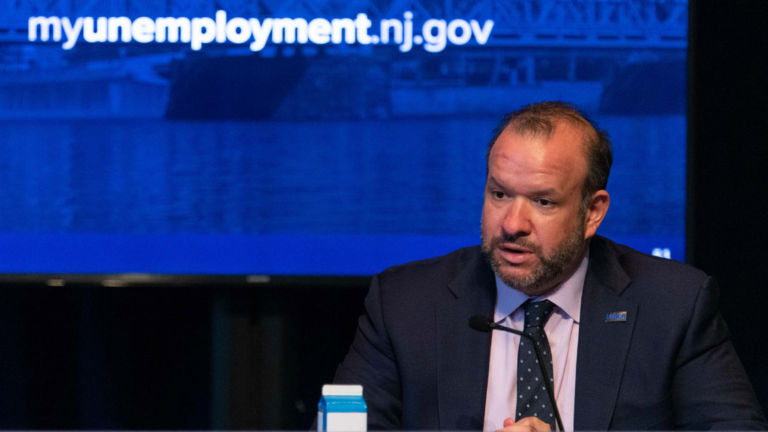
Several years ago, New Jersey was selected as one of two states to participate in a national unemployment pilot program led by the U.S. Department of Labor.
New Jersey was also awarded a federal grant to undertake changes to its unemployment system, including improving the application process. A portion of the federal funding New Jersey received from the landmark American Rescue Plan Act has also been allocated for ongoing unemployment system upgrades, according to budget documents.
During Tuesday’s hearing, several lawmakers praised Asaro-Angelo for the strides the department has made in recent years to update the department’s systems.
“We went through some rough times, together, as a state,” said Sen. Declan O’Scanlon (R-Monmouth) during one of those exchanges. “We all were at the breaking point at various times.”
“Importantly, we learned from the problems,” Asaro-Angelo said as he credited staff for implementing the improvements. “We want to learn from our mistakes and thank you for holding us accountable.”
