Credit: (Senate Television via AP)
WASHINGTON — Republicans dismissed the history-making speech Cory Booker delivered this week as another one of his attention-grabbing stunts that accomplished little.
But to many of the Democratic lawmakers who sat in rapt attention Tuesday evening when Booker broke the mark of longest speech in Senate history, his display carved a blueprint to confront the second Trump administration: Show some rhetorical fight to the public and continue a multigenerational pursuit of racial justice.
U.S. Rep. Jahana Hayes, like other Black lawmakers NJ Spotlight News interviewed during and after Booker’s speech, was well aware South Carolina senator and segregationist Strom Thurmond set the previous record in 1957, when he tried to block a civil rights bill.
“Incrementally, these are huge, barrier-crushing moments,” said Hayes, the first Black Democrat to represent Connecticut. She mentioned both men’s technique of holding command over the Senate floor by speaking until total exhaustion. “Using the same mechanism, you have Cory Booker amplifying American greatness and our people and our strength.”
History and hope
As hundreds of Democratic members and staffers buzzed around Capitol Hill on Tuesday with excitement as Booker approached and then overtook Thurmond’s mark, the moment provided a jolt to the Democratic Party, without a clear leader and relegated to voting minorities in Washington, and held particular resonance for Black lawmakers.
The legacy of former congressman and civil-rights activist John Lewis was top of mind in the Capitol, a building constructed, like the White House, in part with labor from enslaved people.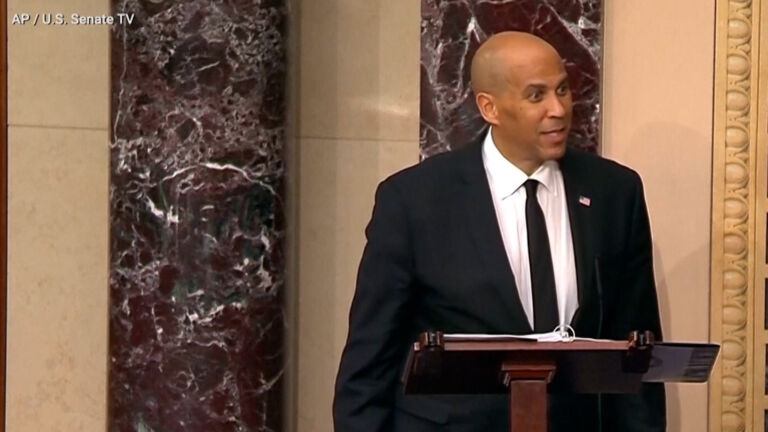
“He and I would not be here were it not for the likes of John Lewis,” Sen. Raphael Warnock, a Georgia Democrat, said in an interview, alluding to Booker and noting elections last year of two Black women to the Senate — Angela Alsobrooks of Maryland and Lisa Blunt Rochester of Delaware. “There are now two Black women in the Senate. First time that’s the case in the history of this country.”
Booker bookended his remarks with stories of and quotes from Lewis, who died in 2020.
“The civil rights generation is starting to be called home,” Booker said.
Supporting Booker
Nikema Williams holds Lewis’ old seat today. The Trump administration threatens civil-rights gains of the mid-20th century, Williams, who was following Booker’s progress down to the minute, told NJ Spotlight News in an interview.
“All of that is being thrown out,” Williams said before turning her aim at President Donald Trump and the administration. “Each generation has an obligation to pick up the mantle and move it one step further,” she said. “These struggles aren’t new.”
Several New Jersey lawmakers trickled over from the House on Tuesday to watch. Rep. Nellie Pou (D-9th) said she came over for moral support, adding that while the physical act was impressive, Booker’s words were essential. “It’s about the content and the substance.”
Recent polls place approval of Democrats in Congress at low marks, as a mid-February survey from Quinnipiac University found.
Sen. Andy Kim (D-NJ) watched from the public gallery with his two sons. Rep. Herb Conaway (D-3rd) stood along the chamber wall. Rep. Bonnie Watson Coleman (D-12th) sat across the room as Booker closed in on his mark.
“Cory keeps talking about the impact of the proposals that the Republicans are making and how they devastated the well-being of the people that they’re supposed to be serving,” Watson Coleman said in an interview before the speech ended. “That resonates with me, over and over again.” Watson Coleman said she would vote for Booker for Senate Majority Leader if she could. And president? “I’d vote for him for that, too.”
‘A true leader’
Rep. Jonathan Jackson, son of the civil-rights advocate Jesse Jackson and a Democrat who represents a Chicago House district, also endorsed Booker for Senate leader.
“He’s asserting himself as a true leader,” Jackson said in an interview. Beyond the juxtaposition of Booker and Thurmond, Jackson and Rep. Cleo Fields, a Black Democrat from Louisiana, said Booker tapped into a pent-up frustration that the Trump administration and Republicans on Capitol Hill are sidelining Congress.
“The senators are frustrated. They’ve been excluded,” Jackson said, singling out Trump adviser and multibillionaire Elon Musk, who had not and is not required to file financial disclosure statements or appear at a confirmation hearing before Congress, though he has been working out of an office in the White House budget office. “Everyone’s feeling violated. That’s not what we’ve signed up for.”The public wants action from Democratic lawmakers, Fields said. “They want their Congress to stand up,” he said. “He’s hurting so many people so rapidly, we have to stand up and try to get in front of this freight train,” he added of Trump. “I’m impressed with what Senator Booker is doing, and I think we need more of it,” Fields said around the 18th-hour mark.
Rep. LaMonica McIver (D-10th) watched on YouTube when Booker started Monday night.
“This is the kind of leadership that we need,” McIver said mid-speech. “I see a lot of people saying ‘Hey, is this enough? Is this enough?’ It’s not about it being enough. It’s about speaking out.”
Sobering polls
Recent polls place approval of Democrats in Congress at low marks, as a mid-February survey from Quinnipiac University found.
Just 21% of voters approved of Democrats’ work in Congress, an all-time low, the poll found, while 68% disapproved.
Sen. Lisa Murkowski, a Republican from Alaska, applauded the physical act.
“It’s a sobering slap down of historic proportions for the Democrats in Congress. Their Republican counterparts take a victory lap as the Democrats try to get their footing,” Quinnipiac University polling analyst Tim Malloy said in a statement.
Booker’s speech drew eyeballs. But it didn’t do much legislatively.
Moments after Booker yielded the floor, Idaho Republican Jim Risch teed up a vote to confirm a nomination for U.S. ambassador to NATO, a nomination the chamber quickly approved on a party-line vote, 52-45.
Republican reaction
Republicans were largely tight-lipped about the address. Sen. Mitch McConnell called it “long.” Few were in the chamber at the end of Booker’s remarks.
John Curtis of Utah, a Republican, passed Booker a note of “encouragement” during the speech but declined to elaborate to NJ Spotlight News.
Sen. Lisa Murkowski, a Republican from Alaska, applauded the physical act. “Whether you agree with him or not, the past 24+ hours was what most people think a filibuster actually looks like. Congratulations to @SenBooker for his historic feat (while staying on his feet!),” she wrote online.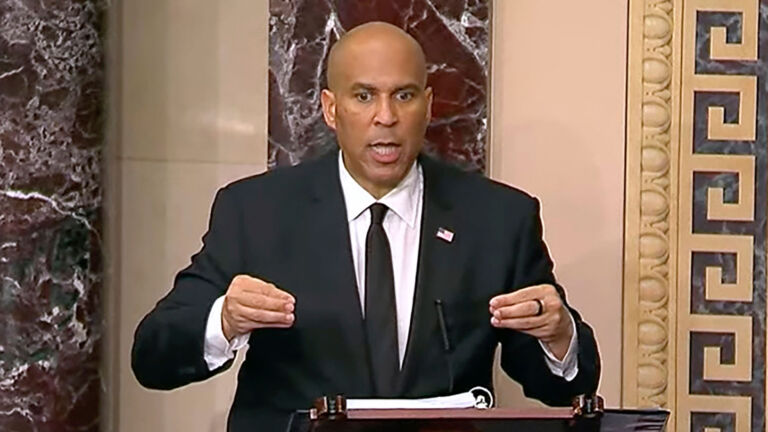
Harrison Fields, a White House spokesman, skewered Booker in an emailed statement, alluding to a moment during the Supreme Court confirmation hearings of Brett Kavanaugh when the senator released documents about Kavanaugh, accused before the Senate confirmed him in 2018 of sexual assault.
“Cory Booker is looking for another ‘I am Spartacus’ moment, but that didn’t work for his failed presidential campaign, and it didn’t work to block President Trump’s Supreme Court nominee, Brett Kavanaugh,” Fields said. “When will he realize he’s not Spartacus — he’s a spoof?”
Years later, Republicans staffers on the Hill derisively refer to Booker by that name.
Thurmond’s shadow
After Booker broke the record, Democrats swarmed him on the Senate floor, hugging and applauding.
On Aug. 28, 1957, Thurmond, who used the n-word openly and campaigned as a Dixiecrat — a southern political party created to oppose racial equality — tore into what would become the Civil Rights Act.
“I am convinced that this is bad proposed legislation, which never should have been introduced, and which never should have been approved by the Senate. I urge every member of this body to consider this bill most carefully. I hope the Senate will see fit to kill it,” Thurmond said in his speech decades ago.
Once that bill became law, it established safeguards for voter rights and empowered federal law enforcement officials to protect voting access.
A short walk from the Senate chamber is a meeting room in the Capitol named, in 1991, after Thurmond.