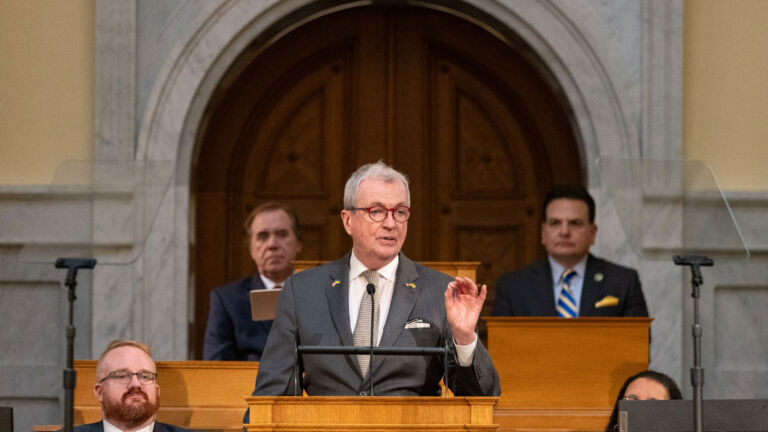
Credit: (Edwin J. Torres/NJ Governor’s Office)
Among the biggest issues up for debate amid the public hearings on Gov. Phil Murphy’s proposed $58 billion state budget is a plan to hike taxes by more than $1 billion starting later this year.
The list of tax increases put forward by Murphy, a Democrat who is term-limited, includes higher levies on alcohol, cigarettes and marijuana, online gambling and online sports betting.
Meanwhile, new taxes on things like warehouse truck traffic and drone sales would also be established in New Jersey, according to budget documents released by the Murphy administration last month.
The state’s 6.625% sales tax would also be applied to additional “transactions and services” if state lawmakers go along with the governor’s plan. But whether lawmakers, who have power under the state Constitution to modify or outright reject Murphy’s budget plan, accept the proposed tax hikes remains a big question.
Criticism from business groups
During the Legislature’s initial public hearings to review Murphy’s budget plan, many of the tax proposals have drawn criticism, including from business lobbying groups and others.
Levying a new tax on warehouse truck traffic could “raise the cost of food and other necessities” in New Jersey, Mary Ellen Peppard, vice president of the New Jersey Food Council, told the Assembly Budget Committee during a hearing in Trenton last week.
Higher taxes on cigarettes and vape products could also have unintended consequences, warned Eric Blomgren, executive director of the New Jersey Gasoline-Convenience Store-Automotive Association, during the same hearing.
That tax increase could result in reduced foot traffic and depress overall sales at convenience stores, including those located in communities that border neighboring states where taxes on such products may be much lower, Blomgren said.
The proposed tax on warehouse traffic could also hit auto-repair shop owners since it could “increase the cost of auto parts and therefore auto repairs,” Blomgren said.
“This is a part of the economy that has seen a tremendous increase in prices over the last few years,” he said.
Others who have testified before lawmakers suggested plans to repeal a partial sales tax exemption for boat purchases would harm the Jersey Shore economy. And a proposal to hike taxes on high-dollar real-estate sales was criticized as especially damaging to the state’s business community.
Election factor
While Murphy’s pitch to hike taxes comes during his last year in office, he’s asking lawmakers to approve the increased levies just as many lawmakers are gearing up for their elections.
In November, control of the 80-member Assembly will be in contention, and Democrats are hoping to retain their wide majority. Meanwhile, the deadline to pass a new state budget is July 1.
‘As we look forward, we need to be thinking about how to find progressive revenues that are going to shore up our state budget in the long term.’ — Peter Chen, New Jersey Policy Perspective
At the start of a public hearing convened by the Senate Budget and Appropriations Committee in Newark last week, committee chair Paul Sarlo (D-Bergen) suggested preemptively that at least some of Murphy’s proposed tax and fee hikes would be “eliminated” by the time lawmakers draft and send a spending bill back to the governor in June.
“This is the beginning of the process for this Legislature, hopefully in a bipartisan manner, to take a hard look at Governor Murphy’s proposed budget,” Sarlo said. “I’m quite confident the budget that has been introduced will be modified.”
A different problem
However, if the Legislature, currently controlled by Democrats, does reject some or all of Murphy’s tax proposals that would only create another fiscal dilemma for lawmakers to solve in the coming months.
Eliminating all of the revenue from the proposed hikes would open a more than $1 billion hole in a budget plan that right now calls for increasing spending in a number of key areas, including direct property-tax relief, mass transit, public-worker pensions and state aid for K-12 schools.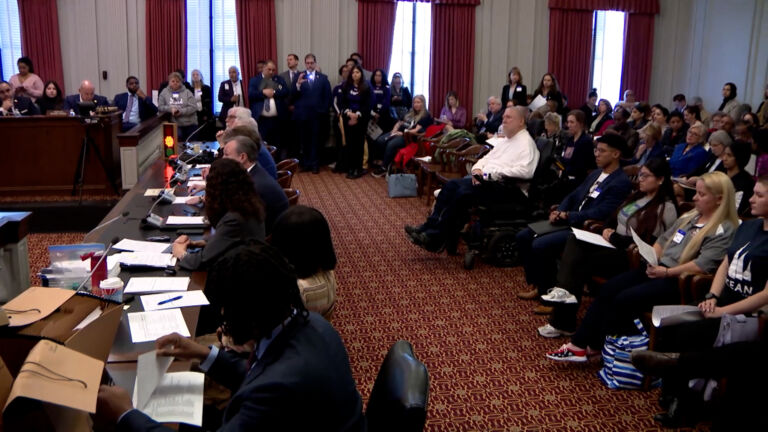
Moreover, Murphy, a former Wall Street executive, is already proposing spending over $1 billion more than the state would take in from taxes during the next fiscal year. And that assumes projections released by the administration last month hold up through June 30, 2026, amid what’s becoming an increasingly volatile economic climate.
To bridge the structural imbalance in his own proposed budget, Murphy wants to spend down a share of the state’s budget surplus and raid a dedicated reserve for debt defeasance and prevention, according to budget documents.
But the gap would only widen if lawmakers rejected some or all of the tax-hike proposals without making coinciding cuts.
And what about state spending?
Meanwhile, many of those testifying at the recent budget hearings are asking lawmakers to do whatever they can to preserve state spending on key programs and services, such as aid to two-year county colleges, which would be reduced on a year-over-year basis under Murphy’s budget.
“It’s about being fair to our students and our communities,” said Anthony Iacono, president of the County College of Morris, during Wednesday’s hearing.
And not all of those who’ve been testifying before lawmakers about taxes have been critical of hiking levies or establishing new ones.
’I’m really here to just plea that the Legislature does not follow through with these taxes.’ — Anthony Russo, Commerce and Industry Association of New Jersey
Before Wednesday’s hearing in Newark, several groups rallied outside the event in support of higher taxes on wealthy individuals and big corporations.
During the Assembly Budget Committee’s March 19 public hearing, Peter Chen, senior policy analyst at the New Jersey Policy Perspective think tank, told members, “We cannot cut our way to fiscal responsibility in this state.”
“The reality is, all of these programs, which help all of the people all of you care about, come from revenues,” Chen said.
“As we look forward, we need to be thinking about how to find progressive revenues that are going to shore up our state budget in the long term,” he said.
What happened last year
Last year, lawmakers were also asked to increase taxes by more than $1 billion to support the fiscal year spending plan that’s currently in place through the end of June.
In the end, they accepted some of Murphy’s tax proposals, including a temporary higher tax on top-earning corporations, but rejected others, such as a previous version of the proposed tax on warehouse truck traffic.
They also added hundreds of millions in new spending to Murphy’s final draft of the proposed budget last year, including enough funds to undo a similar planned reduction in state funding to county colleges.
Anthony Russo, president of the Commerce and Industry Association of New Jersey, raised concerns during an Assembly Budget Committee hearing last week about the sustainability of the state budget amid what’s become a series of year-over-year spending increases during Murphy’s two terms in office.
Russo suggested growing the overall tax base, and not hiking taxes, was the better path to long-term sustainability.
“I’m really here to just plea that the Legislature does not follow through with these taxes,” Russo said.