A state initiative to couple police with mental health professionals on emergency calls has been widely touted as a way to guide people in crisis toward the help they need.
But while the Arrive Together program is ending its third year in New Jersey and state officials have rapidly expanded the program over the last year, it is still not available in nearly half of municipalities.
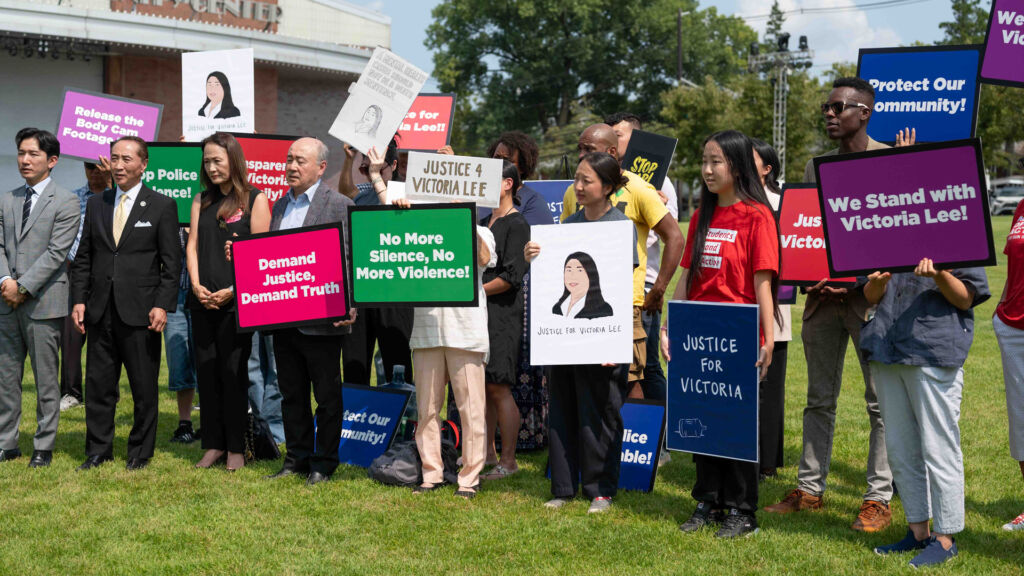
That reality came into stark relief with last month’s police shooting of a Fort Lee woman who was going through a mental health crisis. In that case, the entire incident spanned just 10 minutes before a Fort Lee officer — without any mental health professionals present — shot and killed 25-year-old Victoria Lee.
The especially tragic part: Fort Lee police were in the process of implementing Arrive Together.
The state nearly doubled the program’s funding this year, and the attorney general’s office has said its top priority is bringing the program to every town and city across New Jersey.
New guidelines
On Thursday, state Attorney General Matt Platkin also announced new statewide guidelines for police when dealing with incidents where people are barricaded, including by making every effort to de-escalate the encounters. That announcement came the same day as the Lee family held a press conference to decry the police response in Fort Lee.
“Our goal is to provide first-responders with the tools to slow and stabilize these standoffs, empowering officers to navigate the dangerous first minutes of these encounters, so proper resources can be deployed to intervene and resolve the situations safely without force, significant injuries, or death,” Platkin said in a statement.
Criminal justice experts and community leaders say the absence of the Arrive Together program in hundreds of communities has left a gap of care, where adjacent municipalities can have starkly different practices in how they respond to crisis calls.
“That needs to change, and it needs to change with urgency, because if not, you’re subject to seeing more cases like Victoria Lee’s,” said Michael B. Mitchell, an assistant professor in the departments of African American studies and criminology at The College of New Jersey.
Origins of Arrive Together
Arrive Together began in Cumberland County in late 2021 as a way to help police respond to mental health calls. It’s now available in over 219 municipalities in all of New Jersey’s 21 counties, covering “more than 50% of New Jersey’s 9.3 million residents,” Tara Oliver, a spokesperson for the attorney general’s office, said in a statement.
Oliver said that the attorney general’s office “works with prosecutor’s offices and law enforcement agencies serving municipalities wishing to implement ARRIVE.”
“Once an interested law enforcement agency is identified, [the attorney general’s office] funds the mental health professionals that will work with local law enforcement,” she wrote in an email.
The state attorney general’s office said the state is making progress in expanding the Arrive Together program, and eight to 10 more municipalities will implement it in the ‘near future.’
Currently, Arrive Together has two main strategies, where either mental health professionals join police on emergency calls or police refer people for follow-up care. State officials and others maintain that where Arrive Together is available in a city or town, it has proven effective. A Brookings Institution analysis of early call data showed that 97% of Arrive Together cases did not use force and 98% of calls or follow-ups did not result in arrest. The state’s data dashboard listed a total of 12 arrests through the end of July.
“ARRIVE Together has the potential to improve police-community relations, change law enforcement culture, and provide substantive assistance to people suffering from mental health symptoms,” said the Brookings report’s authors.
Expanding the intervention program
The state attorney general’s office said the state is making progress in expanding the program, and eight to 10 more municipalities will implement Arrive Together in the “near future.”
Platkin has held various events, big and small, to spread the word about Arrive Together over the last two years. His office also said that he has “personally called mayors and law enforcement executives across the state to encourage participation,” and created an office to oversee the initiative.
“From small community-led engagement opportunities, to a large-scale kickoff event in Perth Amboy; from round tables, from regional convenings of currently participating and prospective law enforcement agencies… Attorney General Platkin has clearly demonstrated that he prioritizes making ARRIVE Together available throughout the state,” Oliver said in her email.
But criminal justice experts and community leaders are raising focus on the availability and effectiveness of Arrive Together after the police killing on July 28 in Fort Lee, where Lee was experiencing a mental health crisis at home when her family called 911 for help.
What didn’t happen in Fort Lee
Lee’s family had explicitly asked that police not enter her apartment. Police did not attempt to calm Lee down before breaking down the apartment door and firing the fatal shot.
Especially jarring, Fort Lee police were in the final stages of implementing the Arrive Together strategies in a joint program with Teaneck police at the time of Lee’s killing.
“The room is already set up,” said Fort Lee Mayor Mark Sokolich. “The technology is already available, because that person has to be in touch with our dispatcher. That was all done before [Lee’s killing], in anticipation of receiving Arrive Together.”
 Credit: (New Jersey Office of the Attorney General)
Still, even if Arrive Together had been in operation in Fort Lee on July 28, mental health professionals might not have been sent for because the program is not always available 24/7. For instance, in the case of a joint program between Madison, Morristown, Morris Township and Morris Plains, the program is only operational between 7 a.m. to 3 p.m.
“I’m not aware that any of those representatives are available at that hour, because I am told that the average participation [of the mental health professional] is 16 to 18 hours a week,” said Sokolich. “And if that’s the case, there’s 150 unmanned hours.”
Learning to de-escalate
The current state budget includes over $19 million to help expand Arrive Together’s operating hours and to bring the program to more municipalities. In addition to these efforts, all law enforcement officials are required to undergo de-escalation training in New Jersey.
In Platkin’s revised use-of-force guidelines released Thursday, all law enforcement are required to “identify qualified mental health professionals who will be available to respond to incidents involving a barricaded individual or hostage situation,” such as in cases similar to Lee’s.
‘Too many victims who are trying to seek help during a mental health crisis have ended up dead at the hands of police.’ — Amber Reed, AAPI New Jersey
Under the directive, first-responding officers facing a barricaded situation are advised to wait for appropriate resources to respond and not attempt to force a resolution, unless that would be immediately necessary to prevent injury or death.
When feasible and when no immediate threat is present, the directive says officers should establish a perimeter and communication with the barricaded individual to assess their status, including determining whether the person is wanted for a crime or may be in crisis.
The attorney general’s directive applies to all police departments, not only the ones that have Arrive Together.
More training for police
In addition, law enforcement agencies with critical response teams will be required to do quarterly training drills with those mental health professionals, according to the directive. Platkin said the state will also make funding available to implement the new guidelines.
Mitchell, The College of New Jersey professor and a former police officer in Texas, called law enforcement “ill-equipped” to handle mental health crises. Instead of speaking to Lee about her state, for example, Fort Lee police only told her they would break down her apartment door.
“That can be very frightening,” he said. “That can create distress. That can cause a person that’s already experiencing a crisis to really go overboard, because now you’re scaring them. You’re using threatening language.”
In light of what happened to Lee and two police shootings in Paterson and Jersey City last year, experts like Mitchell and other community leaders are pushing for solutions beyond Arrive Together, including community-led intervention programs and greater police accountability. Ultimately, they said, Arrive Together is still a police-first solution.
“Too many victims who are trying to seek help during a mental health crisis have ended up dead at the hands of police,” said Amber Reed of AAPI New Jersey at a rally in Fort Lee last week. “What will we do to make sure that we are removing violence and police from these interactions that should be simple?”