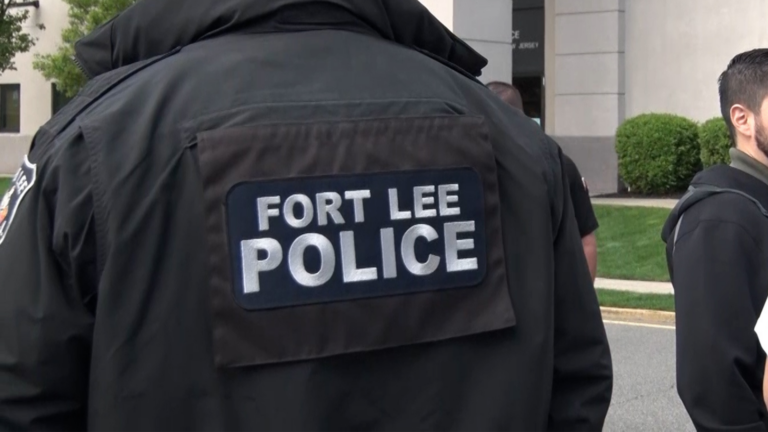
Credit: (New Jersey Office of the Attorney General)
At 1:13 a.m. on July 28, Victoria Lee’s brother calls 911, saying his sister is having a “mental crisis,” and that he wants her sent to Valley Hospital. The operator says she has to send police in addition to an ambulance.
Around seven minutes later, he calls 911 again. He asks to cancel his request, but the operator says that’s not possible; he tells the operator his sister is holding a folding knife. The operator asks if she is threatening anyone. The brother says she is not.
Thirteen minutes after the first call for help to 911, Fort Lee Police Officer Tony Pickens Jr. walks down the hallway to the Lees’ apartment. Chris Lee, Victoria’s brother, opens the apartment door to speak with him. Pickens asks Lee if he is the one with a knife.
“Who’s dealing with the mental health crisis? Who’s having the nervous breakdown right now?” Pickens asks. “Who’s the problem, your sister or you?”
More officers arrive. They can be heard asking who will use “lethal force” and “less lethal force.” They smash the apartment door down. Victoria Lee is then shot once in the chest, and she dies soon after.
What happened immediately before and after police shot Victoria Lee
A fatally brief encounter
The entire incident, shown in graphic detail on body-camera recordings and in audio recordings of the 911 calls released Friday by the attorney general’s office, lasts about three minutes.
Lee’s death is another killing that comes after police were called to respond to a mental health crisis. For years, New Jersey law enforcement, health care providers and community leaders have worked to improve police responses to those calls to avoid violent conclusions like the one that ended Lee’s life.
The recordings released Friday, which typically are made public within 20 days of witness interviews by the attorney general, amplify questions about the police response in Fort Lee and efforts made over recent years to provide nonviolent responses to calls like the ones Lee’s family made. Policing experts and community advocates questioned why officers acted so quickly to shoot Lee, instead of taking steps to de-escalate her crisis.
“What sped up the timeline here? Why did they not continue to wait out in the hallway?” asked Brian Higgins, the former chief of police and director of public safety for Bergen County. “What was [the officer’s] reasoning or justification for going through the door, breaking open that door, at that particular moment?”
Similar fatalities in NJ
Lee’s killing comes a year after similar police shootings of Najee Seabrooks and Andrew Washington, whose families also called for help during their mental health crises.
The deaths of Seabrooks and Washington spurred social justice advocates to push for the expansion of community-led violence intervention programs, which the state provided funding for this year. One of those programs, Arrive Together, is designed to pair mental health professionals with law enforcement on emergency calls. New Jersey police officers are also now required to undergo training specifically to deal with the type of crisis Lee was experiencing and to tamp down the situation.
The Arrive Together program was expanded to all of the state’s 21 counties, but is not yet established in every police department. The program is not yet available in Fort Lee.
‘Isn’t it our goal to put the less lethal as an option first, and then the lethal (as) the backup, the secondary option?’ — Brian Higgins, former chief of police and director of public safety for Bergen County
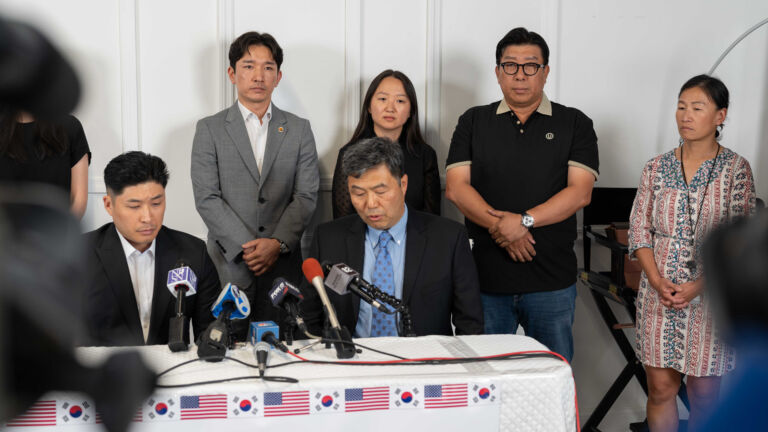
“The footage and recordings released by the NJ Attorney General’s Office confirm what the Lee family has already shared with the world: that in a matter of minutes, the Fort Lee Police shot and killed Victoria, who was in no way a threat to anyone, as her mother watched helplessly,” the AAPI New Jersey, Korean American Association of New Jersey, Korean Community Center and MinKwon Center for Community Action wrote in a joint statement.
A 2023 study of the Arrive Together program showed that most Arrive Together calls did not result in arrest or in use of force by police.
Teaneck and Fort Lee are “finalizing the agreements necessary” to launch their Arrive Together programs in partnership with CarePlus NJ Inc., according to Tara Oliver, a public information officer with the state attorney general’s office.
The state attorney general’s office did not respond to questions this week from NJ Spotlight News seeking confirmation that all law enforcement agencies in the state have completed de-escalation and intervention training requirements.
Failure to de-escalate
In Lee’s case, her family wrote in a statement released earlier this week that Lee was diagnosed with bipolar II disorder and was in distress the night police arrived.
Her mother and brother were present that night and can be seen on the police video recordings. Lee’s mother can be seen asking police not to enter. Victoria Lee can be heard saying she will stab officers when they let her know they would have to break down the door.
Higgins noted that in the footage, there is one officer pointing his gun, another officer with a ballistic shield, which would have protected against a knife, a third officer with a gun and then behind them is another officer preparing to use less than lethal force.
“Isn’t it our goal to put the less lethal as an option first, and then the lethal (as) the backup, the secondary option?” Higgins asked. “It’s almost as if they really never intended to use the less than lethal,” Higgins said.
Criminal justice experts, including Michael B. Mitchell of The College of New Jersey, say the entire response from Fort Lee police officers was “very aggressive and unwarranted.”
Pickens could have taken some time to build rapport with Chris Lee, Victoria’s brother, and had a conversation through the door with Victoria and her mother after additional officers arrived, said Mitchell, an assistant professor in the departments of African American studies and criminology at the university and a former police officer in Garland, Texas.
‘Everything was rushed’
“Everything was rushed, and because it was rushed and because they didn’t take appropriate action in de-escalating the situation, it led to a fatality,” said Mitchell. “There were just so many errors here.”
Asian American groups across the state reacted to the release of the body-camera footage on Friday, calling for “culturally competent mental health services and alternatives to law enforcement responses.”
“For many reasons, it can be challenging for Asian Americans to access mental health support. We are deeply concerned about the impact of this incident and other such devastating incidents on the willingness of Asian Americans to seek medical care when they need it,” the community groups said in their joint statement.
Those groups said that words could not describe [their] grief and anger,” and said that “the Fort Lee community had received no assurance that the officer who killed her is not still patrolling their streets.”