
 Credit: (Colleen O'Dea/NJ Spotlight News)
Wednesday is the first day New Jersey voters can go to polling places across the state to cast early in-person ballots in this year’s primary election, which features the presidential race, one U.S. Senate seat and all 12 of the state’s seats in the House of Representatives. And voters can choose party candidates in local and county races.
More than 235,000 people have already voted in the state, using mail-in ballots. Primary day is next Tuesday, with traditional neighborhood polling sites open from 6 a.m. through 8 p.m.
This is the first presidential election for which New Jersey has had early in-person voting, first implemented here for the 2021 general election. Since then, the turnout for early machine voting in primaries has been underwhelming, with fewer than 30,000 choosing this method in the first two primaries in which it was offered.
This year could be different, though, because it is a presidential election year when turnout tends to be highest. And early in-person voting will be open for five days — Wednesday through Sunday — instead of three during nonpresidential years. Early polling centers are open 10 a.m. to 8 p.m. through Saturday and 10 a.m. to 6 p.m. on Sunday. Voters can cast ballots at any early-voting location in the county where they live. Locations are listed on the sample ballots sent to registered voters and are available on the state Division of Elections website.
Many more voters have embraced mail-in balloting, with the percentage of voters choosing to send ballots or place them in a secure drop box climbing over the years.
Through last Friday, county clerks had received close to 236,000 paper ballots, about a third of the total mailed to potential voters. As in the past, more Democrats than Republicans used mail-in ballots: More than three-quarters of those already submitted were by registered Democrats.
Lackluster turnout
Contested House races so far have not proven a major draw for early voters. The most mail-in ballots submitted so far — more than 43,000 — were in the 1st District, which includes Camden County, where voters have long embraced mail-in voting. The 3rd District in Burlington, Mercer and Monmouth counties, the only one with an open seat in the June 4 primary, had the second-largest mail-in ballot turnout. But two other races in which incumbents face serious challengers — the 8th District based in Hudson County and the 9th in Passaic County — have seen fewer than 10,000 mail-in ballots each so far.
Overall, turnout in New Jersey’s primary elections tends to be low, which some activists blame on the state’s closed primary system. Only those affiliated with one of the major parties can vote for their party’s candidates. Unaffiliated voters can choose to vote for one party’s candidates, but they must affiliate with that party to do so, and most don’t bother.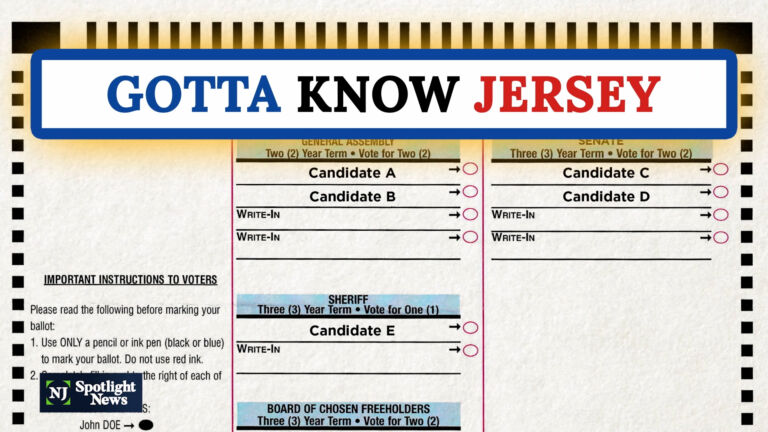
Last spring, when legislative races topped the balloting, 605,000 people voted in the primary, representing about 10% of all registered voters and nearly 15% of Democrats and Republicans. The last presidential primary, in 2020, had a higher turnout: Nearly 1.47 million people voted, roughly a quarter of all registered voters and about 40% of partisans.
New Jersey also does not permit same-day voter registration, so only those who are already registered can vote.
Patrick Murray, director of the Monmouth University Polling Institute, said the magnitude of this year’s turnout is unclear.
“Primary turnout in the past two cycles has been about 26%. This is already more than double what it is in any other year, including years when statewide offices have been up for grabs,” he said. “There could be a small bump from a presidential protest vote on the Democratic side, but there isn’t an alternative option for Republicans.”
The candidates
Former President Donald Trump is the only Republican candidate for president on the primary ballot. On the Democratic side, in addition to President Joe Biden and Terrisa Bukovinac, who is running on an anti-abortion platform, there is a slate of uncommitted delegates. Some Democrats nationally have been voting uncommitted as a protest to try to gain a ceasefire in Gaza and end U.S. military aid to Israel. Nationally, voting uncommitted has drawn more than 10% of the Democratic vote in some states.
There are contests for both the Democratic and Republican nominations for the state’s open U.S. Senate seat, currently held by Democrat Bob Menendez. Menendez is on trial in federal court, facing corruption and bribery charges, as well as repeated calls to resign his office. He has said he would not run in the primary but may run in November “as an independent Democrat.”
One of the most competitive House races is for Rep. Andy Kim’s 3rd Congressional District seat.
Democratic primary ballots will look different this year in part because of that Senate primary. Rep. Andy Kim, who is giving up his 3rd District seat in the House to run for the Senate, filed a federal lawsuit and won an injunction earlier this year that bans the use of the traditional party line ballot on the Democratic side. So in this election, Democratic candidates are being grouped together based on office sought. Because no Republican was originally part of that suit, the judge’s ruling did not apply to GOP ballots and they will be grouped along the party line, as in the past.
Kim, considered the front-runner because of party endorsements and a $4 million campaign account, faces labor advocate Patricia Campos-Medina and social-justice activist Larry Hamm in the Democratic primary. On the Republican side, South Jersey hotelier Curtis Bashaw and Mendham Mayor Christine Serrano Glassner are the lead contenders in a four-person field that also includes Justin Murphy and Albert Harshaw. So far Bashaw has outspent Serrano Glassner 4 to 1, but she is hoping Trump’s endorsement of her will win out.
Races to watch
One of the most competitive House races is for Kim’s seat in the House. Five Democrats and four Republicans are seeking the nomination. In the Democratic race, Assemblyman Herb Conaway has gotten party endorsements and raised more money, while Assemblywoman Carol Murphy, with whom he serves in the 7th District in the state Legislature, has name recognition and gained the endorsement of the Philadelphia Inquirer. Among the Republican field, Rajesh Mohan has gotten GOP party and leader endorsements, but Shirley Maia-Cusick has raised the most money.
And Rep. Rob Menendez (D-8th) is defending his seat against a strong challenge from Hoboken Mayor Ravi Bhalla in the district that covers parts of Hudson, Essex and Union counties. Menendez is the Democratic organization candidate but could suffer both from the lack of the party line ballot and from potential voter backlash against his father and the corruption allegations against him. Bhalla has raised more money than Menendez this cycle, but Menendez had about twice as much money in the bank as of mid-May for final get-out-the-vote efforts and advertising. Kyle Fort Jasey is also on the Democratic ballot.
Information about all the races, including candidates’ answers to key issue questions, is available at the NJ Spotlight News congressional voter’s guide.
The elections page includes links to stories about the races, as well as key information about voting, including how to check your voter registration and the locations of polling places and drop boxes.
_
