 Credit: (Edwin J. Torres/NJ Governor’s Office)
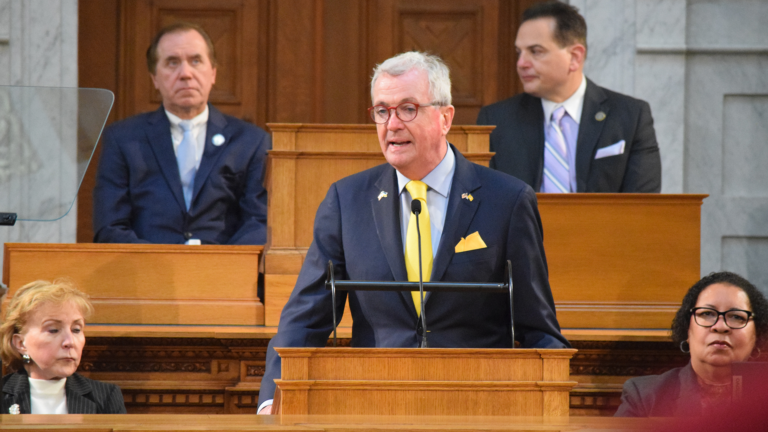
Gov. Phil Murphy’s budget plan includes a slew of proposals he said are aimed at keeping life in the state affordable, an attempt to hold to his State of the State promise to do that for everyday New Jerseyans.
In addition to a new tax on top-earning corporations intended to help fund New Jersey Transit, those measures include a new retirement savings plan for residents and more funding of tax relief programs. Murphy included the measures in a budget proposal that would once again be a record for state spending while he faces political pressure to keep spending down amid lagging tax revenue collections.
Policy analysts and social-justice advocates were concerned that low- and middle-income residents would face increased taxes and fees to help fund the state budget. They pushed Murphy to reinstate a corporate business tax surcharge he allowed to lapse in order to help boost state revenue, saying most residents can’t squeeze more money out of their budgets.
Murphy’s proposals all need to be approved by lawmakers who must pass a balanced budget before July 1. Affordability advocates and analysts say Murphy made great strides with this budget proposal but that more could still be done to help low- and middle-income residents.
“The governor’s budget proposal rightly asks the world’s biggest corporations to pay for the infrastructure that helps generate their record breaking profits,” said Nicole Rodriguez of New Jersey Policy Perspective in a statement. “This budget proposal still has some red flags that lawmakers will have to address.”
New corporate charge to aid NJ Transit
The biggest win for advocates is what the administration is calling the Corporate Transit Fee, which would be imposed on corporations with net annual incomes more than $10 million. The state says doing that would provide around $800 million in revenue per fiscal year and affect 600 businesses. Representatives of the business community say the fee is a replacement for the corporation business tax surcharge, an additional tax of 2.5% on businesses during the pandemic with net annual profits totaling more than $1 million.
The surcharge was always meant to be a temporary fix to help fund state government during uncertain pandemic times, and it lapsed in December. It was a hot topic when NJ Transit announced it would be raising its fares 15% this year to help meet a budget deficit. Policy analysts said the surcharge could have brought in $1 billion in revenue to fill the transit agency’s budget hole.
Murphy also announced increased funding for the Anchor property-tax program.
Those analysts, and transit advocates, have called for NJ Transit to have a dedicated funding source, which they say would help keep a stable cash flow instead of passing costs onto riders. Nedia Morsy of Make the Road New Jersey said the new proposed charge on corporate earnings was “huge,” and a “testament” to the advocacy work that happened across New Jersey.
But Morsy and other For the Many coalition members, including New Jersey Policy Perspective, still called on Murphy to reinstate the corporation business tax surcharge because NJ Transit fare increases could still hurt the wallets of some residents.
“If you go to a layperson and we say, ‘But your transit and your bus (fares are) still going to go up,’ we have not communicated effectively, to the New Jersey working family that New Jersey is actually more affordable,” said Morsy.
Retirement savings plan
Murphy announced other affordability measures, but who will benefit from them remains an open question.
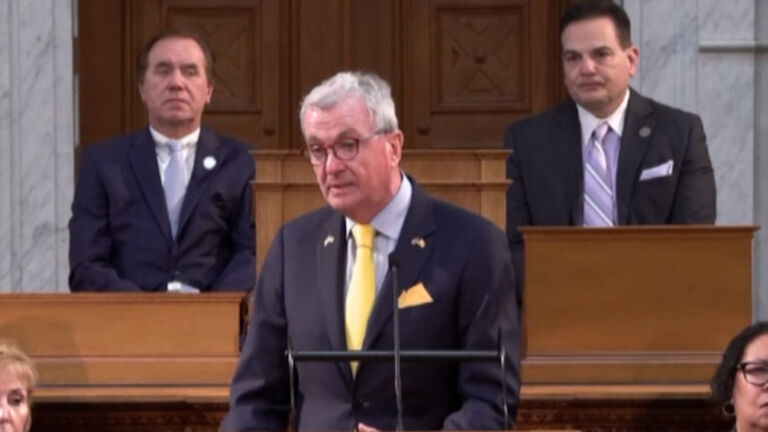
The Retire Ready NJ program, “will provide nearly every worker — particularly those who do not have a pension or 401(k) — an option to invest in a retirement savings plan,” Murphy said in his speech to lawmakers Tuesday.
“Enrolling in Retire Ready NJ is entirely free. So you can start preparing for a dignified retirement at no extra cost,” he said.
In some ways, the program could be an economic justice win — people of color are more likely to have less money saved in their retirement funds or work jobs that provide retirement savings programs. But it’s not immediately clear which workers will be eligible for the program and if it will include gig workers or undocumented workers.
Property-tax relief
Murphy also announced increased funding for the Anchor property-tax program, which he said provided $2.5 billion in relief to “millions of homeowners, renters, and especially seniors.” His proposed budget would increase that to $3.5 billion. Murphy also said he allotted $700 million in relief through the child tax credit, the child and dependent care tax credit and the earned income tax credit.
The Anchor program could be seen as an affordability measure, but it largely benefits homeowners — who tend to be white — and not renters, said Peter Chen, senior policy analyst with New Jersey Policy Perspective.
“This continues to be a concern, especially if those kinds of programs are taking money away from potentially other programs that do go more directly to folks who needed the most stuff, like the earned income tax credit, like workforce security, or the child tax credit,” he said.
Murphy said in his speech that his budget would give $700 million in “direct relief” to families through programs like the earned income tax credit, the child tax credit and others — but that number could include money the state is simply not collecting through those tax breaks.
While advocates and analysts say they are happy with some of Murphy’s affordability measures, they said more needs to be done. Chen talked about how Murphy started his address talking about his own working-class upbringing, with his father that did not finish high school and his mother that worked full-time while raising four kids.
“Thinking about that family in New Jersey today … what do we need in order to help that family? I think that’s the question that we’re always trying to ask,” Chen said.