
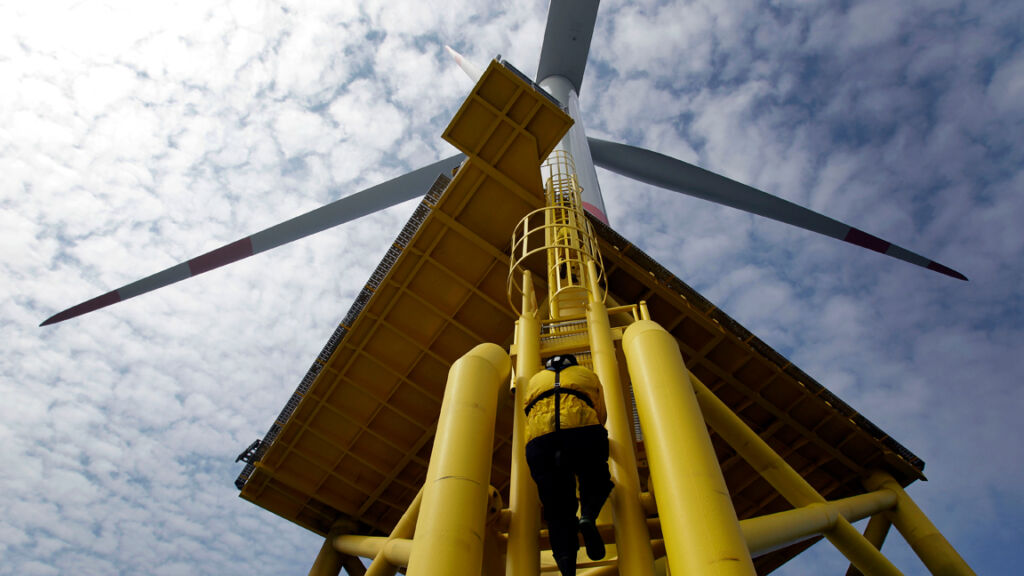
Generating power from offshore wind faces an assortment of challenges, but at least one developer remains bullish about the prospects for the sector. It’s seeking to build a project 42 miles east of Seaside Heights to power more than 600,000 homes.
Attentive Energy is one of four developers now vying to build projects off the Jersey coast after the New Jersey Board of Public Utilities sought proposals in August. The agency is expected to decide what projects, if any, move forward, early next year.
The Murphy administration has designated offshore wind as a cornerstone of its efforts to transition to a clean-energy economy, but that goal has run into fierce opposition in recent months, in part because of rising costs and resistance from Shore communities.
The Attentive Energy project, a joint venture between Total Energies, which is based in France, and Corio Generation, in the United Kingdom, aims to build a 1,342-megawatt wind farm in an offshore wind tract it secured in 2022. The company also has a proposal to build a slightly larger wind farm as part of a project under consideration in New York.
“We are excited about the opportunity to work with New Jersey to help reach the state’s ambitious clean-energy goals while driving economic growth and improving the lives of all New Jerseyans,’’ Damian Bednarz, managing director of Attentive Energy said.
Towering ambitions
The project includes a plan by the company to build a facility to manufacture offshore wind towers at the New Jersey Wind Port in South Jersey. The facility would strengthen the Wind Port’s position as a marshaling yard for offshore wind projects along the East Coast, according to the company. The Murphy administration intends to make the state the hub for building those massive towers and other components needed for the emerging offshore wind sector.
Unlike earlier wind projects approved by the BPU, some of the latest projects extend up to 42 miles off the coast, a distance that makes them invisible from the shore.
In addition, Attentive Energy plans to invest in a monopole manufacturing facility in Paulsboro, Bednarz said. Monopiles are the underwater foundation for the wind turbines. Wind towers are built atop the monopiles after they are assembled and shipped out to sea where the wind farm will be built.
Attentive Energy also plans to spend up to $300 million in community investments supporting environmental justice, labor and supply chain, as well as conservation activities, according to the company.
More than the Shore
“The opportunity for offshore wind is beyond just the Shore,’’ Bednarz said. If the project is approved by New Jersey, it is projected to be operational by the early 2030s, he said.
Beyond Attentive Energy, other projects before the BPU include the Community Offshore Wind initiative from RWE and the National Grid off Long Beach Island; the Leading Light Wind project by Invenergy and energyRE about 40 miles off Long Beach Island; and a project by Shell Energies US and EDF Renewables between 10 miles and 20 miles offshore between Barnegat Light and Atlantic City.
No offshore wind farms have been built yet in New Jersey, but three projects have been approved by the state. Gov. Phil Murphy wants to develop 11,000 megawatts of offshore wind capacity by 2040.
‘Everyone is investing in New Jersey and New York. We are the epicenter of offshore wind.’ — Doug O’Malley, Environment New Jersey
Unlike earlier wind projects approved by the BPU, some of the latest projects extend up to 42 miles off the coast, a distance that makes them invisible from the shore.
Bednarz said its site 42 miles out also offers the best wind resources to power the wind turbines.
Doug O’Malley, director of Environment New Jersey, welcomed the latest offshore wind project to be announced. “This is another sign the offshore wind potential off the Jersey Shore is the best path go reach New Jersey’s renewable energy goals,’’ he said. “Everyone is investing in New Jersey and New York. We are the epicenter of offshore wind.’’
“Clean energy innovation is essential to domestic energy security, mitigating climate change, and establishing a robust onshore economy,’’ said Dr. Michael Zwick, senior vice president for research at Rutgers University.
