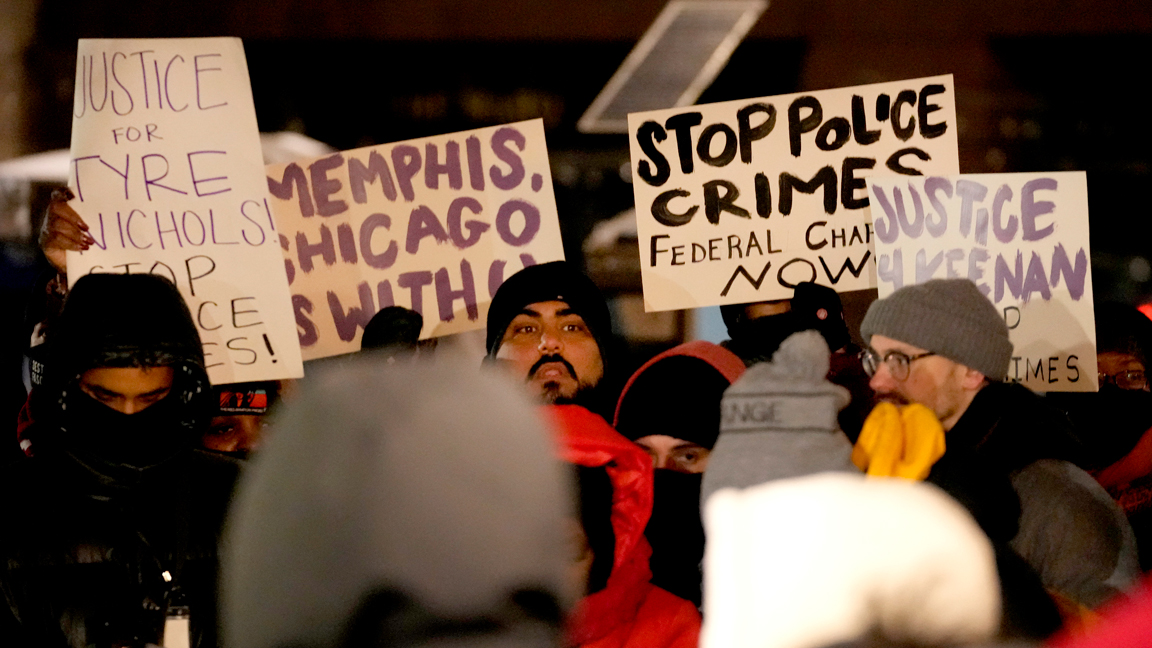
 Credit: (AP Photo/Charles Rex Arbogast)
The killing of Tyre Nichols has prompted the usual condemnations of police brutality and expressions of condolences from top state officials in Trenton.
Nichols’ death, though, has left social justice advocates and experts wondering why police accountability bills have stalled while “tough-on-crime” legislation, which they say will harm Black and brown people, is gaining momentum in the State House.
“Nationwide, we had lots of expressions of condolences and sympathy, right?” said Yannick Wood, director of the criminal justice reform program at New Jersey Institute for Social Justice. “But there has to be a shift in policy, there has to be movements on either directives or legislation to meet those words, otherwise, those words ring hollow.”
Wood said that while New Jersey lawmakers and officials have taken some steps toward reform, he dismisses them as “half measures.”
“They don’t strike at the heart of what we’re trying to accomplish here,” Wood said.
Saw lots of words from lawmakers & leaders this wknd. Time for action.
In NJ it’s past time to:
➡️ Make police discipline records PUBLIC
➡️ Allow REAL civilian review boards
➡️ END QUALIFIED IMMUNITY
➡️ REDUCE police department budgetsAnd that’s just scratching the surface.
— Amol Sinha (@AmolSinha) January 30, 2023
NJ’s reform efforts
Former state Attorney General Gurbir Grewal created a number of directives during his tenure. In 2020, Grewal directed use of force to be a last resort from law enforcement. His office also directed all departments to publicly release the names of law enforcement officials who received major discipline.
 Credit: (Edwin J. Torres/NJ Governor’s Office; CC BY-NC 2.0); NJ Spotlight News)
His successor, current Attorney General Matt Platkin, has taken steps as well. He put a police internal affairs database online so that the public can see information on investigations across agencies. He also created an office of Diversity, Equity and Inclusion in his department.
Legislators have passed measures as well. One passed last summer created a program to have mental health professionals accompany police officers in some emergencies.
The other required the police to be professionally licensed, which includes training and psychological evaluations. The latter bill brought New Jersey’s licensing requirements current with those of over 40 other states.
Advocates argue for more
But advocates and some experts say it’s not enough. For instance, they say licensing decisions — particularly revocations — should be made available online to the public. They also point out that the attorney general’s new databases and guidelines need to be codified into law.
Advocates say anti-crime focus could stymie advances for nonwhite New Jerseyans
“I don’t think we’re going to train the white supremacy out of these agencies,” said Williams.
Law enforcement, Williams said, has its roots in policing and surveilling enslaved Africans and African Americans. He added, since its inception, “it’s been the institution itself” that is anti-Black. What is needed, Williams said, is police accountability.
Advocates cite several important bills from the Legislative Black Caucus that have not made significant progress in the State House. They include prohibitions against police use of chokeholds (A-1370); establishment of civilian complaint review boards to oversee police conduct (A-1515 and S-2295); further disclosure of disciplinary records (A-996, A-1369 and S-371), and the end of qualified immunity for police in certain cases (A-1006, A-1378 and S-375).
“There’s been a lot of surface-level pandering,” Wiliams said. “Politicians know how to talk to marginalized communities, how to hype them up and give them what they want, at least verbally. But then when they go back to Trenton … nothing is really happening.”
Protecting the police
Meanwhile, bills seen as more law-and-order appear to be progressing. They include efforts to extend the list of crimes that require pretrial detention (S-3347) and another to crack down on auto thefts (S-3345). One bill upgrades penalties for assaulting officers (S-3093). That measure would upgrade certain crimes, like “throwing bodily fluids at law enforcement” to the second degree if the victim is harmed, with a first version of the bill stipulating a mandatory five-year minimum sentence for the crime.
The officer-assault bill made waves on Jan. 30 after a Senate Law and Public Safety Committee hearing but was pulled because committee chair Sen. Linda Greenstein (D-Middlesex) did not want to appear “insensitive” after the release of the Nichols’ video.
Social justice advocates have lambasted the bill, saying that it will only harm Black and brown New Jerseyans who are already more likely to be targeted by law enforcement.
“The NJ legislator will be SPITTING in the face of Black NJ if you EVER pass this bill! You know the history of racial profiling! You know the disproportionate use of force on Black people. YOU KNOW WE WILL BE THE ONES WHO GET HIT THE WORST!” tweeted Rev. Charles Boyer, founder of Salvation and Social Justice.
Greenstein, the bill’s co-sponsor, defended the bill to NJ Spotlight News, but also said it was a work in progress
“Since the onset of COVID, many (police) have been subjected to various types of assaults, including the contamination from projected bodily fluids,” she said in an emailed statement. “The intent of the bill is to provide a needed layer of protection.
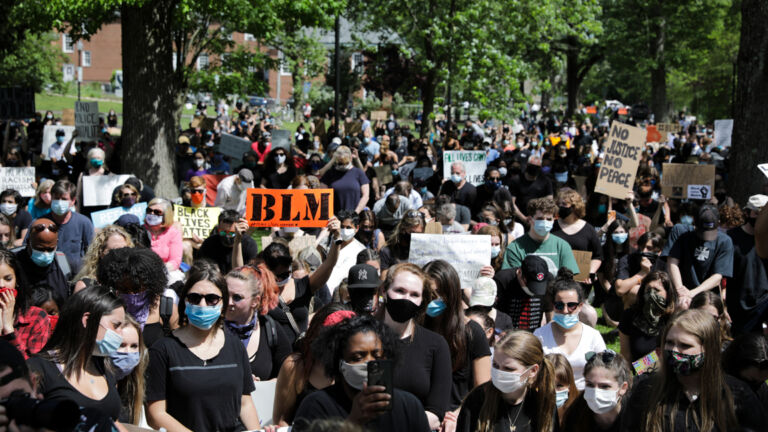
Activists in NJ still wait for passage of police reform legislation
“However, the legislation is still in a formative stage,” the statement continued. “I believe it is crucial to take the time to fully consider the impact of this bill on all communities, particularly communities of color. We will amend it to remove mandatory minimums and we will continue an open dialogue with advocates and the law enforcement community to find the fairest way to protect officers and the public.”
Marleina Ubel of New Jersey Policy Perspective, a liberal think tank, said these and other bills “undermine” the bail reform measures that New Jersey put in place nearly a decade ago, ones that advocates have called among the few major wins for criminal justice reform in the state. Established in 2014, bail reform removed cash bail in certain instances and instead created a points system that helped lessen the number of people detained because they could not afford bail.
Yet with the potential penalty for crimes increased, that could mean more people could find themselves detained, Ubel said. And since Black and Latino communities in New Jersey are already incarcerated at higher rates than their white counterparts, that could only serve to further marginalize those New Jerseyans, she said.
Getting a fix on Murphy
Advocates have been looking to Gov. Phil Murphy for his support, but say he has been difficult to read. At his recent State of the State speech in January, for example, he explicitly applauded the auto-theft bills, without mention of police reforms.
But when asked by MSNBC last week in the aftermath of the Nichols’ killing if he could support reforms like ending qualified immunity for police, he said, “Nothing could be said to be a nonstarter.”
“How could we be presented with this tragedy and not all of us, regardless of our party or what level of government we serve, look in the mirror and say what can we do to prevent something like this from happening again,” says @GovMurphy about nationwide calls for police reform. pic.twitter.com/crWzZ0w9SP
— Chris Jansing Reports (@JansingReports) February 2, 2023
“How could we be presented with this tragedy and not all of us, regardless of our party or what level of government we serve, look in the mirror and say, ‘What can we do to prevent something like this from happening again?’” Murphy continued.
The tough-on-crime bills are being pushed forward by Democrats, too, leaving some advocates wondering if their actions are part of a nationwide effort by the party to appear more moderate on these issues to appeal to more voters. All 120 seats in the New Jersey Legislature are up for vote this fall.
Williams said that Democrats are talking “out of both sides of their mouths.”
“It’s a question, really (of) when are the Democrats actually going to take the stand and do what they know is right,” he said.