Credit: (AP Photo/Matt Rourke)
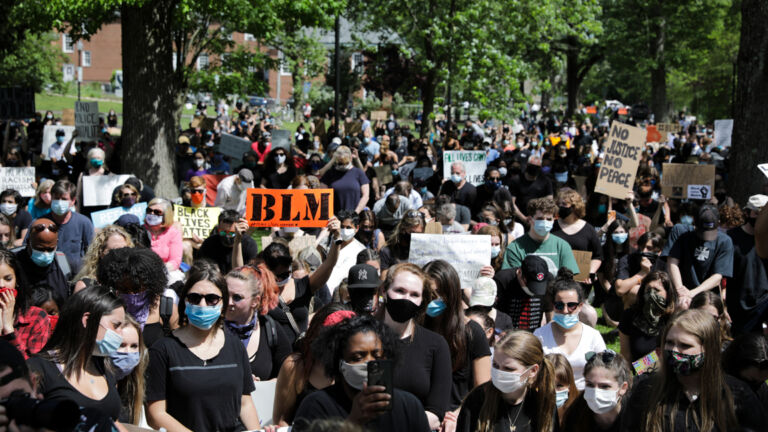
After the racial justice protests of 2020, local and state leaders in New Jersey vowed they would break down systemic racism in policy decisions.
Advocates and sociologists warned that discussing the ways in which racism seeped through the daily lives of people of color would have to be a long-distance conversation, not a sprint.
While Gov. Phil Murphy and state officials have made progress toward ending racial disparities in criminal justice, wealth and health outcomes, advocates and legislators say a slew of racial justice bills is still left on the table. These bills — which would make it easier for New Jerseyans to vote, cut costs of prescription drugs, end discrimination in auto insurance rates or protect Black, Latino and Asian civilians from harmful interactions with law enforcement — have made no progress in the Legislature.
That is, they have been introduced by lawmakers, but not moved forward. In their place, advocates say, are anti-crime and bail reform measures that could roll back protections for nonwhite New Jerseyans.
“When we look back at 2022, unfortunately, we just haven’t seen that much progress this year. And instead, we’re seeing a lot of pushes, especially in the criminal justice space, to take us back to tough-on-crime, mass-incarceration-era bills,” said Henal Patel, law and policy director at the New Jersey Institute for Social Justice.
While discussion of how to fix systemic racism might have slowed among the public, attacks have risen on a perceived rise in crime or teaching about racism and LGBTQIA communities in schools. These talking points were central to Republican campaigns this past election season, and it appears Democratic New Jersey lawmakers may have adopted some of them.
The Sarlo bills
Advocates interviewed by NJ Spotlight News all pointed to a package of bills recently introduced by Sen. Paul Sarlo (D-Bergen) which would take a “tough-on-crime” response and roll back criminal justice reforms, they said. One bill( S-3347) would extend the list of crimes that require pretrial detention. Others (S-3345, S-3346) would upgrade the penalties for stealing cars and for burglarizing homes. The anti-auto theft bill has already progressed in the Legislature even though it was introduced three weeks ago.
Sarah Fajardo, policy director at ACLU-NJ, said those bills were reminiscent of “fear-mongering” during the 1990s about crime being out of control across the country.
Fajardo and other advocates said they weren’t sure what data Sarlo was using to justify his bills. In a statement describing his anti-auto theft bill, Sarlo pointed to statistics that backed his measure. “According to State Police figures, 15,644 cars will be stolen this year, up from 14,405 last year, and from 11,770 in 2020,” he said. “More needs to be done to reverse this trend, which is why we are moving bills aimed at auto thefts and related crimes.”
The “rise in crime” rhetoric has largely been criticized by criminal justice experts and advocates, who say it isn’t simple to say that there is an increase in crime. A quick Google search shows a variety of data: Property crimes are on an overall downward shift nationwide. And while violent crimes increased during the pandemic, they are still near record lows. Murders were up in 2021 nationwide, but were trending downward this past year. And Republican-led states saw some of the highest murder rates.
Jumping to conclusions
Experts caution that politicians shouldn’t jump to conclusions about crime because the data is complex. Social justice advocates who spoke to NJ Spotlight News said it’s troubling that lawmakers jumped on legislation to “combat crime” and saw it as urgent — which might incarcerate more Black and Latino New Jerseyans, they fear — but have been slower to take on other reforms that would help people of color in New Jersey by addressing affordability, codifying measures to regulate law enforcement and more.
NJ Spotlight News reached out to Senate President Nicholas Scutari (D-Middlesex, Somerset, Union) and Assembly Speaker Craig Coughlin (D-Middlesex) for comment as to why racial justice bills haven’t moved this year. Scutari’s office did not reply.
A spokesperson for Coughlin, Maggie Garbarino, responded that the Assembly is “proud of its accomplishments in 2022” and that had an “indelible impact on economic and social justice.” Garbarino noted that the Assembly moved forward bills on food insecurity, passed the Child Tax Credit bill, and “established common sense gun safety laws around concealed carry and gun trafficking.” It also passed a bill requiring police to hold licenses.
“Through the annual budget, we made a historic commitment to construct new affordable housing and fund the expansion of the Earned Income Tax Credit program along with funding the Legislative Black Caucus priorities, particularly in the area of maternal health. We look forward to continue working on economic and social justice issues affecting residents across New Jersey in the new year,” Garbarino said.
Social justice advocates welcome the progress the Legislature has made, but are worried that not enough legislation to address racial injustice has made it through.
All 120 legislative seats are up in 2023. So, policy decisions those lawmakers make now, or didn’t make in 2022, could signal what’s in store for 2023, said Amy Torres, executive director of the New Jersey Alliance for Immigrant Justice.
Part of the issue is a lack of representation in the Legislature that Henal Patel of the New Jersey Institute for Social Justice says is ‘whiter and older’ than the general New Jersey population.
“It’s a very worrying bellwether, if that’s what the 2023 legislative cycle is going to look like. Because if those are the kinds of policies and platforms that lawmakers are going to be running for their races, I think that’s worrying,” said Torres of the “tough-on-crime” bills that were introduced in December.
Some progress was made in 2022 on social justice, advocates said, but not without caveats. Torres mentioned the language access bill (S-2459), which would require state agencies to translate their information into the top 15 languages spoken in New Jersey. The bill passed a Senate committee vote in November and still needs to make its way to the Assembly. But Torres was told by some lawmakers that the initiative was “too expensive” and “too big of an idea.”
Dealing with diversity
“(But) New Jersey is too diverse for the types of services that are already offered in the state, right? Our population is more diverse than most other places in the nation,” Torres said. “In New Jersey, nearly one-third of New Jerseyans speak a language other than English at home.”
Torres said they are hopeful that the Values Act (A-1986) will pass in 2023. This bill would allow residents to seek state services without fear of deportation by limiting the data that state agencies collect. It would also prohibit state and local law enforcement from voluntarily working with the U.S. Immigration and Customs Enforcement agency. Its Senate companion bill has moved to a committee. But the Assembly version hasn’t made any progress yet.
“And yet we can’t pass the Values Act because there’s this knee-jerk reaction to doing immigrants rights bills or police accountability bills in Trenton,” Torres said. “So real communities are being actively harmed because they’re being put in the crosshairs of ICE targets. And they’re being harmed because they’re avoiding services and they’re avoiding programs that the Legislature has worked really hard to pass to uplift communities.”
Affordability issues
New Jersey Citizen Action expressed a similar frustration about lawmakers. “Affordability” has been a buzzword legislators used throughout the last year, but the organization has struggled to convince lawmakers to push through a bill that would end racial discrimination in auto insurance rates and a bill that would establish a team of experts to review prescription drug affordability.
Murphy’s solution, said Dena Mottola Jaborska of New Jersey Citizen Action, was to cap prices for medications like insulin or EpiPens. She called it a Band-Aid solution, referring to her colleague Laura Waddell’s analogy of “squeezing a balloon.”
‘We’ve weathered so much together, and our communities have faced so many unique and yet intersecting oppressions that we can’t let something as silly as a politician’s lack of confidence get in our way of the pursuit for justice.’ — Amy Torres, New Jersey Alliance for Immigrant Justice
“You squeeze the balloon at one end, and it just gets bigger at the other,” said Mottola Jaborska. It means that by capping prices for some drugs, the cost of others could rise and the problem of affordability isn’t fixed.
And the New Jersey Institute for Social Justice has been fighting for same-day voter registration (A-1926), banning the use of chokeholds (A-1370), establishing a reparations task force (A-938) and creating a civilian complaint review board to review police operations (A-1515) — none of which moved last year, despite some interest by top lawmakers to review these reforms in 2020.
“There’s not even as much interest (as two years ago). And that’s what we’ve seen in the last year … (that) they don’t even want to have a conversation anymore,” Patel said.
Patel believes part of the issue is a lack of representation in the Legislature that she says is “whiter and older” than the general New Jersey population — which is almost 50% people of color. She also says that because legislators work part-time and year-round, only people in certain jobs can afford to be politicians.
Humanizing conversation
Torres of the New Jersey Alliance for Immigrant Justice believes part of the issue is that there’s a reluctance on the part of top state legislators to embrace “diversity as an asset.”
Chair of the New Jersey Legislative Black Caucus Assemblywoman Shavonda Sumter (D-Passaic), whose caucus members have sponsored or co-sponsored racial justice bills, said that it takes time to convince other lawmakers to advance these kinds of bills. It takes what she calls “socializing”: inviting community members, advocates, lawmakers and officials from government agencies to have conversations about racism and think through all the ways to solve discrimination. She said that criminal justice bills like establishing a civilian review board, for example, require urgency. But by the same token, they take time for all stakeholders to come to a consensus. Creating meaningful reform requires a balance between urgency and patience, she said.
“I spend my time trying to have that data and humanizing conversation at the same time. And as New Jersey’s become more colorful, with majority-minority communities, that work is a little easier, but it takes time,” Sumter said.
Sumter said she’s been working on these issues for 10 years. Mottola Jaborska from New Jersey Citizen Action said that the auto-discrimination bill has been in the works for 20 years.
Advocates say that while it shouldn’t take so long to convince lawmakers to end racial injustice, they won’t lose hope for 2023.
“We’ve weathered so much together, and our communities have faced so many unique and yet intersecting oppressions that we can’t let something as silly as a politician’s lack of confidence get in our way of the pursuit for justice. We’ve come too far. We’re not giving up now,” Torres said.