
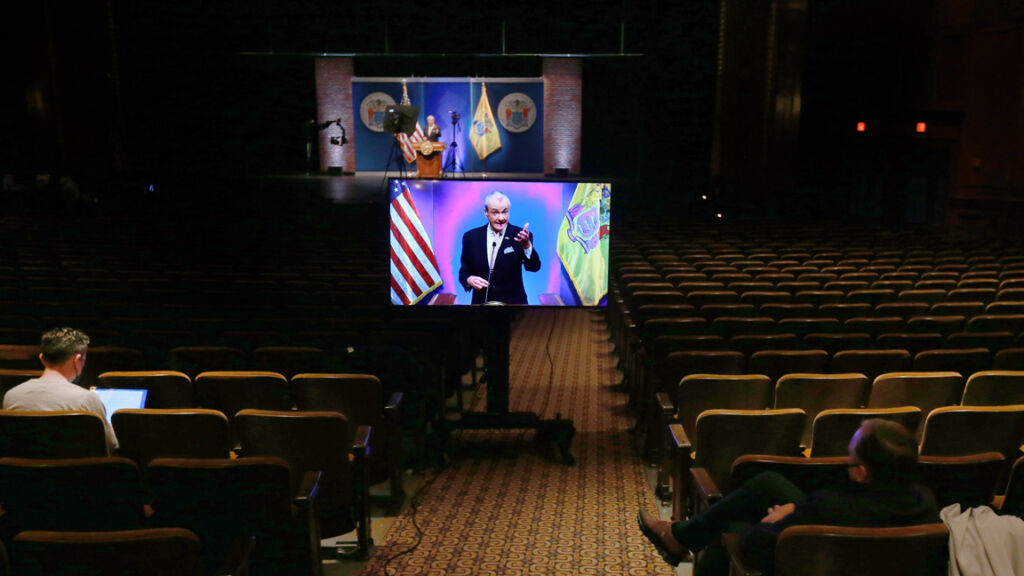
Gov. Phil Murphy is set to deliver his fifth State of the State message Tuesday, a chance to brag about his administration’s accomplishments in a speech likely to focus on New Jersey’s economy, new burgeoning business sectors and a revamped $2 billion property tax relief program.
The annual address is a time for the governor to reflect on the previous year and hint at programs he may propose in next month’s budget address before a captive audience of legislators, cabinet officials and the media. Murphy is scheduled to deliver this year’s message live and in-person in the Assembly Chamber at 2 p.m. It would be the first time in three years that he has delivered the address to an audience, after providing prerecorded speeches in 2021 and 2022 due to the COVID-19 pandemic. With speculation that Murphy may be considering a presidential bid should President Joe Biden not seek reelection, expect the governor to aggressively highlight his successes over the previous 12 months and his entire five years in office.
While the COVID-19 pandemic largely dominated much of Murphy’s agenda in recent years, history suggests it will not be a major part of this speech. In past addresses, Murphy has focused mainly on other health-related efforts, such as expanding access to health insurance, making prescription drugs more affordable, improving women’s health care services and maternal care specifically. These remain administration priorities today.
Instead, Murphy is likely to highlight the new Anchor property-tax relief program that is to provide as much as $1,500 to eligible home owners and $450 to renters, as well as a number of recent wins in the area of business and the economy and his efforts to expand abortion access and control firearms in the state.
“Anger over masks and vaccines has really dissipated,” said Ben Dworkin, director of the Rowan Institute for Public Policy and Citizenship at Rowan University. “I think he’s going to talk about property taxes and the ANCHOR (Affordable New Jersey Communities for Homeowners and Renters) program. I think he’s going to talk about the emerging industries that have really grown and developed on their watch … the emerging industries that the Murphy administration wants to take a lot of credit for, and can legitimately do so: cannabis, sports betting, movie and TV and offshore wind.”
Here’s what Murphy faces in key issues and what he may — or may not — address on Tuesday.
The Economy
The new year is beginning amid a prolonged period of generally low unemployment in New Jersey. Further, overall state tax collections have been outpacing last year’s totals through the same point in the state’s July-to-June fiscal year. The latest quarterly estimates of gross-domestic product, or GDP, indicated growth in New Jersey outpaced the nation’s as a whole during the third quarter of the 2022 calendar year. Still, many of the members that responded to the New Jersey Business & Industry Association’s annual member poll late last year had a generally pessimistic outlook for the state economy in 2023 but they also indicated they were able to increase sales and grow or at least maintain profits in 2022.
More than 2,000 permanent jobs and several thousand more construction jobs should be the result from the development of two movie and TV production facilities in the state. Last month, the administration announced two major projects: Lions Gate Films will become the state’s first “studio partner,” leasing a 350,000-square-foot production space in Newark. And Netflix will develop the 292-acre former Fort Monmouth into an $848 million studio facility with a dozen state-of-the-art soundstages. Some worry that any tax credits and other state incentives could lessen or even negate any benefit from these facilities, but local and business officials have cheered the projects.
For many of the state’s lowest-wage workers, 2023 also brought a raise after the state’s minimum hourly wage ticked up by $1.13, to $14.13, on Jan. 1 under a law enacted by Murphy and lawmakers several years. Ultimately, the bill will result in the minimum wage rising to $15 in New Jersey. And if a recession is looming, state government appears to be well prepared for potential revenue losses: Murphy and lawmakers left nearly $7 billion in surplus in the state’s latest fiscal year budget, which is more than 10% of planned annual spending.
But property taxes remain a concern throughout the state, having risen to an all-time high. This year, more than 1 million New Jersey residents will collect their first benefits from the roughly $2 billion ANCHOR property-tax relief program established last year in response to concerns about affordability. Benefits total as much $1,500 for homeowners and $450 for renters. But even as the new relief efforts are being rolled out — the application deadline for ANCHOR is Jan. 31 — county and municipal government officials are sounding alarms about the potential for additional property-tax hikes due to rising pension and health benefits costs for public workers. And persistently high inflation could also compound the tax burden for many taxpayers because New Jersey does not link its income-tax brackets to annual inflation.
— John Reitmeyer
Environment and Energy
The state’s third solicitation for an offshore wind developer is scheduled for early this year and could be its largest to date. So far, the state has approved three offshore wind farms — none of which are operating yet. The administration has pushed to accelerate its earlier plans for developing offshore wind, last year raising the state’s goal for electricity from offshore wind from 7,500 megawatts by 2035 to 11,000 megawatts by 2040. The state Division of Rate Counsel last month urged the state to scale back the amount of capacity it plans to approve this year, saying economic and financial uncertainties could lead to higher prices.
Murphy’s goal of moving New Jersey to a 100% clean-energy economy, one of his most consequential priorities, is likely to pose new challenges this year, according to climate activists. The administration faces a number of tough decisions likely to determine its success in sharply curbing global warming pollution and phasing out a reliance on fossil fuels — choices with implications for stabilizing rising energy costs for the public.
Among the more pressing issues is whether New Jersey follows California’s lead in phasing out the sale of new gasoline-powered passenger cars and light-duty vehicles by 2035. The California program is viewed as critical to reducing greenhouse- gas emissions and getting more electric cars on the road.
Several other important climate initiatives also are expected to be decided this year, including whether the state needs to accelerate its reliance on renewable-energy technologies, such as solar and offshore wind, and whether it should take steps to begin reducing the use of fossil fuels to generate electricity or heat buildings.
— Tom Johnson
Health Care
Murphy is likely to highlight the state’s success in building its own Obamacare insurance exchange platform — a process Murphy reclaimed from the federal government in 2019 — and the growing level of subsidies available for consumers. He may also point out the state expanded its FamilyCare, or Medicaid, program to include all children whose families qualify financially, regardless of their residency status in this country.
In his speech last year, Murphy teased plans to address the high cost of prescription medication and has worked with lawmakers on several bills. Many of these have advanced, but advocates insist they will do little on their own and are urging the governor to also back a more controversial proposal that would allow outside experts to propose additional policies to control these costs.
With abortion access no longer protected nationwide, Murphy will likely use this speech as a chance to showcase his administration’s growing investment in women’s health, including recent commitments to boost security at abortion providers and fund training to expand the number of providers in the state. New Jersey is seen as one of the leaders in the nation protecting abortion rights in the wake of the U.S. Supreme Court’s overturning of Roe v. Wade. Advocates, however, say the state needs to take more steps to reduce the racial and financial gaps limiting who is able to receive abortion care, something the Murphy administration has acknowledged is necessary.
Murphy may also highlight the state’s ongoing work to reduce maternal mortality and racial disparities, a cause championed by his wife Tammy under her Nurture NJ campaign.
— Lilo H. Stainton
Mental Health
Young people throughout the state are facing ongoing mental health challenges magnified by COVID-19. Last July, Murphy announced the “Strengthening Youth Mental Health” initiative that aims to address the crises many young people face throughout the state and country when he began his term as the chairman of the National Governors Association. Murphy could build on this initiative by laying out his youth mental health goals for 2023 and the need for continued funding in the upcoming budget for youth mental health services.
Murphy may also mention his decision to continue funding school-based youth services programs for another year, after his administration received significant pushback from advocates, state lawmakers and school personnel about ending the services currently offered in 90 schools throughout the state. The Murphy administration’s proposed plan, known as the New Jersey Statewide Student Support Services network (NJ4S), aims to serve the mental health needs of more students across the state through a regional hub-and-spoke model. But supporters of the current system are skeptical about the changes the new plan is proposing.
One highlight for Murphy to mention was the launch of the 988 suicide crisis hotline in July. He could also look ahead to the continued efforts to combat the opioid epidemic statewide. In late December, Murphy appointed 10 members to the Opioid Recovery and Remediation Advisory Council. The council provides recommendations to the state on how to use the money that the state is receiving from nationwide settlement agreements with opioid manufacturers and distributors who contributed to the epidemic.
— Bobby Brier
Education
New Jersey’s public schools continue to grapple with the pandemic’s effects, both short and longer term. Most immediate is continued uncertainty over the virus’s transmission, prompting some districts to reimpose mask mandates and other precautions. But longer term is the continued impact on children and staff, with ongoing signs of disruption to student learning, and especially mental health. Murphy is sure to highlight his administration’s numerous steps to try to ease those challenges, but it has also largely relied on federal aid that is soon to run out.
Outside the pandemic, expect Murphy to also promote the state’s continued increases in funding to both K-12 education and also preschool expansion. But looming on the funding front is the state Supreme Court’s expected action on school construction and facilities in many of the state’s poorest districts, a decision that could come with a huge price tag. The state’s lower courts are also expected to weigh in on the longstanding patterns of racial segregation in New Jersey schools.
— John Mooney
Social Justice
The Murphy administration may be proud of the progress it made in this area in 2022, but advocates would say that state government has accomplished only the bare minimum. The Legislature made strides last year to make the state more affordable with child-tax credits and to hold police accountable by requiring them to be licensed. Yet advocates say a number of critical social justice bills were left on the table, with no clear future for their passage in sight.
— Taylor Jung
Criminal Justice
It is unclear whether Murphy will talk about crime in general, though he is likely to discuss gun control. Murphy ended 2022 signing into law strong gun control legislation to dictate where guns could be carried, though at least one gun rights group has already filed suit seeking to overturn the law, and the governor could seek to champion additional initiatives to end gun violence.
Reacting to local officials’ complaints about crime, including those committed with guns, Sens. Paul Sarlo and Joseph Lagana (D-Bergen) introduced a measure, S-3347, that would extend the number of reasons why a person would presumptively be detained without bail pending trial to include seven additional offenses, including some involving firearms. Democrats who support the bill say it could help get more guns, especially unregistered ones, off the streets. And in response to what had been a rise in car thefts during the first half of the year, lawmakers introduced a nine-bill package designed to discourage car theft, including by increasing penalties, that the Senate Judiciary Committee advanced last month.
But social justice advocates worry about the direction the Legislature is taking. They say these legislative efforts are reminiscent of racist “tough-on-crime” programs that have led New Jersey to have some of the highest policing and incarceration racial disparities in the nation.
Two months ago, Murphy backed legislation to toughen penalties for auto theft, but it is unknown where he stands on the effort to make it easier to detain those accused of crimes pending trial.
A major unfilled promise in the area of prison reform is the construction of a new women’s prison to replace the 110-year old Edna Mahan Women’s Correctional Facility in Hunterdon County, troubled for decades by sexual abuse and assaults and, more recently, serious physical assaults of inmates by corrections officers. Murphy announced his intention to close the facility, currently under federal monitoring due to civil rights violations related to the sexual assaults, 19 months ago, but no plans for a new prison have been released. It is unknown whether Murphy is ready to announce a new location — and how much that might cost — but he could take some credit for what the federal monitor says are somewhat improved conditions at Edna Mahan.
Next month, Murphy is scheduled to present a new state budget to lawmakers at a time of potential economic uncertainty, since many economists have been predicting a possible recession. Murphy and lawmakers also face the pressure of maintaining spending on property-tax relief and the public-worker pension system, among other programs, at a time when the rapid growth in revenue that occurred during the COVID-19 pandemic is expected to moderate even if a full-blown downturn is not triggered. Meanwhile, the state is still not fully funding its K-12 education formula, despite a series of recent increases. And there are questions about the future of New Jersey’s Transportation Trust Fund, which funds road, bridge and rail improvements across the state on a regular basis and whose authorization is set to expire next June.
— Colleen O’Dea