
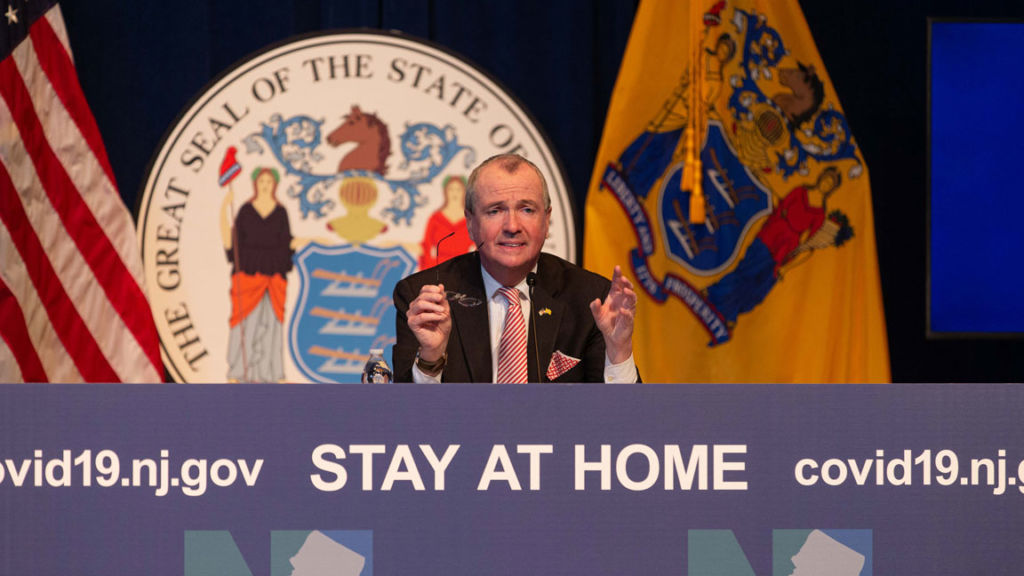
Gov. Phil Murphy’s plans to launch a year-long “independent review” of New Jersey’s response to the COVID-19 outbreak — including its oversight of nursing homes where deaths soared early on — drew praise from public health leaders but also some advice on how to proceed.
More than two years after Murphy first promised the pandemic postmortem, the governor said Tuesday that the delay in launching the inquiry reflected the “enormous amount of time (we took) to make sure we got this right and landed in the right place.”
He said the outside investigators would be well-positioned to review New Jersey’s preparations and actions and recommend changes to improve outcomes for future health emergencies.
“This is not just a look back on what we did right, wrong or otherwise, but we want to develop a playbook for the next governors down the road, the next administration who may have to do something — please God they won’t — but if they have to, that this is going to be a relevant document for the future, not just the past,” Murphy told reporters Tuesday after an unrelated event.
‘Clearly the most important part of a “look back” is to help inform the “look forward” so we are better prepared for the next public health or weather or environmental crisis.’ — Dr. Denise Rodgers, Rutgers Biomedical and Health Sciences
Health care leaders welcomed the assessment as a chance to strengthen the public health system, improve public messaging around things like vaccinations — which became politically charged — and reduce racial gaps in clinical outcomes. They urged Murphy’s hired team to ensure the review incorporates the work of other examinations of the state’s response, like the COVID-19 Task Force on Racial and Health Disparities, which held several hearings this fall.
“Clearly the most important part of a ‘look back’ is to help inform the ‘look forward’ so we are better prepared for the next public health or weather or environmental crisis,” said Dr. Denise Rodgers, a vice chancellor at Rutgers Biomedical and Health Sciences, professor at Robert Wood Johnson Medical School and community health leader in Newark.
“This review will also need to examine the role of social determinants in contributing to excess mortality in Blacks and Hispanics in New Jersey,” Rodgers said — work she hopes “complements and includes” that being done by the racial and health disparities task force.
“Social determinants or more specifically poverty also contributed to increased suffering for those with insufficient food, unstable or overcrowded housing, those with limited access to health care, and those whose livelihoods were adversely impacted by the shutdowns that accompanied the early days of the pandemic,” Rodgers said.
COVID-19’s heavy toll
New COVID-19 diagnoses have remained fairly stable in recent months but nearly 2.4 million New Jerseyans have reported infections — an undercount, given the popularity of rarely reported home testing — some 141,000 have been hospitalized and 35,000 have died. The impact is far greater among Black and Hispanic populations — here and nationwide — who experienced higher rates of infection, severe sickness and death than white people.
New Jersey’s postmortem will be led by Paul Zoubek, who has served in the U.S. Attorney’s Office and as an assistant attorney general under several Republican governors in New Jersey and is now with New York City-based law firm Montgomery McCracken Walker & Rhodes, along with Boston Consulting Group, which Murphy described as a global leader on management practices with “a large army of people.”
‘I think they believe it will take them plus or minus a year to do this. If they can do it sooner, I’m all for that. If it takes them longer and it gets to a better result, I’ll support that as well.’ — Gov. Phil Murphy
It is not clear how these entities were chosen or what their work will cost taxpayers; Murphy said it was “not a public bidding process” and payment would come at the end, based on expenses.
“It will cost what it takes to get an honest assessment,” Murphy said. His office declined to provide additional details or clarify discrepancies Tuesday.
Murphy said New Jersey was the first state in the nation to conduct an independent review of its COVID-19 response, but New York state announced similar plans last summer and confirmed details of the agreement earlier this month, according to published reports. New York solicited proposals for the job through a public process and selected a Virginia-based emergency management group, Olsen Group Ltd, to conduct a year-long review for $4.3 million.
The timeline is similar for New Jersey’s review. Zoubek’s team is expected to release a report in “late 2023,” Murphy said, a timeline he insisted was not influenced by politics; all 120 seats in the New Jersey Legislature are up for election next year.
“I think they believe it will take them plus or minus a year to do this,” the governor said. “If they can do it sooner, I’m all for that. If it takes them longer and it gets to a better result, I’ll support that as well.”
A chorus of critics
Republican lawmakers have repeatedly called on Murphy to initiate this review, something he first proposed in April 2020 but said couldn’t happen until the outbreak had stabilized some. The announcement of the outside review struck some critics as too little too late, with GOP lawmakers pointing to the ongoing problems at the state-run veterans homes, where COVID-19 has continued to spread.
The federal government has suspended funding for new admissions at the Menlo Park facility, where the state dispatched a team of experts last week to assist with daily operations. Murphy’s administration has also agreed to pay $69 million to 190 families of residents of the homes to settle claims their loved ones were harmed by the state’s pandemic response.
‘I think that New Jersey did a great job of implementing and maintaining a strong stance on masks for example, but there were obvious failures with respect to nursing homes that need to be addressed.’ — Stephanie Silvera, Montclair State University
New Jersey has enacted numerous reforms at the veterans homes, as well as traditional nursing homes in the state, which were also hard-hit by the virus. Deaths in these facilities made up half of New Jersey’s pandemic fatalities in early May 2020.
The state paid consultants Manatt Health $500,000 for an early review of its COVID-19 response in these facilities, which house some 45,000 frail older adults or medically compromised residents. Its June 2020 report called for structural changes at facilities, more bedside staffing, better access to protective clothing for staff, greater disclosure around ownership and finances and stronger enforcement mechanisms, among other recommendations.
The state’s experience with Manatt demonstrates it is not afraid of criticism, Murphy said Tuesday.
“We’ve already proven we can take a punch,” he said. “We’re going to take whatever comes at us. We’re going to be transparent (and) completely cooperative — period, full stop.”
Lessons learned
The review was good news to epidemiologist Stephanie Silvera, a public health professor at Montclair State University who has been critical at times of the state’s COVID-19 response. She also urged officials to use this opportunity as a chance to renew investment in the state’s public health system and address weaknesses exposed during the pandemic.
“An important part of emergency management after any crisis, whether man-made or natural, is a review of what worked and what did not,” Silvera said. “I think that New Jersey did a great job of implementing and maintaining a strong stance on masks for example, but there were obvious failures with respect to nursing homes that need to be addressed.”
Rodgers, the Rutgers vice chancellor, said the review should include things like vaccination distribution and other operations, but also what she called “public health messaging failures.”
“We continue to be in a situation where we can develop effective vaccines and we can’t get people to take them,” Rodgers said, noting the low rate of booster uptake nationwide.
Linda Schwimmer, president and CEO of the New Jersey Health Care Quality Institute, encouraged the review team to consider the action plan created in 2021 by the institute based on input from more than 60 stakeholders. It includes two dozen policy recommendations to strengthen the public health system, grow the workforce and better address social issues here.
“Analyzing our collective response to this public health emergency will better prepare us for any future emergencies,” Schwimmer said, welcoming the outside inquiry.
