
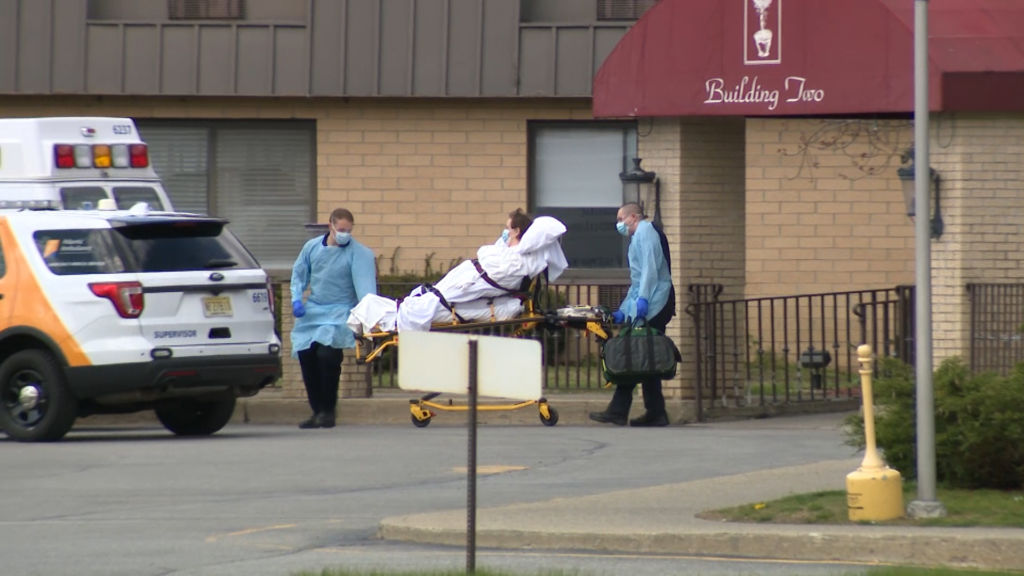
Editor’s Note: NJ Spotlight News is marking the second anniversary of the arrival of COVID-19 in New Jersey by focusing on how the disease changed our lives and what life looks like now. This story assesses to what degree promised reforms have been made thus far in the state’s nursing home industry, which suffered a shockingly high death rate early in the pandemic. You’ll find all our pandemic-related stories here.
 On Easter Sunday in 2020, New Jersey authorities were called to a Sussex County nursing home where staff had placed the bodies of 17 residents — victims of COVID-19 — in an outdoor shed when they ran out of room in the facility’s full-sized, temperature-controlled morgue. Dozens of residents there had already died from the disease, more than at any other nursing home in the state.
The horror at Andover Subacute and Rehabilitation Center — since renamed Woodland Behavioral and Nursing Center, but otherwise largely unchanged — was extreme. But it highlighted the desperate situation nursing homes throughout New Jersey and other states faced at that time.
Early in the pandemic COVID-19 tore through facilities dedicated to caring for medically fragile older people, infecting residents and staff who unknowingly carried the virus to others when working at multiple sites. By May 2020, nursing home residents accounted for 40% of New Jersey’s COVID-19 victims. In all, almost 9,300 people living or working in long-term care here have died from the virus — nearly half in the first three months — and close to 85,000 have been infected.
Federal regulators gave Woodland’s owners until Thursday to make significant improvements at the facility or risk losing critical Medicaid funding. State officials have also clamped down on violations at Woodland, the state’s largest nursing home, which houses 450 people, many of them with significant mental health concerns.
Pushing for reform
But the effort to improve nursing home care in New Jersey goes far beyond Woodland. Two years after the first COVID-19 case was identified in New Jersey on March 4, 2020, the state’s 370 nursing homes are the focus of unprecedented reform designed to address urgent needs and long-standing problems, both of which were laid bare by the pandemic.
“I think in retrospect it’s pretty clear that the nursing home infrastructure was completely unprepared for a pandemic in this country,” said Dr. Shereef Elnahal, president and CEO of Newark’s University Hospital and a former state health commissioner.
The fact that COVID-19 was extremely transmissible made older people living in congregate settings an easy target, Elnahal said, and the wide range of outcomes — from asymptomatic infection to hospitalization and death — made it harder to control. In many facilities, including Woodland, two or even three people share a room, exacerbating the risk.
How that reform process is going depends on whom you ask. Some elder advocates are buoyed by the progress to date and stakeholders’ commitment, while others are lukewarm. Nursing home operators support some of the changes, but believe others have only worsened staffing problems and other concerns. And the governor has promised to review the situation, something that has yet to happen nearly two years later.
“New Jersey really took the lead in front of many states” on nursing home reforms during the COVID-19 pandemic, said Evelyn Liebman, state advocacy director for AARP of New Jersey. “But it’s sort of like two steps forward, one step back,” she said, “and we still have hundreds of facilities that have outbreaks.”
Active outbreaks still a problem
According to state data, 394 facilities — including assisted-living and other long-term care settings — still had active outbreaks.
Liebman and others are pleased that the state eventually stepped forward to ensure nursing home staff had proper protective gear after reports caregivers were wearing trash bags when they ran out of gowns. They are encouraged by a new law that forced nursing home operators to increase staffing levels and the state’s effort to boost pay for these caregivers. But they said more must be done to ensure public funding is used for resident care, not to benefit the owners of nursing homes, two-thirds of which are operated as for-profit enterprises in New Jersey.

Laurie Brewer, the state’s Long-Term Care Ombudsman, said she is gratified by the changes she’s seen so far, but agreed more needs to be done to keep seniors safe and happy. “I think New Jersey has really leaned into this reform process in a way that I’m not sure other states have done,” Brewer said. “I would say we need to do more so that we truly understand the finances of this industry, so we truly understand where these millions and millions of dollars in public money is going.”
Brewer’s team worked with the State Comptroller’s office on a report, released in February, that examined 15 nursing homes — including Woodland — that have received a single star in Medicare’s five-star public rating system. Together, these facilities were paid more than $100 million in Medicaid funds to house close to 2,000 low-income residents.
Much of New Jersey’s reform work has been guided by a consultant’s report from Manatt Health, published in June 2020. The group outlined 11 core recommendations, both short- and longer-term, to strengthen nursing homes’ emergency response, improve communication with families and regulators, beef up state oversight, stabilize the workforce and increase transparency about ownership.
“Having that road map was really valuable,” Liebman said, “and that report really helped in guiding the Legislature and administration to do the most immediate things.” State legislators held hearings based on the Manatt report and proposed some two dozen bills in response, many of which become law.
Murphy came in for criticism
Gov. Phil Murphy, who has faced significant criticism from Republicans and others over his handling of the pandemic in nursing homes, has also pledged a review of New Jersey’s long-term care response. It’s a promise he made early on but has yet to complete, insisting his staff is focused on addressing the ongoing public health emergency.
“There is a desire to retrace steps and understand what happened,” Elnahal, with University Hospital, said. “That motivation is the right motivation, but it’s hard to do that when you are still literally in the midst of a pandemic.”
James McCracken, president and CEO of LeadingAge New Jersey and Delaware, which represents about 50 not-for-profit nursing homes here, said more hearings may not solve problems. “Here’s what I think we need to do. Number one, be honest with each other and not finger-point,” he said. “Let’s look at what happened. Let’s look at what we can do better.”
McCracken and others in the nursing home industry are somewhat skeptical about the Manatt report and some of the subsequent reform efforts. “I’m not going to say it’s worthless, because it’s not, but it was a very rushed, very short work that was evaluating something while we were in the middle of a crisis,” he said. “Has anything come out of it that has been demonstrated to improve patient care in nursing homes? I don’t know that there is.”
Sense or nonsense
Several of the reform measures no longer make sense for nursing home operators, McCracken explained. The state now requires each site to keep 60-days of protective gear in stock, which made sense at the pandemic’s start but now creates an unnecessary expense for facilities, some of which he said have been forced to toss expired equipment.
Another law requires each nursing home to employ a full-time infection control expert, something McCracken said adds cost for expertise that isn’t always necessary. Delaware has a state team of infection experts that rotate among long-term care facilities working with staff to improve their outcomes, he said, instead of punishing them for mistakes.
McCracken said the biggest concern for nursing home operators is the staffing ratio law, which requires nursing assistants to care for no more than eight residents during the day, up to 10 in the evening and just 14 at night. Previously, staffing was governed by a complicated system designed to ensure each resident got certain amounts of care every day, which sometimes allowed operators to schedule fewer workers per shift.
Now more caregivers are needed from a workforce that is shrinking, leaving nursing home operators struggling to find staff, McCracken said. Lower-paid nursing aides — who earn $15 an hour, on average — can find better pay and lower-stress jobs in retail or online sales, advocates note, underscoring the need for better training and workforce retention. While some facilities have opted to boost pay, others are struggling economically, and several nursing homes have closed in the wake of reforms and declining revenue.
“I wasn’t opposed to ratios at first,” McCracken said, “there are some bad actors and people need to be held accountable. What I was against, and I’m still very concerned about, is what exactly the ratio is, and can we meet it. And we can’t meet it because the people to hire don’t exist.”
The state Department of Health has also taken many steps to implement Manatt’s recommendations, while others are in progress or awaiting action from other agencies. The state arranged for more than 75 million pieces of protective gear — primarily masks, gloves and gowns — to be distributed at nursing homes, provided nearly 2 million COVID-19 testing kits and awarded $25 million in federal funding to help facilities conduct regular viral screenings, according to documents related to the current state budget. It also dispatched National Guard teams to then-Andover and other overwhelmed sites.
To address the communication gap, the health department set up a long-term-care emergency operations center within the existing State Police emergency operations center in West Trenton. The program is run by experts already on the state’s payroll and has no budget of its own, the documents note.
The department provided $3.6 million to eight hospitals to have them work with nursing homes to improve infection control practices, according to the documents. It also partnered with the University of New Mexico Health Sciences Center to provide remote training to staff at 286 nursing homes that accept Medicaid funding.
Staying the course
“We need to continue to walk down that road that Manatt laid out. We addressed the most urgent problems,” AARP’s Liebman said, “but now we really need to step up on the work that needs to be done to transform the system and improve care.”
Liebman and Brewer, the state ombudsman, agreed that includes rethinking long-term care in general and working to keep more seniors at home.
“For the long range, what we really need to do is deinstitutionalize long-term care. We need to be looking at smaller facilities. Single room occupancy,” Brewer said. “The real challenge is going to be revamping long-term care for the future to prevent this from happening again. And I think that will be harder, and longer term.”
