
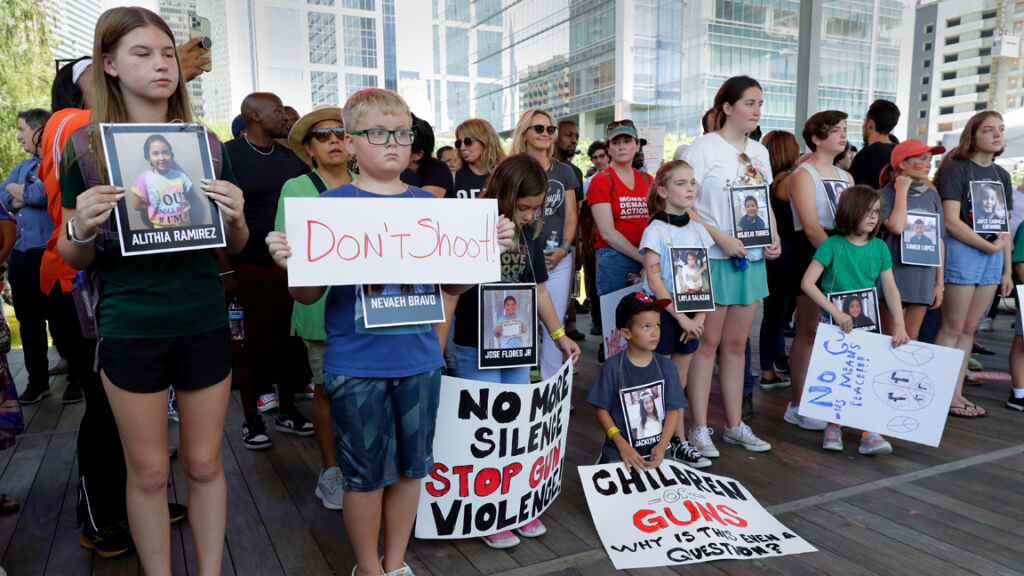
For 60 years, car crashes killed more young people than any other kind of injury. That changed in 2017, when gun incidents surpassed auto accidents to become the top cause of injury-related deaths among Americans between 1 and 24 years old.
This shift was driven by both the rising number of firearm fatalities and the decline in fatal motor vehicle crashes that followed modifications in public policy and automotive product design, a trio of doctors said in an article published online by the New England Journal of Medicine in April.
“The crossing of these trend lines demonstrates how a concerted approach to injury prevention can reduce injuries and deaths — and, conversely, how a public health problem can be exacerbated in the absence of such attention,” they wrote, spelling out how the comprehensive public health approach to auto accidents has saved lives.
There have been renewed calls to consider gun violence a public health threat after the latest mass school shooting, in Uvalde, Texas, in which 19 children and three adults — including the 18-year-old gunman — were shot to death. The massacre came less than two weeks after 10 people were killed and three wounded — all but one Black — in a racially motivated, targeted attack by another 18-year-old shooter at a grocery store in Buffalo, New York.
These killings have prompted familiar calls from Democratic leaders, including New Jersey Gov. Phil Murphy, for additional gun control and pushback from Republicans who insist further limits would infringe on individual rights. But some experts believe that while firearm safety is a critical part of any response, it is not the only path to reducing gun violence.
Police presence, gun reform
“I think there are multiple lanes (to addressing firearm violence), including but not limited to commonsense gun laws,” said Catherine Wilson, president and CEO of the United Way of Greater Newark, a nonprofit focused on reducing the impact of poverty and addressing social determinants of health, like housing and education. “There are also lanes around mental health, there are also lanes around looking at larger issues (of) self-violence, interpersonal violence, community violence.”
“Unfortunately, because we’re not investing on the front end, we end up having to deal with the gun violence on the back end,” Wilson said.
Hours after the Texas shooting last week, Murphy’s administration called for strengthening the police presence at New Jersey schools, a controversial move that some say won’t make children feel more safe. Murphy also pushed state lawmakers to adopt a package of gun reform measures they failed to pass last year, including proposals to mandate safe firearm storage, increase education requirements around safe use and storage, and give police better tools to track illegal weapons.
 Credit: (AP Photo/Craig Ruttle, File)
New Jersey already has some of the nation’s strongest gun laws, according to Paul Boxer, a psychology professor at Rutgers University in Newark, and an expert on social development and gun violence, and he praised the existing multi-disciplinary team with state and local officials, law enforcement and other partners that currently works to improve school safety. Studies — including his own — have shown states with tougher gun laws have lower levels of firearm violence, Boxer said, but also that more cops in schools don’t make classrooms safer.
NJ among states with fewest gun fatalities
With a rate of five firearm deaths per 100,000 people, New Jersey has the third-lowest gun fatality level in the nation, following Hawaii (3.4) and Massachusetts (3.7), according to 2020 data — the latest available — from the federal Centers for Medicare & Medicaid Services, which tallies health impacts by state. New York is fifth-lowest (5.3 deaths per 100,000), while Pennsylvania (13.6) is 20th nationwide. But even with the low state rate, 443 New Jerseyans lost their lives to gun violence in 2020, CMS found.
‘The ramification of (gun violence) is this ripple effect.’
However, these figures fail to paint the full picture of firearm violence, experts said. One gun death can impact the mental, financial and social health of a family, or neighborhood, all of which can trigger other negative outcomes, Wilson explained. Underinvested communities often lack the resources needed to avert these damaging effects, she said.
“The ramification of (gun violence) is this ripple effect,” Wilson said, “and we’re not talking about isolated incidents. It keeps happening over and over and over again.”
“You have the individual who is impacted, you have their bubble that is impacted, you have the larger community that is impacted,” she continued. “All those systems that have to be responsive and navigate around that. That is what makes this a public health issue.”
School vs. street shootings
While mass shootings — and school-based attacks, in particular — get outsized public attention, they comprise just a tiny fraction of overall gun violence, experts note. Boxer, who was part of a team that studied youth violence in the wake of the 2018 high school massacre in Parkland, Florida, found that while school shootings tend to involve white offenders with a history of violence, victimization or both, and happen on rural or suburban campuses, street shootings are more likely to occur in cities, with nonwhite gunmen and victims and limited media coverage.
Boxer said systemic racism is partly to blame for our outsized focus on mass shootings. “When I hear about a little two-year-old girl who is playing in her backyard in Chicago, or Paterson, or Trenton, who gets hit by a stray bullet,” he said, “that’s just as bad as a kid getting deliberately shot. It’s someone who got killed who shouldn’t have, by a gun.”
While ensuring firearm safety is critical to reducing all gun deaths, law enforcement should not have to tackle this challenge alone, experts said. Municipal agencies have a role to play in keeping streets safe by providing proper lighting and cleaner public spaces and by reducing vacant properties, Boxer said, while community groups can engage in anti-violence projects.
“By saying it’s a public health issue, we’re saying the primary responsibility for managing gun violence includes the police department, but it also includes municipal authorities, it includes the school district, it includes local researchers and public health experts, it includes the medical centers,” Boxer said. “So it’s a broader, multi-disciplinary response.”
Schools can teach students coping skills to deal with stress and help spot family violence, which can spiral into firearm injury or death, Boxer said. After-school and summer recreation and education programs are also critical to help keep children safe when not in the classroom, Wilson said. The United Way is raising money to expand these efforts, she said, and is conducting training in mental-health first aid, an approach designed to identify people who are struggling with psychological issues and quickly connect them with appropriate help.
‘We know who the next offenders or victims would be’
Even medical trauma centers — like University Hospital in Newark, which cares for hundreds of gunshot victims each year — could be empowered to play more of a preventive role, Boxer said, by expanding access to violence prevention programs, social service supports and clinical interventions. A number of trauma ward surgeons, who see the broader family impact of firearm violence all too often, have become vocal advocates for a public health approach.
“In the trauma ward, we know who the victims are, so we know who the likely next offenders or victims will be. They are the people we want to save,” Boxer said. Studies have shown that some people become victims after they are involved in “pretty serious inter-personal conflicts” like domestic violence or gang activity, he said, increasing the likelihood they will perpetuate violence on others.
A comprehensive, public-health response to gun violence could provide widespread benefit to New Jerseyans and their communities, Boxer said, but access to guns is the one commonality between all shootings, including domestic violence incidents.
‘It all boils down to gun control.’
“If we’re talking any kind of intervention for folks that would target both street shootings and mass shootings, we’re talking about making it much, much, much, much, much more difficult for anyone to access any firearm and especially assault weapons and high-capacity magazines” like those used in Buffalo and Texas, Boxer said. “It all boils down to gun control.”
America’s love for firearms is also an unyielding factor in the growing violence, Boxer said.
“We are a violent culture. We have tons of violence in our media. We have an enormously generous gun culture … We glorify police officers and the military,” he said. “Guns have a very, very shiny happy place in our society. And they’re out there.”
