
Editor’s Note: NJ Spotlight News is marking the second anniversary of the arrival of COVID-19 in New Jersey by focusing on how the disease changed our lives and what life looks like now. Part One: Guidance on public-health protections has evolved, while some experts say society must reckon with a parallel pandemic of misinformation. You’ll find all our pandemic-related stories here.
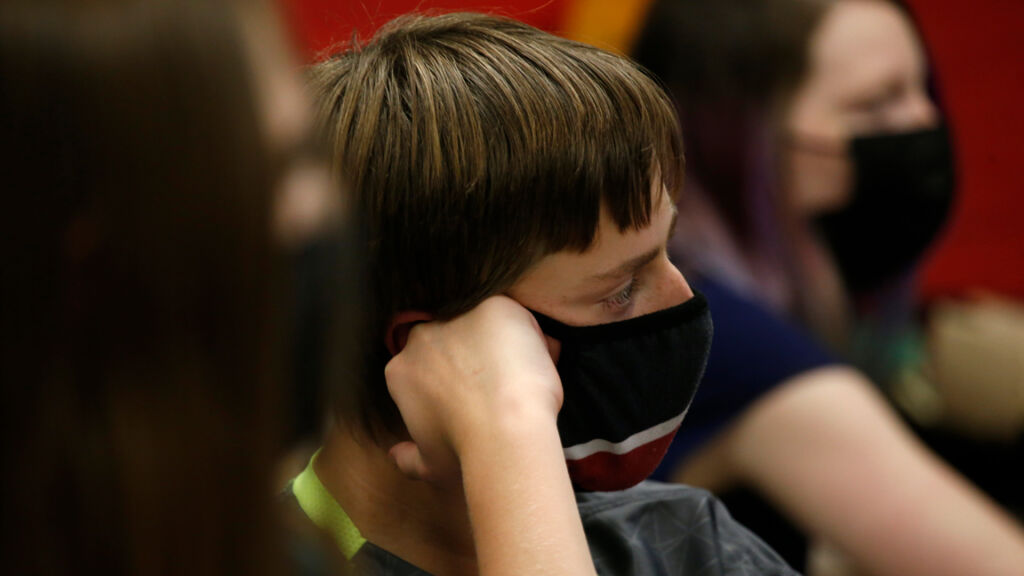
 At the very start of the COVID-19 pandemic, only health care providers were supposed to wear masks. But soon enough, New Jerseyans — and residents in a growing number of states — were encouraged to use face coverings to reduce their risk of getting and spreading the coronavirus.
Ten months later, when COVID-19 vaccines were rolled out nationwide, public health officials said the highly effective shots could protect us and others by reducing viral transmission. But the omicron variant, first found in December 2021 in New Jersey, proved it could still be spread by people who had been fully vaccinated and received an additional booster shot.
The public health message around COVID-19 has evolved with the coronavirus itself, which has mutated and surged multiple times since the first cases were diagnosed in the United States more than two years ago. New Jersey reported its first COVID-19 diagnosis on March 4, 2020, and declared a state of emergency three days later, which is still in effect.
The changing guidance — essentially official suggestions to the public and policymakers — has sparked anxiety, confusion and frustration among many New Jerseyans, leaving them struggling to know how best to keep themselves and their families and friends safe. These state and federal government guidelines and public health recommendations were at times mistaken for mandates, adding to people’s stress and uncertainty.
Distrust of government
For others, the policy shifts added fuel to an already raging fire of government distrust, anti-science rhetoric and conspiracy theories. Many in this camp have taken to social media to spread a counternarrative to the standard public health message. Two popular topics particularly ripe for distortion: masks and vaccines.
Nationwide, there is growing concern about the nature of the discourse and the societal impact — which some call a parallel pandemic to the virus itself — of the misinformation circulated by anti-science groups. Some scholars suggest Americans, with their unique focus on individual rights, are particularly suspicious of universal guidelines designed to protect other people.
‘Limiting the spread of health misinformation is a moral and civic imperative…’
“What’s very important to lift up and keep in people’s minds is that we’ve had a pandemic caused by a novel virus and we’ve had a pandemic of misinformation,” said Leslie Kantor, a professor and chair of the Urban-Global Public Health department at Rutgers School of Public Health.
Last summer U.S. Surgeon General Dr. Vivek Murthy declared misinformation is a “serious threat” to public health by sowing mistrust and undermining the pandemic response. His report, “Confronting Health Misinformation,” includes wide-ranging tips to counter these falsehoods. “Limiting the spread of health misinformation is a moral and civic imperative that will require a whole-of-society effort,” he wrote as an introduction.
Misinformation is also a target for Dr. Robert Califf, a cardiologist appointed in February to lead the Food and Drug Administration, the agency with final approval over the COVID-19 vaccines and treatments. On Twitter, he pledged to use the best, most up-to-date science and data to protect public health and counter related falsehoods.
‘Distortions and half-truths’
“These kinds of distortions and half-truths that find their way into the public domain do enormous harm, both by leading people to behavior that is detrimental to their health and by causing them to eschew interventions that would improve their health,” Califf tweeted.
 Credit: (AP Photo/Julio Cortez)
This newest coronavirus itself presented unique communications challenges, as clinicians note, and despite America’s test runs with SARS or Ebola or its experience with AIDS, a century has passed since the nation had witnessed disease this widespread. “None of us had any experience with this,” recalled Dr. Shereef Elnahal, president and CEO of Newark’s University Hospital, which treated scores of infected patients. “We were learning rapidly very specific things about COVID-19 but also how to optimize pandemic response.”
Elnahal, a former state health commissioner, said public health messaging was challenging given this context. The message “has to change rapidly and it is inherently complex,” he said. “And when the information changes, the message often has to change,” he continued, even if it contradicts earlier guidance.
“We should be encouraged by that and not ascribe unfair interpretations of what that is,” Elnahal said.
Fertile ground for conspiracy theories
Misinformation has a long history in American medicine, but social media exacerbated its spread during the COVID-19 pandemic, according to a study published in January by the American Nursing Association that built on the surgeon general’s report. The social media platforms presented public health officials with new tools to reach diverse audiences in real time, but the siloed, un-fact-checked and anonymous nature of social media also proved fertile ground for unfounded conspiracy theories, the study found.
‘There is actually a very well-organized global movement related to the anti-vax movement and connected to other misinformation.’
Kantor said for public health messages to be effective, the messenger must be trusted, considered an expert and accessible to the audience involved. She recommends more diverse messengers and letting scientists or clinicians — not politicians — take the lead on public communication.
The nursing association’s study said that nurses, as trusted health care providers, are uniquely positioned to help correct the record on COVID-19 misinformation. The authors include a list of suggestions on how bedside-care providers can counter misinformation in their work with patients.
While social media is not the only factor in the spread of misinformation, Kantor said it has benefited worldwide conspiracy movements. These forces are closely tracked by the Center for Countering Digital Hate, which also posts tips for identifying and refuting misinformation.
“There is actually a very well-organized global movement related to the anti-vax movement and connected to other misinformation,” Kantor said. “I think we keep forgetting in the United States that we actually have been subjected to a lot of manipulation over the last several years.”
Angry public debate
Unique cultural factors also shape Americans’ experience with COVID-19, Kantor said. We resisted using data from other countries, including China, where this coronavirus was discovered in late 2019, she said, and initially shunned responses embraced in other nations like widespread masking and universal testing.
“We sort of waited until it got here and thought it would behave differently,” Kantor said. “And our individual-freedom perspective versus societal responsibility to the more vulnerable explains a lot of what has happened and what is still happening.”
The angry public debate over vaccines — and New Jersey’s current mandate requiring health care workers, teachers and others in high-risk settings to be fully immunized and boosted — reflects the gulf between those focused on themselves and those more concerned with larger society, according to researchers. While those who are vaccinated and boosted can still get and spread COVID-19, unvaccinated people are roughly four times more likely to be infected and hospitalized and nearly 10 times more likely to die as a result.
‘Vaccine rates, the only thing they correlate to now is political party.’
New Jersey’s organized anti-vaccine movement emerged publicly in late 2019, when crowds swarmed the State House and managed to scuttle legislative attempts to tighten school immunization standards. State officials therefore anticipated there would be skepticism of the COVID-19 vaccines and were surprised by the high demand that overwhelmed the state’s scheduling system when the shots were opened to the public in early 2021.
 Credit: (NJ Spotlight News)
Nearly eight in 10 New Jersey residents have now been fully immunized, and more than half of those eligible have been boosted, but the angry debate has become increasingly partisan. “Vaccine rates, the only thing they correlate to now is political party,” Kantor said, with conservative Republicans less likely to support immunization. “There is no longer a big gap by race or ethnicity.”
With COVID-19’s impact on the nation, and New Jersey, declining sharply since the omicron surge in January, the public is eager to move on. But the coronavirus has taken a heavy toll on the state’s public health. Since March 2020, New Jersey has reported nearly 2.2 million cases of COVID-19, more than 113,000 hospitalizations and close to 33,000 deaths.
Declarations of pandemic’s end
Many state and local leaders, including Gov. Phil Murphy, have declared we are nearing the pandemic’s end and moving into an endemic phase with COVID-19 in which we learn to live with the virus. New federal guidelines indicate 70% of Americans — and all New Jerseyans — now live in areas where most don’t need to wear masks. However, those considered higher risk — including smokers, people who are overweight and those with depression — are urged to first consult with their doctors if spread is still somewhat active. New Jersey will lift its controversial school and child-care mask mandate Monday.
‘But when it gets to a level of spread that is very low, vulnerable people will still be at risk.’
Universal mandates may not be needed, but health experts warn we must be prepared to mask up again, or take other precautions, if a new variant sends cases spiking again. “People should understand the endemic world will look a little different from the standpoint of universal recommendations. But when it gets to a level of spread that is very low, vulnerable people will still be at risk,” Elnahal said.
The so-called endemic phase clearly empowers individual decisions, but Kantor said people should still consider the community impact of their COVID-19 decisions. A diabetic who choses chocolate cake is endangering themselves, she said, while someone refusing a COVID-19 vaccine could expose themselves to infection and endanger others, including children under age 5 who are not yet eligible for the shots.
Kantor encourages people to consider the so-called Swiss cheese model, which layers levels of protections like masks, vaccines and other public health measures. “Any one behavior, there’s a hole in it. It’s not perfect,” she said. “But if you layer them, you end up with a block of cheese.”
‘I don’t think the message should be, figure out your own individual risk and do whatever you want.’
As we enter a new phase of COVID-19, Kantor said government messaging must continue to focus on broad community health goals. “As a public health person, I want to shriek when I hear people talking about how they are figuring out their individual risk related to their actions,” Kantor said. “This is an infectious disease. This is not an individually contained clinical decision.”
“I don’t think the message should be, figure out your own individual risk and do whatever you want,” Kantor continued, although flexibility is key. “Viruses tend to mutate — that’s what they do to survive — and we may see another form (of the disease) and if so, we may need to go back to some of these protective behaviors. So, stay tuned.”
