
 Credit: (iSO-FORM LLC; CC BY-ND 2.0)
With new COVID-19 cases down eightfold statewide since the start of the year, officials said New Jersey is over the omicron hump and moving into a new phase in which people must learn to coexist with the coronavirus.
But with outbreaks still on the rise in some settings, they also said it’s too soon to relax New Jersey’s public health precautions, like the mask mandate in schools.
“The general consensus is we’re on the road from a pandemic to an endemic,” Gov. Phil Murphy said Wednesday, recalling conversations he had earlier this week with other state leaders at the National Governors Association meeting in Washington, D.C.
Like influenza, endemic infections always exist at a baseline level, with health officials working to control larger spikes or outbreaks among vulnerable groups instead of seeking to eradicate a pathogen entirely. Endemic diseases also require society to accept a certain level of sickness and death, a process that continues with COVID-19.
“No one knows how straight the road is, or how long it will take us,” Murphy said at his weekly pandemic media briefing. “But the overwhelming sense is we want to get to a place where we can live with this thing in as normal a fashion as possible.”
Steep decline
The number of new COVID-19 cases or likely diagnoses announced daily has dropped from more than 35,000 in early January to fewer than 4,000 on Wednesday, according to NJ Spotlight News analysis of state data. Hospitalizations are half of what they were then and the rate of transmission, or RT — a measure of viral spread — continues a steep decline.
“Trends we are seeing across all metrics continue to suggest that the omicron tsunami, as fast as it washed in, is pulling back at nearly the same speed,” Murphy said of the highly transmissible variant that flooded the nation in the weeks following Thanksgiving, driving up case counts and hospitalizations in most states.
Given this latest trend, a COVID-19 testing site that opened two weeks ago will close this weekend, state officials said, and federal teams of clinicians now helping at Newark’s University Hospital will be reassigned by the end of February.
In all, more than 2 million New Jerseyans have been infected since the pandemic began here in March 2020 and more than 30,000 have died as a result, with more than 100 fatalities a day recorded for much of January.
“However, even with these dropping numbers, none of us are yet at a point where we feel totally comfortable,” Murphy continued, noting how the omicron spike came quickly. “We have to remain on vigilant footing.”
Keeping an eye on schools
On Wednesday Murphy noted school-related outbreaks have ticked up in the past week as more students return to classrooms from a period in remote learning. Health officials reported at Wednesday’s media event that nearly two dozen new COVID-19 cases at state veterans’ homes and psychiatric hospitals and nine more diagnoses of multisystem inflammatory syndrome in children, or MIS-C, a dangerous condition that is becoming more common as the number of infected kids rises. The state is also maintaining two temporary morgue spaces, in Trenton and Newark, to accommodate what existing facilities cannot.
These facts underscore the need to maintain the current level of public health protections, Murphy said, especially in schools.
“And they speak to why we are not prepared to pull away any of these layers,” he said. “But, as I’ve said over the past week or so, and my conviction has already gone up, I look to a time in this school year when we are no longer masking in our schools.”
The school mask mandate has prompted passionate opposition from some who consider it “muzzling” children. Murphy kept the mandate in place when he reinstituted a public health emergency on Jan. 11. A week later, he strengthened an existing vaccine mandate for workers at health care facilities and congregate-living sites, prompting furor among some nurses who feel they are being unfairly burdened by the state requirement, which mirrors a federal order.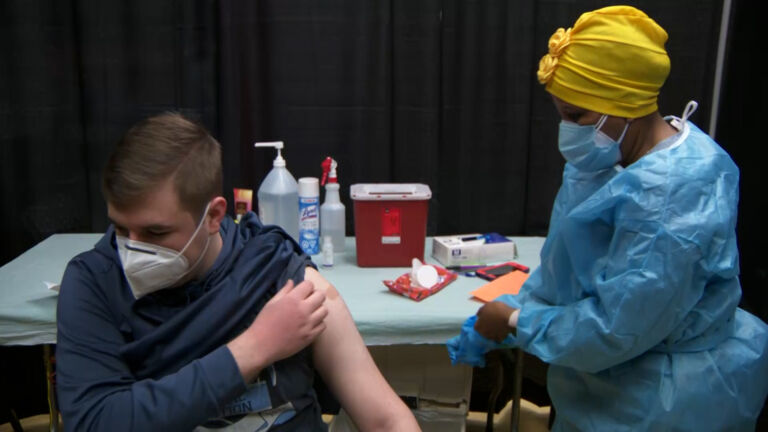
Despite this pushback — and a new poll by the Monmouth University Polling Institute that indicates one in five Americans refuses to get COVID-19 vaccinations — New Jersey officials continue to work diligently to encourage residents to get immunized and boosted. The state health department’s call center is proactively contacting people to remind them to get second shots and boosters and officials reopened several large vaccination sites in areas where immunization rates are below the average.
Vaccination push
Health commissioner Judy Persichilli said Wednesday her department is also continuing its partnership with churches to encourage immunization and dispatched vaccine ambassadors to encourage more people to get the shots. She said DOH has also worked with local and school officials to host some 700 vaccine-education events for families with children ages 5 through 11, an age group where immunization rates continue to lag.
The DOH maintains a video library of town hall-style discussions related to COVID-19 vaccines and will host a Facebook live event with pediatric experts to help answer parents’ questions about the vaccine on Feb. 9. Later this month federal regulators are scheduled to review vaccination trial data from Pfizer involving children as young as six months old, something the health commissioner called good news.
“Our state has one of the highest vaccination rates in the nation,” Persichilli said, with more than three in four eligible residents having received their initial shots and half also boosted. “While most counties in the state are at or above the state average, we still have much work to do,” she said, noting that booster rates remain too low among staff in long-term care facilities. “We must do better.”
