
Editor’s Note: NJ Spotlight News is marking the second anniversary of the arrival of COVID-19 in New Jersey by focusing on how the disease changed our lives and what life looks like now. In this story we focus on the decision to downgrade COVID-19 to an endemic, a move many experts think was premature. You’ll find all our pandemic-related coverage here.
The COVID-19 pandemic is not over in New Jersey, regardless of how eager elected officials — and the public — are to put the past two years behind them, according to a panel of experts that included a former state epidemiologist.
“I personally can’t say that we’re in the endemic phase just yet. I think we’re still in the middle of a pandemic. And that’s true for places in the world where a lot of people are vaccinated,” said Dr. Eddy Bresnitz, who was state epidemiologist during the 2000s and returned to advise the Department of Health during the first year of the coronavirus crisis.
New Jersey has the eighth-highest COVID-19 immunization rate in the nation, with roughly three-quarters of eligible residents fully vaccinated and half who have also received a booster shot. Polls show residents are tired of pandemic restrictions and Gov. Phil Murphy, who ended his regular coronavirus media briefings two weeks ago, began talking about a shift to an endemic, or stable, phase of the disease at the start of February.
Camden school nurse Robin Cogan, a fellow panelist, agreed with Bresnitz. “Pandemics end psychologically before they end biologically,” she said, recalling a saying that had stuck with her. “And we cannot let collective will overpower public health.”
Bresnitz and Cogan were part of a virtual roundtable “Living with COVID: From Pandemic to Endemic,” hosted by NJ Spotlight News on Wednesday.
The other participants, Dr. John Bonamo, an executive vice president and RWJBarnabas Health and Dr. Denise Rodgers, a vice chancellor at Rutgers University, agreed it is too soon to consider COVID-19 an endemic disease, like influenza, something that a number of state and federal leaders have done recently despite concerns from public health experts.
Assess household, community risks
The roundtable participants also encouraged residents to think carefully about who in their household or community may be at higher risk for COVID-19 and to follow guidelines from established sources. They recommended the federal Centers for Disease Control and Prevention, the American Academy of Pediatrics website Healthy Children, the state DOH’s COVID-19 dashboard, or Believe in a Healthy Newark, a nonprofit organization that Rodgers helps lead.
“I don’t believe we’re in an endemic phase yet. I think perhaps we have declared that too soon because we are hopeful to be there,” Bonamo said, urging New Jersey’s government leaders to “slow down” their push to dismantle the state’s pandemic response. “We want it to be over and that’s why we’re believing it is over,” he said.
Bonamo and Rodgers warned that a premature celebration of the pandemic’s end could lead even the most cautious residents to abandon their masks and other infection-control measures proven to control viral spread.
“Declaring it over too soon is a great way to have it become unmanageable again,” Bonamo said, adding, “even in an endemic phase of the disease, people still get sick and people still die.”
NJ not in the clear
In New Jersey COVID-19 cases, hospitalizations and deaths have declined significantly since the surge caused by the omicron variant earlier this year. But more than 2,000 new diagnoses or likely infections were reported Thursday, when 300-plus patients remained in acute care and hospitals reported 13 deaths while a new sub-variant is causing unprecedented sickness and death in Europe and Asia.
Murphy’s office released a statement Thursday acknowledging the growing risk from overseas outbreaks and predicting New Jersey will also see COVID-19 cases rise again. But his office said new statewide precautions are not necessary now given the high rate of vaccinations and current capacity of the health care system.
“We are not going to manage COVID to zero nor are we impervious to the virus. We expect COVID to continue to mutate and cases to continue to ebb and flow. Moving to an endemic status still means we must all take personal responsibility to protect ourselves and our loved ones,” read the statement from Murphy and state health Commissioner Judy Persichilli.
New Jersey’s public health emergency expired early this month — although a broader state emergency continues, enabling COVID-19 testing, vaccination and other responses to continue. And Murphy lifted the controversial statewide mask mandate for schools and child-care facilities, starting March 7. Late last month federal health leaders announced most Americans, including residents in all New Jersey counties, can go maskless indoors, although those with underlying conditions — including asthma, depression and obesity — should consult their physician first. Face coverings are still required for public transit and hospitals, but Murphy has said he plans to lift the mask mandate for state workers soon.
Rodgers, director of Rutgers Urban Health and Wellness Institute, agreed we are not yet at an endemic state with COVID-19. She worries that message may conflict with what residents hear from other sources about ditching their masks and returning to pre-pandemic life as normal.
“I think a lot of what we’re seeing in communities like Newark … and around the state is a lot of confusion because we’re giving extremely mixed messages right now,” she said. “And yet we are not, in my opinion, at a rate of cases that really warrant quite that level of sort of optimism and throwing caution to the wind.”
Follow the science
The panelists underscored the need for government leaders to follow the science, something Bresnitz — who no longer has a formal role with the state — says he is confident New Jersey’s health department will do. But it will require dedication to reinstate public health interventions when the public is eager to be done with the pandemic, he added.
“Ultimately,” Bresnitz said, “it’s the governor’s decision on what the policy should be. And of course, that comes with blowback and pushback from a lot of people who would not want to and would resist any reinstitution of what they would perceive as interfering with their liberty.”
Cogan said she was worried state officials might not have the data they need to make the best public health decisions. When the mask mandate was abolished in early March — which she described as opening Pandora’s Box — many schools also chose to end other pandemic responses, like regular COVID-19 testing and contact tracing to determine how an infection might have spread. And if they aren’t testing and tracing, districts can’t report data to the state, she added.
“The landscape in New Jersey is very different (since the statewide mandate lifted) because every district now, 600 of them, are kind of cherry-picking which guidelines to follow,” Cogan said. While it is important to consider what is next, she also worries how schools will be able to reinstate public health protections if cases surge again.
“It’s very concerning,” Cogan said, noting that Camden and a number of other urban districts have opted to continue mask requirements for the time being.
Another complication is the limited knowledge of this coronavirus, the panelists said, since it was only discovered in humans in late 2019 and quickly bloomed into a global pandemic. We have no history of endemic COVID-19, Bresnitz explained, making it hard to know what what’s ahead.
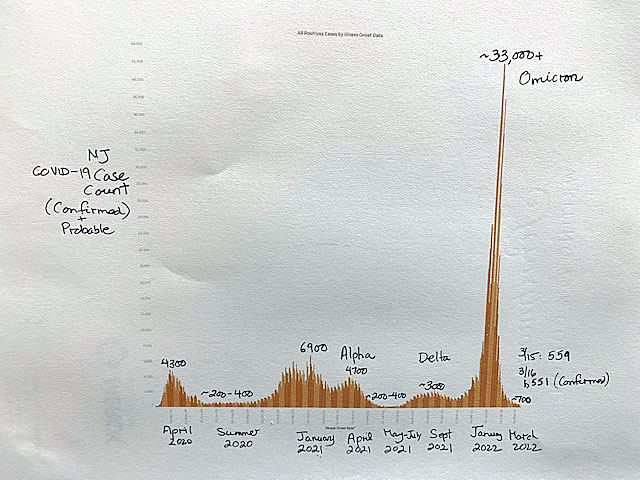 Credit: Dr. Eddy Bresnitz
What we do know about COVID-19 in New Jersey is that it is unpredictable. During the roundtable Bresnitz shared a graph of New Jersey’s daily diagnoses going back to March 2020, with the highest peak — by far — recorded early this year during a surge of the highly transmissible omicron variant. An even more infectious but possibly less severe subvariant is now gaining traction here, following widespread outbreaks in Germany, Hong Kong and other countries.
“What we’ve seen is a rollercoaster ride,” Bresnitz said, noting even the recent peak didn’t capture all the cases confirmed by home testing. “What I want to emphasize here is the ups and downs of the disease incidence over time. I think you can appreciate that we don’t know where this is going.”
