
 Credit: (Santiago Mejia/San Francisco Chronicle via AP, Pool, File)
Gov. Phil Murphy’s decision to lift the statewide school mask mandate next month was hailed by many as a victory for coronavirus-weary New Jerseyans. With similar steps taken in Connecticut, Delaware and New York, it seemed as though the region was moving into a new phase of the pandemic.
But some health care leaders have raised concerns about these moves, which they believe are premature, given their experience with COVID-19. Federal guidance still calls for school masking, they note, children remain under-vaccinated and health care workers have yet to catch their breath from the last wave of infections driven by the highly transmissible omicron variant.
 Credit: (Courtesy of HPAE)
“It’s incredibly frustrating to see that there is an announcement that masks will come off,” said nurse Debbie White, president of Health Professionals and Allied Employees, which represents thousands of frontline caregivers. Nurses and other health care workers are exhausted after the omicron surge, she said, and feel abandoned by state and federal officials who pledged to support them in this crisis.
“It’s scary,” White said of the policy change. “Masking has become a very politicized issue and really not necessarily based on science anymore.”
While she is grateful Murphy didn’t implement the change immediately, White said “there is no science that says right now that in a month we will be safe” without face coverings. “Why are we doing it?” she asked. “Aren’t we a state that takes action based on science?”
Why Murphy lifted the mask mandate
Murphy’s team insists that’s the case. Last week, when he unveiled his plan to lift the mandate — which takes effect March 7 in schools and child care settings — Murphy credited the sharp decline in COVID-19 cases and related hospitalizations and predicted this trend would continue. Individual districts or facilities can keep the requirement in place, he noted, something Newark, Camden and other districts said they plan to do.
“By next month we are predicting that the whole state will be [experiencing] moderate disease progression and some going over to low risk,” state health commissioner Judy Persichilli said on Chat Box with David Cruz. “As we get everyone into a moderate or low-risk situation, it gets safer and safer,” she said.
Murphy’s decision on masks was also based on the fact that federal officials were slated to review approval of the vaccine for children younger than age 5. On Friday, the Food and Drug Administration announced that it would delay that review. Another factor in this decision is the overall vaccination rates and the apparent ability of the vaccine and its booster to prevent serious infections and illnesses. Also Friday, the Centers for Disease Control and Prevention announced that the booster shots lose potency after about four months, a finding that could mean more are needed.
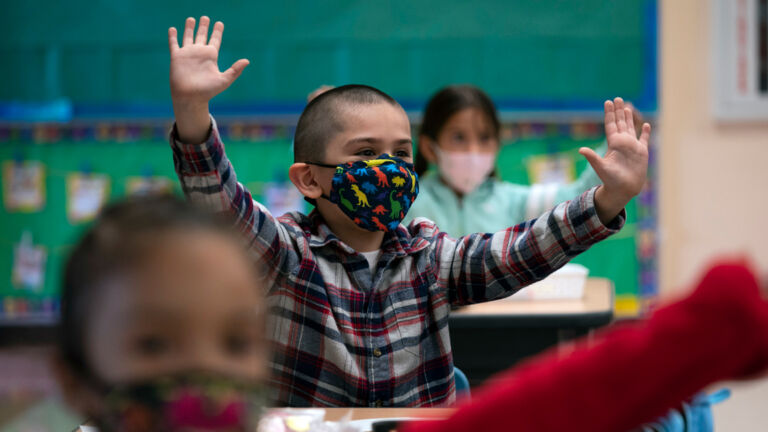
State health officials said Friday the predictions are based on pandemic modeling and careful review of COVID-19 activity in recent weeks, which has declined steadily according to reports from the state’s Communicable Disease Service. In addition, new COVID-19 diagnoses have dropped more than 90% since peaking in early January, when more than 38,000 cases and likely diagnoses were reported in a single day. Related hospitalizations have also dropped nearly threefold in recent weeks.
Public appetite for pandemic-related restrictions is also waning. A Monmouth University poll conducted in late January said seven in 10 Americans believe that COVID-19 is here to stay, and people need to learn to live with the coronavirus. Murphy convened focus groups that also made this frustration clear following his narrow reelection in November, but his staff said these findings didn’t influence the decision to end the mask mandate.
A silent majority
HPAE’s White said she believes there is a larger, more silent majority that favors keeping more pandemic precautions in place. She questions why the state acted to end this requirement when the federal CDC, which has guided the nation’s COVID-19 response, continues to encourage masking for all students 2 years and older and adults in all schools and daycare centers, regardless of vaccination status.
Persichilli said on Chat Box that this is the first time New Jersey has “gotten ahead of the CDC” on a pandemic policy recommendation. In the past, the state has matched or exceeded the agency’s guidance, she said, but the COVID-19 trends here supported the decision to lift the mask mandate next month.
“The CDC has a responsibility for the whole nation,” Persichilli said. She noted the federal agency must set policy recommendations for the entire country, parts of which are still struggling with the virus.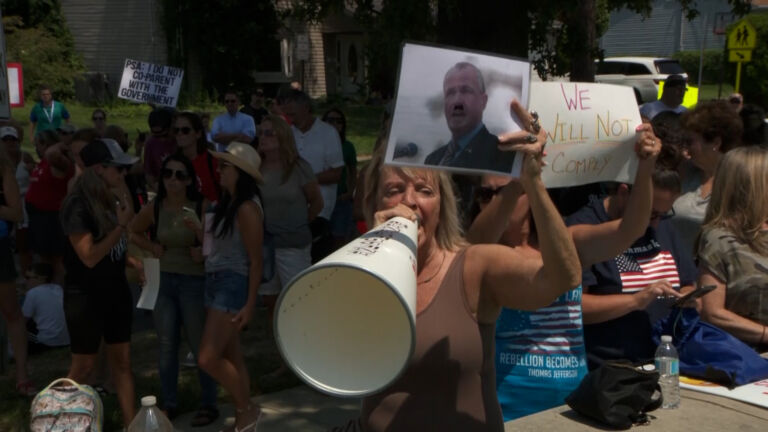
But even with the positive downward trends in COVID-19 here, it is “still a bit too soon” to lift the mask mandate in New Jersey, according to Doug Placa, executive director of JNESO, a union representing some 5,000 health care workers in New Jersey and Pennsylvania.
“We understand the public’s wanting to get back to ‘normal,’ but the strain on the health system is already at a critical point, in spite of the number of hospitalizations and deaths declining,” Placa said. “Our hope is to avoid another spike, but by scaling back an effective tool such as the proper use of masks to eliminate this virus may be too soon.”
Younger children
Sen. Joe Vitale (D-Middlesex), the longtime chair of the Senate health committee, also disagreed with Murphy’s decision to lift the mandate, according to a report on NJ.com. Vitale, who has two children younger than age 5, said he is particularly frustrated with the decision to lift the face-covering requirement in child care settings. He and his wife have decided to keep their kids home until they can be vaccinated.
“I don’t care what other states do,” Vitale said. “I care what the CDC says. And they don’t think taking masks off in schools is a good idea.”
While New Jersey has one of the nation’s higher vaccination rates overall — more than nine in 10 residents have had at least one shot — immunizations continue to lag among children, something Vitale said underscores the importance of masking in these settings. Fewer than 30% of children ages 5 to 11 have received all their shots, while 57% of those 12 to 15 and 68% of those 16 and 17 are fully immunized, according to state data.
These low vaccination rates also worry White and HPAE members, many of whom have young children themselves. “Kids are tiny little petri dishes. They’re adorable, but they are little germ spreaders,” White said. “What about their family at home, what about the grandparents of those kids, what about their teachers?” she added. “This creates a whole new set of problems for kids and schools.”
