For the first time since the last school funding bill was passed, Toms River Regional School District is in the green.
Michael Citta, the district’s superintendent, said the district would receive an additional $1.69 million, but the district will still have a big shortfall to make up
“We’re still short $22 million moving into next year, which is catastrophic,” he said. “Last year we went into the school year with a $26.4 million hole, which was filled with the state raising the taxes in Toms River by 10% because our board did not pass a budget. And then us having to come up with $12.4 million by liquidating assets in the district just to survive this fiscal year.”
Citta and others cite the state’s funding formula and its calculations of each municipality’s “local fair share.”
“I think the most confusing part of the formula is the calculation of the district’s fair share, which is just by its nature confusing and difficult to parse, difficult to predict,” said Danielle Farrie, research director at Education Law Center.
The Murphy administration did make some changes to that formula where it will average property values over three years to determine how much of the budget should be funded with local taxes. “So that means a school district that sees a dramatic increase in property values, has a new development come on, or a town that someone very rich moves in, won’t see a dramatic change,” Farrie said.
Local fair share is based in part on the property values and tax ratables in a municipality. This year, South Brunswick saw a 15% increase to its local fair share, but by law, no district is allowed to raise its property taxes past the 2% cap that was put in place under former Gov. Chris Christie.
“In one year, that number went from 142 to 166 [million dollars],” said Scott Feder, the superintendent of South Brunswick School District. “So just logically, how could a district that’s supposed to collect $142 million in year one, who couldn’t collect that because of the 2%, now with a 2% cap the following year, how could we collect $166 million? There’s no way to do it.”
Feder said that even if the district went beyond the 2%, it still couldn’t close that gap. And the result: a loss of 3% to their overall state aid this year.
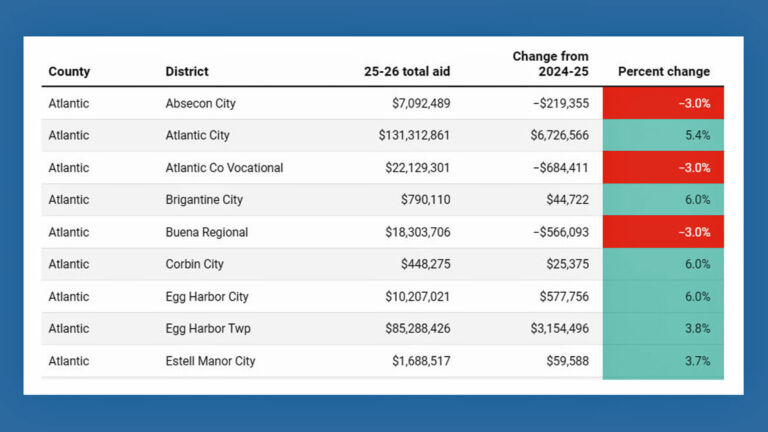
Last year, many districts that lost funding were given supplemental aid, but it wasn’t counted toward their allocation this year, meaning they lost that funding. This year, the Murphy administration is capping the losses a district could face at 3%, and the gains at 6%, with a few exceptions for specific funding allocations above that 6%.
The administration has also changed how tax ratables are considered in the formula.
“At minimum, we should be doing a 5-year average,” said Sen. Vin Gopal (D-Monmouth), chair of the Senate education committee. “There should be a more accurate formula. To do it year by year is why we have these swings. A five-year average would help a lot. It’s something we’re going look to put back in our bill.”
The formula this year did increase aid for mental health programs, special education and transportation. Gopal has introduced a bill that would also include a change to the funding calendar, and show a dollar for dollar funding calculation for each district on the DOE website. And he said the state should absolutely count the supplemental aid that districts received toward their total state aid amount.