
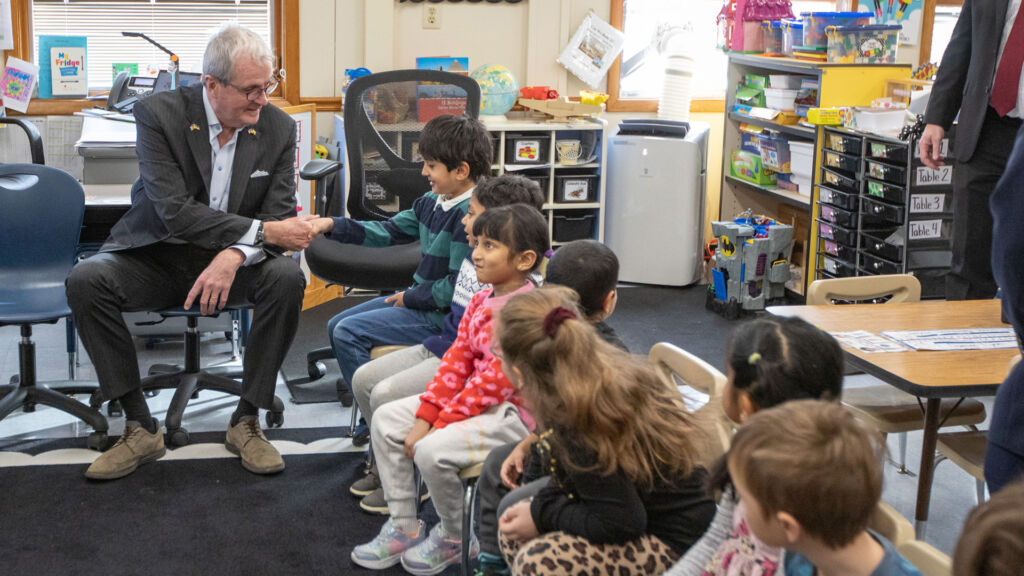
Gov. Phil Murphy proposed significant changes to how New Jersey decides how much aid it sends to local school districts.
The proposed changes aim to increase stability by limiting the increase or decrease in state aid a district can receive from year to year and using three-year averages for property wealth and income measures.
How the state funds special education, a significant expense for schools, would be changed, calculating aid based on actual special education enrollment instead of the census average.
The proposal also updates how the state determines the costs of educating the average student to include up-to-date mental health and school security needs. There would also be a mechanism for additional flexibility in the tax cap for certain districts.
School funding is a significant chunk of the total state budget. And the cost of public education is the largest share of local property taxes in New Jersey.
The exact amounts of state aid individual districts can expect to receive are set to be released on Thursday. They will be calculated based on the updates the Murphy administration is proposing to the funding formula. State officials said state aid for the 2025-2026 school year will not decrease by more than 3% of a district’s state aid in the current school year or increase by more than 6%.
Record spending
Murphy’s $58 billion budget proposal made public Tuesday includes record-high education spending for the upcoming school year with $12.1 billion going to K-12 schools. If the budget is approved, it would mark the second year of full funding of “formula aid” under the School Funding Reform Act of 2008. Murphy and lawmakers must approve a balanced budget before July 1, the start of the next fiscal year.
“With our final budget, we will once again fully fund New Jersey’s public education system,” Murphy said. “And we are also going to reduce volatility in the school funding process by ensuring that no school district sees a steep reduction in state aid from one year to the next.”
“We should have done this years ago,” said Sen. Vin Gopal (D-Monmouth), chair of the education committee. “This is a way more sensible approach than doing the supplementals that we did every year,” he said, referring to additional aid voted on by lawmakers to help districts facing steep cuts.
The state Department of Education notified school districts about the 3% limit on how much their state aid could fall compared to the current school year to help them plan for a worst-case scenario. The memo, sent to districts on Feb. 18, did not mention the 6% limit on increases in aid or any of the other proposed changes to the funding formula.
“Yes, aid might go down a little bit, but it’s going to be moderated and at least now districts can prepare for what that low-end number is going to look like,” Education Commissioner Kevin Dehmer said at his confirmation hearing on Thursday. The Senate voted to confirm him on Tuesday ahead of Murphy’s speech.
State lawmakers, including Gopal, have been working on their own changes to how schools are funded, but they failed to pass a bill to do that before the governor’s budget address. Gopal said he plans to continue work on his bill, which he says aims to increase transparency and stability. The bill would cap a district’s potential losses in state aid at 2% of the previous year’s operating budget, slightly under the governor’s proposed 3% cap on decreases in aid.
‘Critical improvements’
Danielle Farrie, research director at the Education Law Center, said in testimony on the bill that at least two dozen districts faced cuts greater than 5% of their operating budgets during the current school year, with some facing cuts of 10% or more.
The proposed changes make “critical improvements that are necessary to ensure stability and predictability for New Jersey’s students, educators and school districts,” Farrie said in a statement.
“It takes away a lot of instability in funding from year to year for about 117 districts,” said Sen. Paul Sarlo (D-Bergen), chair of the budget committee.
‘With our final budget, we will once again fully fund New Jersey’s public education system. And we are also going to reduce volatility in the school funding process by ensuring that no school district sees a steep reduction in state aid from one year to the next.’ — Gov. Phil Murphy
Murphy proposed using three-year averages for property wealth and income measures to bring about more stability. Advocates have urged that the formula switch from using a single year to a multiyear average of equalized property values and district income when calculating the amount a district can contribute locally. Farrie previously said this would increase predictability for districts that experience rapid economic and demographic shifts.
Switching to multiyear averages and placing caps on how much a district can lose each year are steps in the right direction, said Jonathan Pushman, director of governmental relations for the New Jersey School Boards Association.
“We and many folks in the education community have been looking for ways to place some guardrails or to smooth out year-over-year state aid amounts,” he said.
Broad input
During his budget proposal a year ago, Murphy promised to review the school funding formula. The Department of Education hosted several listening sessions across the state to hear from superintendents, advocates and parents about the changes they would want to see to the formula.
If lawmakers agree to it, Murphy’s proposed formula changes for this year can be included in the language of the budget that’s voted on. Permanent changes would require a separate act, said Mark Magyar, director of the Steve Sweeney Center for Public Policy at Rowan University.
Assemblywoman Eliana Pintor Marin (D-Essex), chair of the budget committee, said the “devil is always in the detail” when it comes to what the Legislature will agree to during budget negotiations.
The changes proposed by Murphy are similar to ones in Gopal’s bill and generally align with suggestions from school superintendents and advocates. Gopal’s bill has not come up for a vote in the full Senate or Assembly.
In Murphy’s proposed budget, special education funding is calculated using actual special education enrollment, rather than the census average. Under the census-based model, funding is based on the statewide average disability classification rate, no matter if a district has a higher or lower classification rate.
The Murphy administration also updated how the formula measures the “costs necessary to educate students to the State’s academic standards,” including money for mental health and school security that would benefit all students, according to the Budget in Brief. The Department of Education did not immediately respond to a request for more information about the changes.
The proposal also provides a mechanism for additional tax-cap flexibility for some districts. The department did not immediately respond to questions about what districts would be eligible or how the mechanism would work.
There is currently a 2% cap on raising the school tax levy in most districts, which makes it difficult for some districts to achieve the “local fair share.” Local fair share plus state aid is meant to equal the amount needed for adequate funding, according to the school funding law. But districts are not required to raise the full local fair share through property taxes, which means they may not reach adequacy as calculated by the formula.
Big effect on property taxes
Paying for public schools is the largest driver of property-tax increases in the state, accounting for about 52% of the average property-tax levy, according to an NJ Spotlight News analysis.
“With this funding, we are not merely investing in the success of our state’s students. We are also helping every working parent save more of their money. Because every additional dollar the state spends on public education is a dollar our families get to save in property taxes,” Murphy said during his annual budget address on Tuesday.
The “devil is always in the detail” when it comes to what the Legislature will agree to during budget negotiations, Assemblywoman Eliana Pintor Marin (D-Essex), chair of the budget committee, said.
The NJ Spotlight News analysis from the prior budget cycle found that taxes rose in all but a few municipalities, regardless of whether a school district’s state aid was increased or cut. People living in districts that lost state aid were more likely to see the highest average property-tax increases, but taxes also went up by more than the state average in most districts that have had a net increase in inflation-adjusted state aid since the 2018-19 school year.
Murphy said in his address the state is facing “more uncertainty — at the federal level — than at any other point in modern history
“We cannot negotiate this budget in a bubble. And while I sincerely hope that the situation in Washington settles down, and that we — in turn — have a normal, healthy budget season over the next few months, that is by no means a guarantee,” Murphy said.
Keeping an eye on Capitol Hill
During Dehmer’s confirmation hearing to serve as education commissioner, lawmakers expressed concern that if President Donald Trump succeeds in dismantling the federal Education Department, it could lead to a decrease in federal education funding for New Jersey. Superintendents have urged the state to step in if funding does decrease.
“The reality is we don’t know what’s going to happen,” Dehmer said, adding that the state Education Department is prepared for multiple scenarios. New Jersey receives about $1.2 billion from the federal department each year, with almost $900 million earmarked for students with disabilities and low-income students, Dehmer said.
Murphy’s proposed budget also includes $34.6 million in new funding for universal pre-K, with $10 million to bring preschool to new districts for a total of $1.27 billion in Preschool Education Aid. Since 2018, the Murphy administration has expanded pre-K to 229 school districts and created nearly 20,000 new seats. This brings the total to 293 or roughly half of New Jersey’s school districts.
There is also a proposed $7.5 million in new grant funding for districts to provide high-impact tutoring to students in need of extra academic support. Researchers have found high-impact tutoring to be one of the more successful methods for academic recovery following the COVID-19 pandemic.

