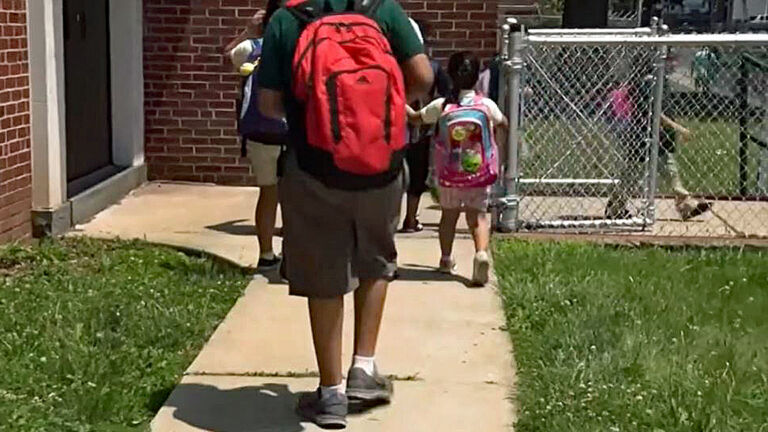
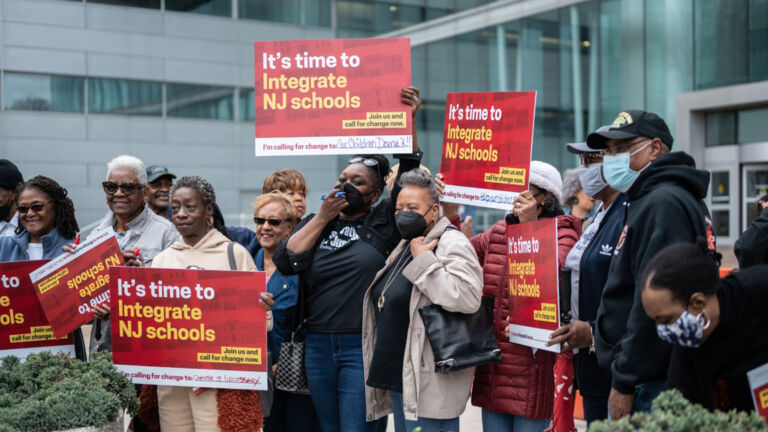
Most New Jersey voters are largely unaware that the state’s public schools are the sixth most segregated in the country for Black students, seventh for Latino — and that a pending lawsuit could upend all that.
Such were the findings of a Fairleigh Dickinson University Poll released on Wednesday that found just 20% of respondents were aware of the legal case challenging the system brought by the Latino Action Network and others, and 65% of voters said they’ve heard nothing about the case whatsoever.
The case is currently in court-appointed mediation to try to reach an agreement without court order.
According to the state Department of Education, New Jersey’s students are a very diverse mix of racial and ethnic backgrounds. But of the state’s 663 school districts, about 80 of them have enrollments that are 90% or more of Black or Latino students, accounting for close to the entire population of Black and Latino students in New Jersey.
“The harms are clear for students in segregated schools,” said Vandeen Campbell, associate director of Joseph C. Cornwall Center for Metro Studies at Rutgers University- Newark. “They are just simply not progressing at the same pace as students in mixed schools or in white isolated schools, on every measure — college enrollment, high school graduation in many cases, in test scores.
“They are just not having the same experiences and outcomes,” Campbell said. “And so what you see in the data is that, generation after generation, the students in these contexts are simply behind.”
Yet the FDU poll indicated this is not a primary concern of New Jersey’s voters, where 79% of respondents said their town reflects a “good mix” of racial backgrounds. Dan Cassino, the director of the poll, said it asked voters which solutions they’d support to help integrate schools, including controversial measures such as merging districts or busing students across town lines.
“The most acceptable one to New Jersey voters is regional magnet schools,” Cassino said. “The idea is that counties, or larger areas would set up magnet schools that would attract students from across districts, from anywhere in that county or area could come. And those schools would achieve a degree of racial integration
“Sixty percent of voters say that’s OK with them,” he said. “Why? Well, it doesn’t mean fundamentally reshaping the education system in New Jersey.”
Others said the state’s school systems are built on the idea of home rule. The Rev. Charles Boyer, executive director of Salvation and Social Justice, said he found the same pushback to merging in a survey of families in largely Black and Latino districts.
“They wanted desegregated resources, they wanted to desegregate how Black children in particular are treated in comparison to other groups, and the last piece, they wanted a curriculum that was inclusive of who they are and recognized them in their humanity,” Boyer said.
“So they very much wanted to be in the very schools they’re in, but they want their schools to have just as many resources, to have the quality of level of education,” he said.
Advocates like New Jersey’s Institute for Social Justice maintain the state can’t address segregation in schools without addressing it in its housing.
“All these issue are directly connected,” said Jean-Pierre Brutus, senior counsel of New Jersey Institute for Social Justice. “Issues of housing affordability, economic equality are related to issues of segregation. New Jersey has one of the largest racial wealth gaps, which is driven by significant racial home ownership gap.”
The deadline for any potential remedy — however it is reached — has been pushed back again, with the court extending the year-long mediation now to Jan. 15. An update is due this Friday.