
One street at a time, one day at a time — the work to end homelessness
Street outreach and ‘housing first’ seen as keys to putting people in homes and getting needed help
This is the fifth part in The Change Project series examining New Jersey’s social and economic challenges — and focusing on promising actions that have led to positive change.

It sounds almost simplistic: End homelessness by giving people homes.
But every day in New Jersey, teams of nonprofit leaders, volunteers, specialized social workers, hospital staff and public officials at all levels of government are doing just that.
Dedicated organizations are offering stays in overnight shelters. The state’s largest city has constructed housing units to move residents off the streets and begin their journey toward a permanent home. Other nonprofits are helping clients to schedule medical appointments and budget their finances to ensure they remain housed. And people who were once homeless are reaching back out to offer life-saving care to those still in the throes of addiction or living on the streets. Advocates are putting constant attention and resources toward an urgent issue that is often complex and multifaceted.
Potential for change
- Street outreach teams can help by building trust with people experiencing homelessness, which can prompt them to engage and receive housing and other services.
- The Rescue Mission of Trenton helped to get more than 150 people into housing in the last year.
- The Camden Coalition uses the housing first approach to identify people who are frequently hospitalized and experiencing chronic housing instability.
People are literally rising before dawn, taking to the streets and offering life’s basic necessities: food, clothing and shelter. They are also offering access to health care, including immediate appointments with doctors via telehealth and medication to help with recovery.
Jose Caraballo and Chalia Perry from the Rescue Mission of Trenton are doing just that for people struggling with addiction and living on the city’s streets or in abandoned buildings.
“If you see a light in them, it’s up to us to pull it out,” Perry said of her work.
Street outreach like the work done by the Rescue Mission of Trenton has proven to be a crucial part of addressing homelessness in New Jersey. It has also made an impact in cities throughout the country, including Chicago and Philadelphia.
The ‘housing first’ approach
In addition to direct street outreach, many advocates, nonprofit leaders, city officials and academics point to an approach to homelessness known as “housing first.” This prioritizes providing permanent housing to people who are homeless. Not only does that end their homelessness, but it also serves as a platform from which they can pursue personal goals and improve their quality of life, according to the Washington, D.C.-based National Alliance to End Homelessness.

The approach is guided by the belief that people need basic necessities including food and a place to live before attending to anything deemed less critical, such as getting a job, budgeting properly or attending to substance use issues, according to the National Alliance. Notably, it does not require people experiencing homelessness to address all their problems, including behavioral health issues, or to graduate through a series of service programs before they can attain housing.
Tag us using #ChangeProjectNJ on social media and stay tuned for live events.
The housing first approach is being used not only in New Jersey, but in many other cities in the U.S., including Houston. There, the Coalition for the Homeless, a local nonprofit, and its partners have helped to place more than 30,000 people into permanent housing programs since 2012, according to Kelly Young, the president and chief executive officer of the organization.
“For unhoused people with very high needs, housing first is the most effective approach for helping this particular population stay housed,” said Dr. Emmy Tiderington, an associate professor at Rutgers University School of Social Work.
Decades of research have proven this time and time again across Canada, the United States and other countries, said Tiderington.
More than shelter
The street outreach services distributed by Caraballo and Perry in Trenton are among the many offered by the nonprofit, which also include a shelter, behavioral health center, vocational development program to help people with all aspects of job readiness, supportive housing program and a food pantry.


“The beauty of the Rescue Mission has been [that] we always try to provide what our clients need,” said Barrett Young, the chief executive officer of the nonprofit.
Through the mission’s case management services, its own housing and links to other community partners, the nonprofit has been able to get over 150 people into housing in Mercer County within the past year, according to Young.
New Jersey data
Homelessness in New Jersey increased by 17% between 2022 and 2023, according to a 2023 summary of the state’s annual count of unhoused people. Some 10,267 people were homeless in the state on Jan. 24, 2023, the summary noted, of whom 1,966 people were chronically homeless. Chronic homelessness describes people who are homeless for at least a year — or repeatedly — while struggling with a disabling condition such as a serious mental illness, substance use disorder or physical disability, according to the National Alliance to End Homelessness.
Black residents were overrepresented in the state’s annual count, making up 12.3% of the total population but accounting for 47% of the homeless population.
While there are many causes of homelessness, some of the most common include the lack of affordable housing, the need to escape domestic violence, and long-standing structural racism, according to the National Alliance to End Homelessness. Additionally, an acute physical or behavioral health crisis or any long-term disabling condition may lead to homelessness.
Notably, in New Jersey, the leading cause of homelessness in 2023 was being “asked to leave a shared residence” while evictions were the second-most common cause, according to a report from the state Office of Homelessness Prevention.


Street outreach continues to be a critical piece of addressing and ending the crisis, nonprofit leaders say, as it aims to build trusting relationships between those providing support and people experiencing homelessness. Without that trust, the desperation that people feel can be “all the more painful,” according to Perry of the Rescue Mission of Trenton.
Street outreach
In Essex and Union counties, Bridges Outreach, Inc. aims to provide “robust” street outreach to connect people who are chronically homeless with case management services that can then help them move into permanent support housing, according to Richard Uniacke, the president of the nonprofit corporation.
In Newark, the nonprofit’s outreach and engagement team meets people on the streets, in parks and train stations 365 days of the year. In Union County, the team conducts outreach services five days a week. The team also makes referrals to shelters and provides transportation to them while distributing brown-bag lunches, clothing and hygiene kits.
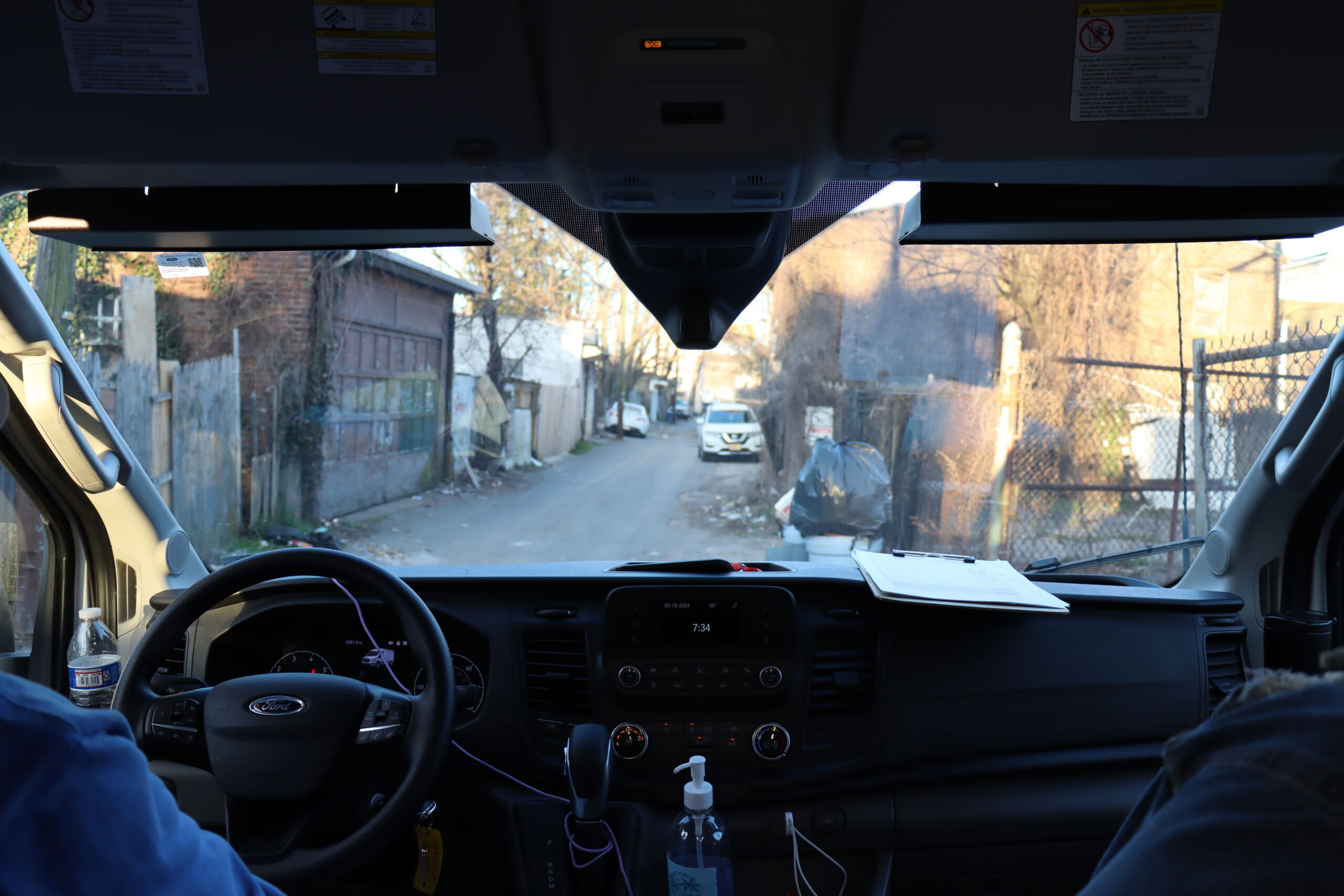
Searching for Gigi
A day in the working life of peer recovery specialists Jose Caraballo and Chalia Perry
Case managers at the nonprofit aim to pick up where the outreach specialists leave off by working with people coming off the streets and placing them in emergency housing to assess their health and social needs. The case managers also aim to identify the barriers to securing transitional or permanent housing while also helping with birth certificates, Social Security cards, Medicaid enrollment and rental assistance, among many other services.
“The goal is helping this person [to] not be sleeping in a place not meant for human habitation and to have their own home,” Uniacke said. “We just leverage everything we possibly can at our disposal.”
In 2023, the organization’s outreach workers offered support and services during 9,623 encounters with people experiencing homelessness in these two counties while helping to house nearly 500 people. Additionally, as of Oct. 31, 2023, the nonprofit contributed to a 23.4% reduction in unsheltered homelessness through street outreach, case management and housing placement.
Unsheltered homelessness refers to situations in which people are not regularly accessing shelters or transitional housing programs and instead often are sleeping in encampments or cars or at other locations “not meant for human habitation,” according to a 2021 California State University report.
The Philadelphia experience
The importance of building these relationships on the street can also be seen in Philadelphia, where Lydia Williams works as a certified registered nurse practitioner at Project HOME Health Services. Project HOME is a nonprofit organization that has worked for 35 years to end chronic street homelessness and alleviate poverty in the city and has built a national reputation as a model for that work. It offers permanent, subsidized housing for people and families who are homeless, adult education and employment programs, a federally qualified health center, and K-8 after-school and college access programs, among other services.
Today, Project HOME provides supportive services at 24 locations across Philadelphia and has developed 1,038 units of affordable and supportive housing for homeless people and for people who are of low income and at risk of becoming homeless. It has an additional 24 units under construction.
While Williams spends part of her week working from a clinic, she also does home visits and street outreach around the city, including in Kensington, a neighborhood long identified as the epicenter of the Philadelphia region’s opioid crisis. More than one-third of the city’s homeless people live in Kensington.
“It helps them to trust you more because they feel like they don’t have to do all of the work, and you are helping them to achieve their health goals,” added Williams, who is also a certified wound, ostomy and continence nurse.
Trailblazing in Camden
In South Jersey, the Camden Coalition is a multidisciplinary, community-based nonprofit that aims to improve care for people with complex health and social needs in the city, across the state and around the country.
It introduced the housing first model in South Jersey in 2015. Today, the coalition uses the housing first approach to identify people who are frequently hospitalized and experiencing chronic housing instability in Camden to provide them with safe, dignified housing and extensive support services so that they can improve their health and manage chronic conditions. People in the coalition’s housing first program have access to a clinical care team that consists of a community health worker, social worker, registered nurse, medical director, housing navigator and a medical-legal attorney, according to the coalition. The nonprofit’s housing first program is supported with Section 8 housing vouchers from the state Department of Community Affairs and a state budget allocation, as well as local and private funding, according to the coalition.
In previous years, the state budget allocation to the organization has been $500,000. The coalition said it is working to restore $250,000 that could potentially be cut under the upcoming state budget.
The group identifies people for the program using real-time data collected by the Camden Coalition Health Information Exchange from a wide range of sources, including regional hospitals, primary care providers and laboratory and radiology groups, as well as external referrals from partners.

One man’s journey out of homelessness
How a “housing first” approach helped Craig Cress get on the right track.
“We look at it every single day to understand who went to the hospital yesterday, so that we can know what are our opportunities to help somebody today,” Natasha Dravid, the senior director of care management and clinical redesign initiatives at the coalition, said of the health information exchange.
Since 2015, the Camden Coalition Housing First program has provided 90 people with housing and seen a 62% reduction in the use of inpatient services and emergency department visits, according to the coalition.
Newark’s villages
The housing first model is also being used in Newark, where Mayor Ras Baraka and the city have committed to the approach and have started by investing in housing for people who are homeless.
In March 2021, the city launched Newark Hope Village, a “no requirements-come-as-you-are” safe sleeping location where people can have access to shelter and supportive services, including assistance with a transition to permanent housing. The 90-day program uses converted shipping containers to shelter residents who are at risk of homelessness, according to a news release from the city.
Newark Hope Village is designed to attract people who have been disengaged from traditional shelters and homeless services. Additionally, the service model aims to transition chronically homeless people through targeted street outreach to the “village” to promote healthy living, among other supportive measures. Since the launch of the village, 53 people have received housing or stabilization services, according to Susan Garofalo, a spokesperson for the mayor’s office.

In January, Baraka and Luis Ulerio, the director of the mayor’s office of homeless services, opened a second Hope Village. Known as the “Come As You Are” Bridge Housing Community, it consists of 12 repurposed shipping containers grouped into clusters of residential units with dorm-style rooms, private showers and communal spaces for 20 chronically homeless residents of Newark.
This second site is also part of the city’s three-year plan, known as “The Path Home,” to end chronic homelessness in Newark. The plan was introduced in December 2022 and has reduced the city’s unsheltered homeless population by 57.6% within the span of a year, according to the January news release from the city.
More resources
NJ Department of Community Affairs, Office of Homelessness Prevention 2022 Annual Report and 2023 Homelessness Update
National Alliance to End Homelessness — Effective Street Outreach: From Unsheltered to Housed (January 2024)
Project HOME (Philadelphia) — Strategic Plan 2023-2025
Community Solutions — Learning Brief: Strengthening Homeless Outreach Through Medically Focused Care
“I really believe that when the mayor of the biggest city in New Jersey decides that under his administration they are going to end chronic homelessness, it opens a lot of doors,” said Uniacke of Bridges Outreach, whose organization works with the city of Newark to address chronic homelessness. “It changes everything. It creates a fertile environment for this kind of work to happen.”
In addition to cities’ efforts to end chronic homelessness, the state is aiming to reduce unsheltered homelessness by 25% statewide by 2025, according to the New Jersey Department of Community Affairs. The latest state budget proposal from Gov. Phil Murphy increased rates for emergency hotel and motel placements to help families in need of emergency housing, according to budget documents released earlier this year. It also includes $30 million to launch a two-year initiative to end veterans’ homelessness with services and interventions and a goal of placing over 1,000 homeless veterans into stable housing.
Through these collective efforts, city and state officials, nonprofit leaders and advocates say they are optimistic about ending chronic homelessness while addressing the immediate needs of people living on the streets.
“It’s up to us to help them recognize that everything is possible,” said Chalia Perry of the Rescue Mission of Trenton.
Cover photo: People receiving help at the Rescue Mission of Trenton’s outreach van (Madeline Ference/NJ Spotlight News)
More from NJ Spotlight News
About this project
The Change Project is a part of the Chasing the Dream multiplatform public media initiative from The WNET Group. We are reporting on challenges facing New Jersey in a variety of areas involving social justice and equity, as well as showcasing promising remedies. Our reporting focuses on inequality in many aspects of life, from birth through school to finding an affordable place to live. We are also focusing on what has worked elsewhere to make life better for people, and what lessons we can learn for the future.
Major funding for The Change Project and Chasing the Dream is provided by The JPB Foundation
Help us continue to report on important issues by supporting our work.
