
Searching for Gigi
A day in the working life of peer recovery specialists Jose Caraballo and Chalia Perry
This is part of The Change Project series examining New Jersey’s social and economic challenges — and focusing on promising actions that have led to positive change.

On a cold, Tuesday morning in late March, Jose Caraballo and Chalia Perry drove around Trenton looking for a woman named Gigi.
“I don’t know where she went, but we’re going to find her,” Perry said.
It was dark outside as the pair drove down one alley after another in the Wilbur section of the city. Perry hoped to talk to Gigi about why she was no longer staying at her mother’s house and if she had contacted Legacy Treatment Services for medication-assisted treatment, as she was in recovery from using cocaine and heroin.
Tag us using #ChangeProjectNJ on social media and stay tuned for live events.
“She says she only felt hope when she talked to me,” Perry said.
The search for Gigi served as the start of another morning for the pair of certified peer recovery specialists with the Rescue Mission of Trenton. Six days a week, the duo travels the streets and side alleys of the state capital in the Rescue Mission’s outreach van to distribute coffee and hygiene kits that include toothbrushes, toothpaste, tampons, deodorant, naloxone nasal spray — commonly known as Narcan — and other harm-reduction supplies, to people actively using drugs, living in abandoned buildings and experiencing homelessness.
Additionally, they provide referrals to mental health care through partnerships with Catholic Charities of the Diocese of Trenton, the Henry J. Austin Health Center and the Iron Recovery and Wellness Center, among other facilities, according to Perry. They can also link people to a telehealth provider right from the van.
It’s a job that has allowed Caraballo and Perry to assist people who are in a position that they were once in, as both peer recovery specialists have been homeless and are in recovery from substance use disorders.
“The lived experience is very important because I can connect with them on levels deeper than other individuals could,” said Perry. “Also, I notice when something’s wrong, quicker. I’ve been the person that hides things.”
Perry and Caraballo did not find Gigi that morning.
More than food and necessities
At dawn, Caraballo and Perry drove to another alley, also in the Wilbur section, to distribute food, coffee and clothing, including shirts and socks, to several people huddled in the early morning cold. Coffee, a 31-year-old mother of four who has lived most of her life in Trenton, was one of the people who received supplies. She has known Perry for several years, says that Perry “watched” her “grow up,” and affectionately calls Caraballo her husband.
“As far as needing a change of clothes or being hungry and … if you don’t have any supports or a family … it does come in handy,” Coffee said of the services offered by the Rescue Mission.
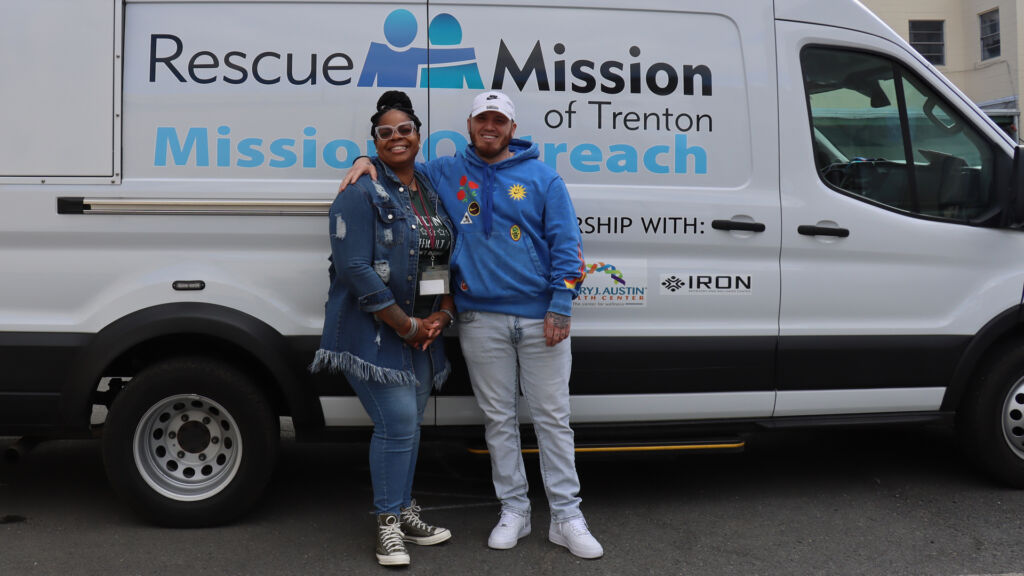
“I could be having a bad morning, [a] bad night and they come through and … give you hope,” Coffee said of the conversations she has with Caraballo and Perry.
As of late March, Coffee was living in an abandoned building in the city. She quit heroin “cold turkey” 12 years ago and was recently sober from cocaine and alcohol for a little over a month, before relapsing on cocaine when she was feeling lonely, she said. She has not spoken to her mother since she relapsed and has felt ashamed and guilty. But Coffee said she gets encouragement from Perry, who knows where she’s coming from.
Consistency is key
The consistent presence of the outreach workers in Trenton is a key piece in the nonprofit’s efforts to address chronic homelessness in the city. Through building relationships and trust with people who are homeless, Caraballo and Perry can then connect them with additional services, including mental health support, substance use treatment and referrals to the mission’s supportive housing, when they are ready to be connected.
It’s one strategy among several — including the “housing first” approach — used in New Jersey and throughout the country in attempts to end chronic homelessness.
Housing first prioritizes providing permanent housing to people who are homeless, thus giving them a “platform” from which they can pursue personal goals and improve their quality of life, according to the National Alliance to End Homelessness, a Washington, D.C.-based nonprofit. It does not require homeless people to address all their problems — including behavioral health issues or graduating through a series of service programs — before they can access housing.
Housing, just the first part
“Our experience at Bridges so far has been that if you remove all of the barriers, and you give a person permanent housing, and then you provide all of the services that they’ve needed all along, that is the greatest opportunity for success,” Richard Uniacke, the president at Bridges Outreach, Inc., said of the housing first approach.
The nonprofit corporation aims to tackle chronic homelessness in Essex and Union counties through street outreach, among other services, with the ultimate goal of getting and maintaining permanent housing for people. In 2023, Bridges’ outreach workers offered support and services during 9,623 encounters with people experiencing homelessness in these two counties while helping to house nearly 500 people, according to the nonprofit.
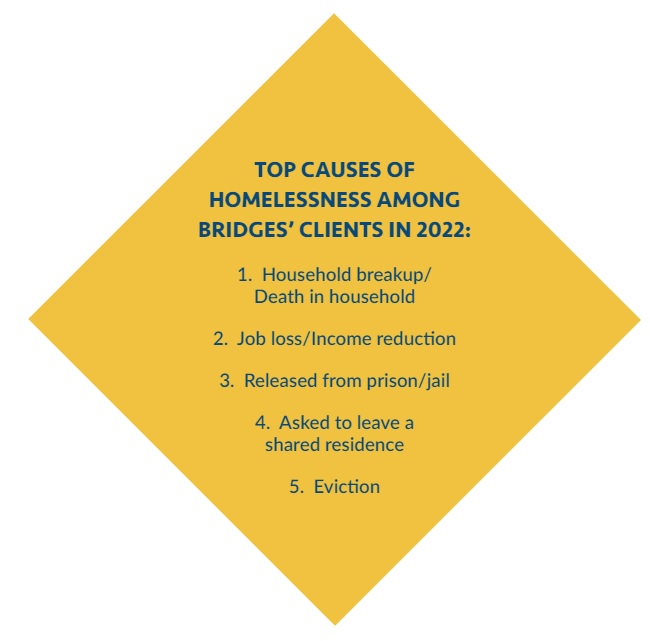
But while the housing first approach is touted by many — both in New Jersey and across the country — as the best method to end chronic homelessness, not everyone is fully on board with the model.
Connie Mercer of the New Jersey Coalition to End Homelessness echoes other long-time nonprofit leaders when she says that although the housing first model is a very important “tool to have in the toolbox” to address and end the chronic issue, it is a mistake to say that “one size fits all.”
“For many people, housing first … is the right way to go. No question. But for some folks, they’re not going to be able to maintain housing,” said Mercer, the chief executive officer of the Princeton-based nonprofit.
Getting people who are homeless into housing is only the first part of the job, she said. Helping them to thrive in and maintain that housing is the second part. The housing first model does not provide enough supports for some people to do that, she said.
Across the country, there is a shortage of 7.3 million rental homes affordable and available to renters with extremely low incomes.
And the reality in New Jersey is that there is not enough affordable housing — even for people who are working as teachers or firemen — never mind the “horrible lack” of affordable housing for people who are of very low income, she said.
“That’s where providing safe, quality shelters is an important piece of the mix,” Mercer said.
Across the country, there is a shortage of 7.3 million rental homes affordable and available to renters with extremely low incomes — that is, incomes at or below either the federal poverty guideline or 30% of their area median income, whichever is greater, according to the National Low Income Housing Coalition, a Washington, D.C.-based nonprofit.
In New Jersey, there are over 300,000 extremely low-income renter households, according to the nonprofit. In March, Gov. Phil Murphy signed into law legislation that aims to establish a “new, streamlined framework” for determining and enforcing municipalities’ affordable housing obligations under the New Jersey Supreme Court’s Mount Laurel doctrine and the state’s Fair Housing Act, according to the governor’s office.
‘A different kind of love’
Still, while the debate goes on about the most effective measures to address chronic homelessness, the work continues for Caraballo and Perry.
By mid-morning on that Tuesday in March, the pair had crisscrossed the city in their van and eventually parked in another alley in South Trenton. Here, they distributed more sandwiches, coffee and clothing and spoke with familiar faces and newcomers eager for services. After ending their outreach for the day, they headed back to the Rescue Mission to prepare for the next day.
“The most important part of this work is that I’m able to see individuals and know that I’m doing something for them,” said Perry. “When we pull up and hear somebody rhyming to us and all the nicknames they have for us, and them just happy to see us — that’s a different kind of love right there.”
The pair found Gigi the next day at a hotel off New York Avenue in East Trenton, according to Perry.
“If I’m her only hope, I need to at least act on it and stay consistent with her,” Perry said of her relationship with Gigi. “And let her know that it’s not over. It’s not over.”
Cover photo: The view through the windshield of the Rescue Mission of Trenton’s outreach van (Madeline Ference/NJ Spotlight News)
About this project
The Change Project is a part of the Chasing the Dream multiplatform public media initiative from The WNET Group. We are reporting on challenges facing New Jersey in a variety of areas involving social justice and equity, as well as showcasing promising remedies. Our reporting focuses on inequality in many aspects of life, from birth through school to finding an affordable place to live. We are also focusing on what has worked elsewhere to make life better for people, and what lessons we can learn for the future.
Major funding for The Change Project and Chasing the Dream is provided by The JPB Foundation
Help us continue to report on important issues by supporting our work.
