
Border Dispatches: The road to Chernihiv, by way of Whippany
Buses, planes, trains: The story of a special delivery to the Ukrainian military
The 1994 Opel Monterey we delivered to the Ukrainian military was an international project, a vehicle assembled in Germany with a GM chassis and Isuzu engine.
The heavy-duty SUV was well traveled, closing in on 150,000 miles, if the odometer was accurate because the speedometer and tachometer no longer work. It needed new brakes, to stop its unloaded 4,500-pound mass.
Still, in Ukraine’s war against Russia, the old muscleman is sturdy and reliable enough to be used by the military, so it was purchased and delivered by a coalition of volunteers in New Jersey, Poland and Ukraine. Somewhere along the line “the jeep,” as the Ukrainians called it, was registered in France.
The plan went haywire from the start. My direct flight from Newark to Warsaw was canceled
Before I left home in Morris County for the 48-hour trip to Ukraine, Dr. Roksolana Vaskul of the Ukrainian American Cultural Center in Whippany handed me an envelope with $2,000 to complete the $12,000 payment for the vehicle and a plan right out of a World War II espionage movie.
My train from Warsaw to Kyiv would stop in Rzeszów, Poland at 20:36 only long enough for passengers to board, and there I would be met by a contact to whom I would give the envelope. They would be holding a sign that said “Roksolana.”
‘Don’t lose my money’
Vaskul is a force of nature who has organized and shipped 15 shipping containers of essential medical and military supplies and goods for civilian relief from Whippany to Kyiv. This was the second purchase of a truck she funded and now, as her emissary, I was left with these blunt words of warning from her.
“Don’t lose my money, or I will find you.”
The plan went haywire from the start. My direct flight from Newark to Warsaw was canceled. But I scrambled and found a flight from Newark to Zurich, with fast connections to Vienna, then Kraków that, with any luck, would let me pick up the same train there.

By some miracle during this summer of interrupted air travel, I made both connections and got to the platform on time. And waited. And waited. The train came 40 minutes late, so I contacted Vaskul, who contacted her contact in Rzeszów, who contacted his wife to meet the train at the later time. I was sent her phone number and texted that I was in Car 11 of a 12-car train, wearing a very American outfit of blue jeans and a purple polo shirt. When the train finally pulled into Rzeszów, there she was, as planned.
The human atrocities and carpet destruction of the cities of Bucha and Irpin happened just off the road
The jeep came to Kyiv 10 days later and spent a day in the shop getting brakes. It was delivered to the secret supply warehouse where I work, and we loaded it until every square inch was filled and the shocks groaned.
A volunteer named Wasyl and I drove it to a drop-off point with soldiers in Chernihiv, a city 80 miles north of Kyiv and just 37 miles from the Russian border. Belarus, where Russia staged part of its initial invasion, is only 25 miles away.
The road from Kyiv to Chernihiv is E95, a straight line of highway the Russian army came down on Feb. 24 in their attempt to take Kyiv.
The marks of Russian scorched-earth tactics are seen all along the E95 road
The human atrocities and carpet destruction of the cities of Bucha and Irpin happened just off the road, as did the full leveling of a village called Moshchun I covered in a previous report.
The road now is a long scar of Russian scorched-earth tactics. They blew up most gas stations, and shelled small, rural villages with no strategic use.
Some Russian targets seem purposeful, others random
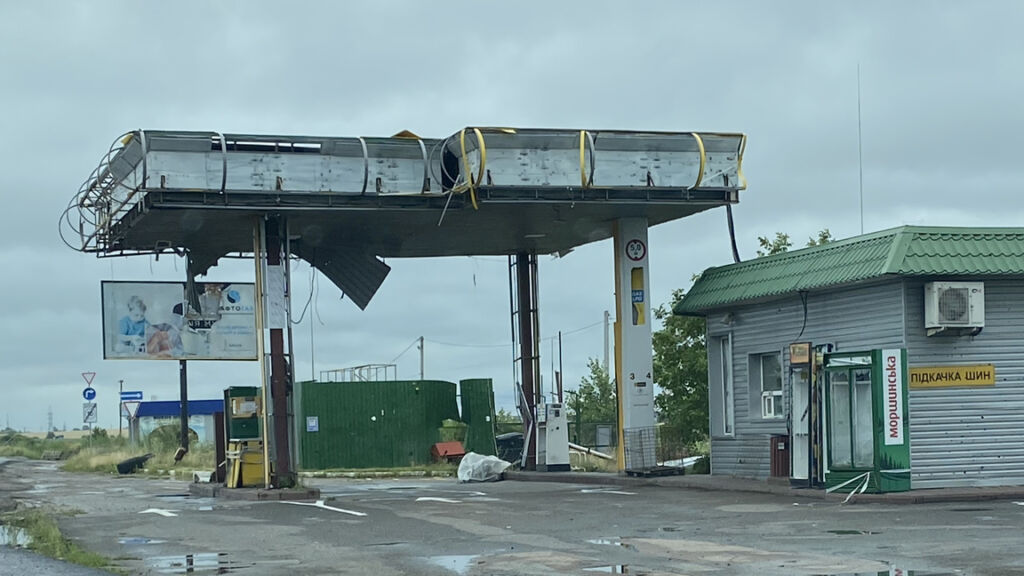
The forests of tall cedar trees are blackened and stand in contrast to endless lush acres of sunflowers, corn, and wheat, still being farmed. It is beautiful country, and Russia’s sin against the environment is second only to its brutal murder of civilians and fiery ravaging of their homes.
Some targets, like the gas stations, were purposeful. A Coca-Cola plant, shopping mall and other commercial buildings were hit, as were major bridges during the retreat a few weeks later. Others seem random, especially the small villages where cluster bombs hit every structure, while other little towns were left intact.
The route also shows evidence of Ukraine’s resistance. Burned Russian military vehicles litter the road, where residents now safely sell vegetables in roadside stands. There is a heavy Ukrainian military presence with checkpoints every few miles, where concrete barriers and sandbags create obstacles to slow vehicles before drivers and passengers are stopped for identity checks.
Burned Russian military equipment litters the road
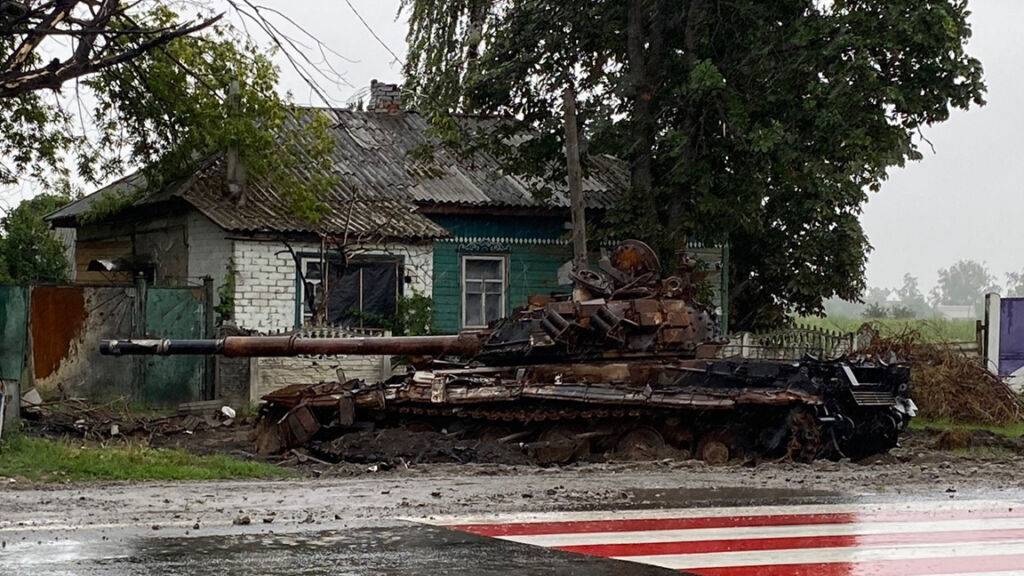
Much of the highway is intact, but there are bumpy parts and detours over temporary bridges. But some parts of the road melted or pitted by warfare are already repaved, new gas stations have opened, and some homes are repaired enough to be habitable.
After a three-hour drive, we met four soldiers at the drop-off point — a closed McDonald’s in the middle of the 10th century city.
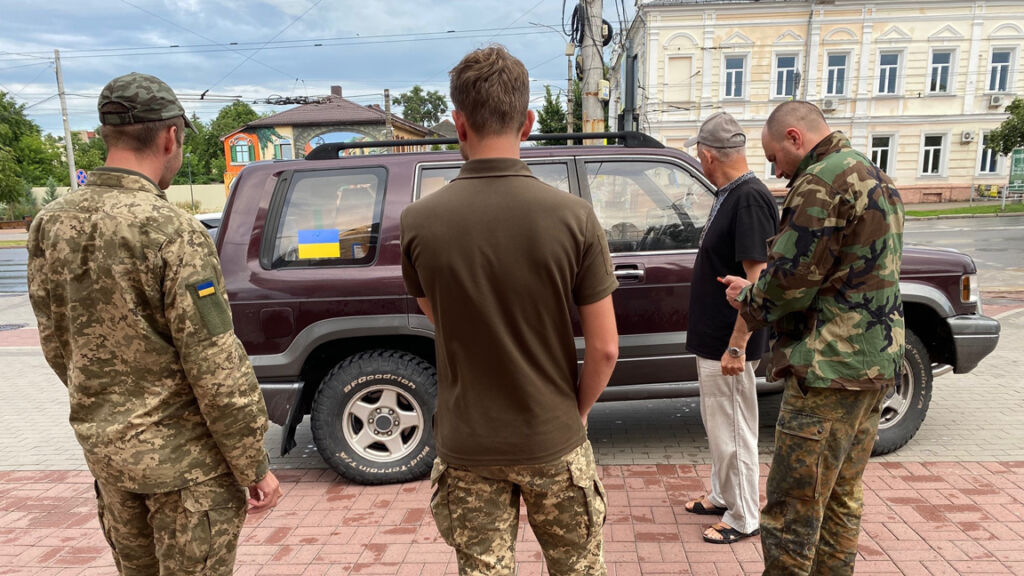
From there, we raced to make the last shuttle bus to Kyiv, with hopes of getting the last metro train on the far end of the line from downtown Kyiv before the 11 p.m. curfew. We didn’t make it, as soldiers boarded at every checkpoint for identification checks.
But it was gratifying that many saw my American passport and nodded in approval. Equally satisfying is that Uber here is up and running to get us home.
— All photographs courtesy of Mark Di Ionno