 Credit: (AP Photo/Richard Drew, File)

Editor’s note: This story has been updated to include comments received after initial publication.
WASHINGTON — Legislation on the move would limit members of Congress from trading stocks while in office, positions that grant them access to information regular citizens do not possess.
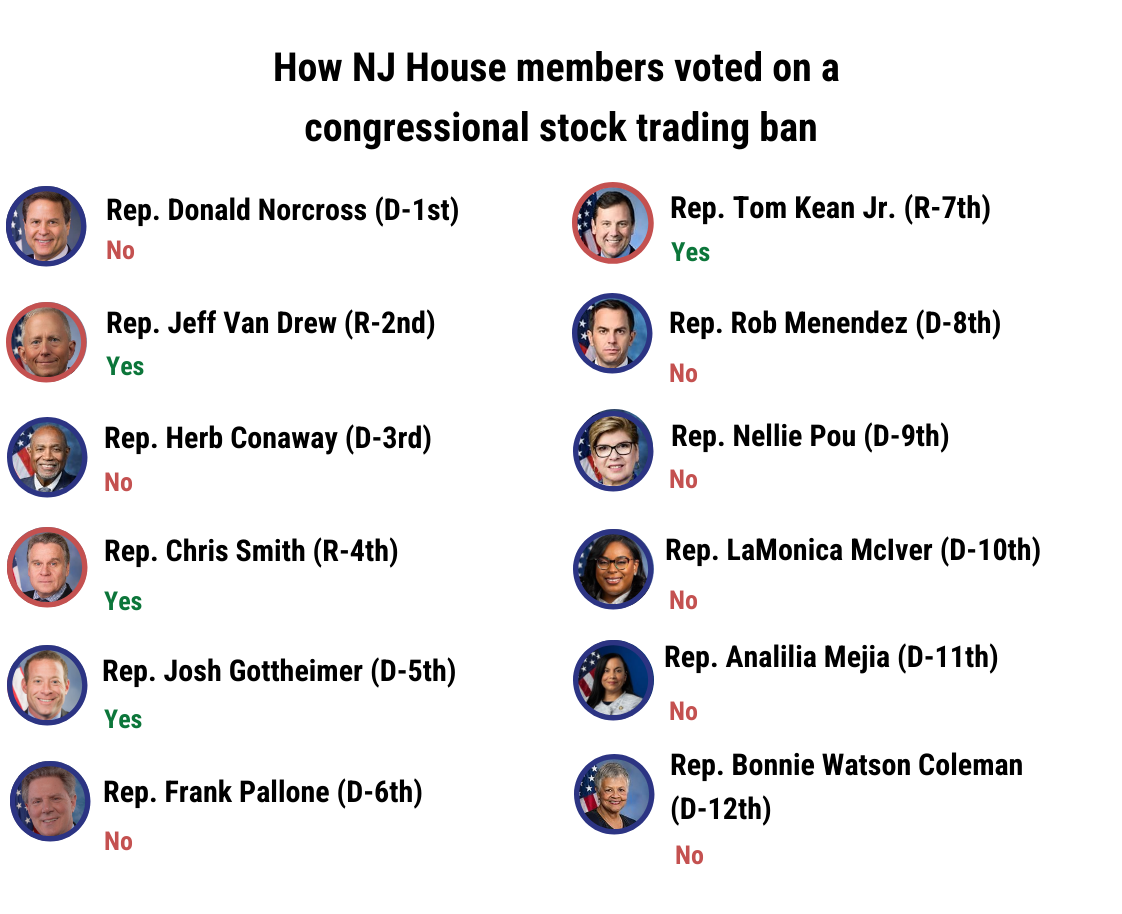
Before leaving for its summer recess, the House voted 232-198 for the bill, largely along party lines, passing it to the Senate. Four New Jersey lawmakers — Republicans Jeff Van Drew (R-2nd), Chris Smith (R-4th) and Tom Kean Jr., (R-7th) plus Democrat Josh Gottheimer (D-5th) — voted for the legislation while the remaining eight Democrats from New Jersey voted against it. Thirteen Democrats out of more than 200 voted in favor.
House Democrats who voted against the bill described it as a half measure, well short of a blanket ban many in their ranks support, and opposed it because it contained an unrelated voting provision.
That provision, known as a “rider,” would require voters to show identification at the polls when voting in federal elections. Republicans have been pressing to attach voter-identification language to myriad bills before Congress, a push that picked up speed in recent days following the voter registration errors in New Jersey Gov. Mikie Sherrill disclosed this month.
“This bill, quite simply, is a sham,” said Joe Morelle, a Democratic congressman from New York and an influential voice on congressional stock trading. “The so-called Stop Insider Trading Act actually allows members of Congress to own and trade stocks,” said Morelle, adding that the ID rider was a “poison pill.”
The bill leaves significant loopholes for members to potentially abuse. In particular, it bans members from buying stocks but not from selling them. And it stops short of an outright ban on owning stocks, a proposal that gained bipartisan steam in recent years.
The legislation also does not halt members of the executive branch and their family members, including President Trump and his adult children from trading — buying and selling stocks, bonds and other financial assets — while in office.
“Americans across the political spectrum overwhelmingly support stronger restrictions on congressional stock trading,” Eric Kashdan, director of federal advocacy at the Campaign Legal Center, a nonpartisan watchdog group, wrote in a letter to members.
“Congress must instead pursue stronger reforms that prohibit both the ownership and trading of individual stocks, as well as other assets that create conflicts between private interests and public responsibilities,” Kashdan said.
The legislative push marks the latest effort on Capitol Hill to tighten the legal rules of conduct that govern the financial activities of members of Congress, their spouses and their staffs.
Under a 2012 law, the STOCK Act, members are required to disclose financial transactions they execute that exceed $1,000 within 45 days — a deadline lawmakers routinely flout. Members file so-called “periodic transaction reports” and annual financial disclosure statements with the House clerk. These files are publicly available online.
Within the New Jersey congressional delegation, Kean and Gottheimer are the only active stock traders who regularly buy and sell in financial markets. After publication, a Gottheimer spokesman told NJ Spotlight News the congressman “turned over management of his retirement savings and investments to a third party, who has full investment discretion.”
“Throughout his time in Congress, decisions related to his managed investments have been made at the direction of that third party,” the spokesman said, adding that Gottheimer is waiting for a blind trust to cover his finances to receive congressional approval.
Gottheimer won election to his seat in 2016.
Stock trading was a campaign topic in Kean’s election races against former congressman Tom Malinowkski and challenger Sue Altman, who ran against the Republican incumbent in 2024.
Kean’s chief of staff did not respond to a request for comment. It is not clear who executes trades for Kean. His office did not respond to questions about trading strategy.
“This bill takes important steps, but we need to go even further,” Gottheimer said in a statement to NJ Spotlight News. “That’s why I’m an original sponsor of the Restore Trust in Congress Act and the TRUST in Congress Act, commonsense legislation to ban insider trading and ensure that government officials have no direct involvement in the buying or selling of their own investments.”
Those bills, which are unlikely to pass in this Republican-majority Congress, are more stringent measures than what the House passed. Similar efforts fizzled in previous congresses when Nancy Pelosi, a Democrat whose husband is a prolific investor, was speaker.
Current Speaker Mike Johnson, who controls what bills come to the House floor, called the bill a “very logical thing to do.”
“Republicans are actually delivering real solutions to actually restore the public’s faith in our institutions because we believe in this country,” Johnson told reporters after passage.
Neither current federal law, nor Senate or House rules prohibit members of Congress from owning or trading assets, and lawmakers do not have to divest or sell assets when they take office.
In his first and second terms, Trump refused to divest himself from his business empire — a subject Democrats are keen to target if they win the House majority in the next Congress.
“Not one branch should be exempt from appropriate ethics in this case,” Rep. Julie Johnson, a Texas Democrat, said at a November hearing in the House on the status of the 2012 law.
“Time and time again elected officials have broken the trust of American people by exploiting their position for personal gain,” said Terri Sewell, an Alabama Democrat on the House committee that has taken the lead on congressional stock trading.
“This was on full display,” said Sewell, “shortly after the COVID-19 pandemic when senators and representatives on both sides of the aisle used privileged information from briefings about the pandemic to trade securities.”
After Senate health and foreign relations committees held briefings in January 2020 on the pandemic — a public health crisis that had yet to envelop the world — a series of senators bought or sold assets related to public health or medicine.
That spring, the Senate Ethics Committee opened investigations into former Sen. Richard Burr of North Carolina, a Republican; former Sen. Kelly Loeffler of Georgia, a Republican; and the late Sen. Dianne Feinstein, a California Democrat.
All three senators reported gains after the pandemic briefings, and though the Department of Justice investigated, those probes were closed without punishment. Loeffler, a Republican mega-donor, is now the head of the Small Business Administration.
More recently, former Indiana Congressman Steven Buyer, a Republican, was arrested and charged with insider trading. He was convicted of securities fraud in March 2023 and sentenced to 22 months in prison.
On June 4, after a lobbying push from his former colleagues on Capitol Hill, including Rodney Frelinghuysen, a Republican lobbyist who until 2018 represented New Jersey’s 11th Congressional District, Trump pardoned Buyer.