Credit: (Benjamin Hulac/NJ Spotlight News)
WASHINGTON — Key pieces of a plan to reopen the federal government fell into place over the weekend, clearing a path to restore day-to-day funding for a wide range of critical programs, including the nation’s largest anti-hunger system.
Eight Democrats in the Senate split from their party and voted Sunday to advance a Republican bill to fund the government, reaching the 60 votes needed to end the debate and overcome any filibuster. Republicans, who hold a simple majority in the chamber, now will be able to pass the bill on their own in a vote expected as soon as Monday night. [Editor’s note: The Senate approved the measure 60-40.]
In addition to restoring benefit programs, the deal would reopen national parks and other federal facilities nationwide and restore pay for millions of federal employees, including about 20,000 in New Jersey, according to the latest available public figures.
New Jersey’s two senators, Cory Booker and Andy Kim, both Democrats, voted against the bill, saying Congress should instead pass legislation that lowers health insurance costs, the central argument Democrats have made throughout the ongoing shutdown, the longest in U.S. history.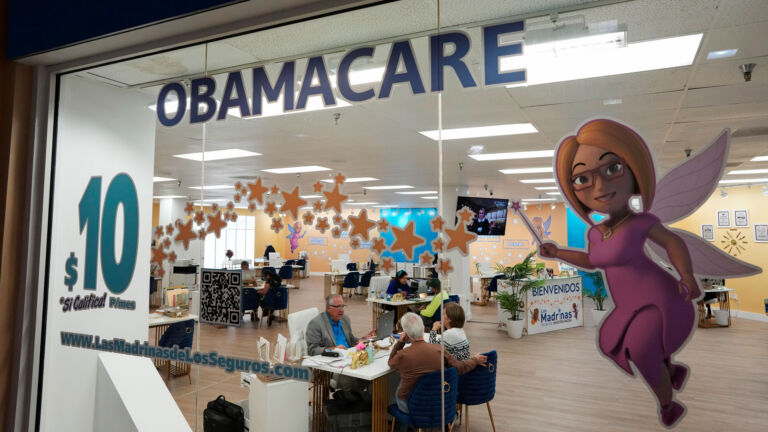
“I can’t support this bill,” Kim said. “It doesn’t meet the urgency of the moment and deliver actual relief that can pass both chambers of Congress.”
Booker said he could not “support a government funding bill that continues to raise our costs, jeopardizes our health care, and hurts the people of my state.”
New Jersey’s House Democrats, including U.S. Reps. Donald Norcross (D-1st) and Nellie Pou (D-9th), also denounced the deal and said they would oppose it on the House floor.
House passage and President Donald Trump’s signature – both likely — are expected later this week.
The Democrats’ primary demand in funding talks was an extension of the federal tax subsidies for the state-run health insurance markets created through the 2010 health insurance law known as Obamacare.
The idea of providing more federal help for those insurance markets had support from Democrats and some Republicans, including U.S. Reps. Jeff Van Drew (R-2nd) and Tom Kean Jr. (R-7th), who signed on to legislation to extend those subsidies for a year. Both Van Drew and Kean, along with Rep. Chris Smith, the third Republican who represents the state on Capitol Hill, are expected to vote for the bill.
Without a new federal law, higher health insurance premiums will increase sharply for the half a million New Jerseyans who have coverage through the 2010 law. Premiums for 2026 will rise 15.9% on average next year, according to the New Jersey Department of Banking and Insurance, without further action from Congress.
If Congress did extend those subsidies, premiums would still increase in New Jersey by 12.8% next year, state officials said.
In late October, Van Drew and Kean urged House Speaker Mike Johnson, a Louisiana Republican, to chart a “conservative path” to prevent the tax credits from running out.

Speaking on Fox Business on Sunday, Van Drew said Republicans would suffer politically in the 2026 midterm elections if they don’t address the issue of rising premiums.
“We need to deal with that now,” Van Drew said. “No. 1, it’s the right thing to do, just morally. And No. 2, we’re going to get killed.”
“We have to win the midterms,” Van Drew continued. “It’s going to be a hell of a hard thing to do, and if people are just struggling with their health care, it’s not going to help us.”
But Johnson did not relent and kept the House in recess for weeks during the shutdown. The chamber last voted Sept. 19.
On Monday in the wake of the Senate vote, Johnson called his members to return to Washington. “You need to begin right now returning to the Hill,” Johnson, the leader of the House, told members Monday when asked about when members would vote on the new deal.
Under the deal the bloc of Democrats negotiated with Republicans, with the White House’s approval, Democrats received little in return. As part of the deal, Republicans only agreed to hold a vote later this year on extending the 2010 subsidies in the Senate, something Senate leaders could ignore. And there were no commitments to a House vote at all. None of the eight Democrats who voted for the bill are up for reelection in 2026.
The legislation moving through the Senate is a short-term bill that will fund the government at current spending levels through Jan. 30. If it becomes law, the bill also provides funding for some federal agencies, including the departments of agriculture and veterans affairs. National parks and other federal facilities would also reopen.
Two federal programs under particular pressure — the Supplemental Nutrition Assistance Program (SNAP) and the Women, Infants, and Children (WIC) program — would also be funded under the deal, although the Trump administration has continued to try to block SNAP payments.
That chaotic pattern of funding during the shutdown has left food banks with limited resources and anxious families scrambling for their next meal.
Despite the funding deal, the Trump administration on Monday went to the U.S. Supreme Court to appeal a lower court ruling that required full SNAP benefits for November to be paid to recipients.
The U.S. Department of Agriculture administers the SNAP program, which helps feed about 42 million Americans and 850,000 people in New Jersey.
Short-term funding has also created problems for WIC, said Georgia Machell, president and CEO of the National WIC Association.

Machell said Monday that “operating WIC with the short-term funding patches we have seen since October 1 has taken a significant toll on WIC programs, including critical staff, whose own livelihoods have become uncertain.”
“Families across America deserve certainty,” Machell said. “Congress should finalize this bipartisan agreement without delay so WIC can remain a dependable support for pregnant people, parents, babies, and young children.”
When the Senate bill comes to the House in the coming days, Norcross said he would vote against the legislation because it doesn’t lower insurance premiums in his district.
“These are real families who will be forced to choose between putting food on the table and keeping their health coverage,” Norcross said Monday. “I will not sit by while our neighbors are squeezed to the breaking point.”
Pou, who represents a district Trump carried in 2024, said she was a “no” vote, too.
“Lowering high costs is the top priority of tens of millions of Americans and Congress should listen to them,” Pou said. “This funding package in the Senate will only make Americans angrier – and rightly so.”