Credit: (Benjamin Hulac/NJ Spotlight News)
WASHINGTON — Congress is split on moving to check President Donald Trump’s authority to start wars.
Trump is ordering lethal military strikes on what the administration says are suspected drug smugglers in the eastern Pacific Ocean and the Caribbean Sea and he is suggesting the prospect of attacking Venezuela.
Under Trump’s direction, the U.S. also launched air strikes with “bunker buster” bombs against an Iranian nuclear site in June.
The House of Representatives voted in September, 261-167, to attach a bipartisan amendment to defense legislation that would rescind two legal authorities presidential administrations of both parties have used to send U.S. forces into combat, including recent wars in Afghanistan and Iraq. Those authorizations, formally called “authorizations for military force”, or AUMFs, are decades old — one is from 1991, the other 2002.
On Thursday, the Senate voted 51-49 along party lines to prevent bringing a similar measure up for a vote. Legislation Democratic Senators, including Sen. Andy Kim (D-NJ), have pushed to rein in Trump’s war powers has stalled in the Senate.
“I share the sentiment that we need to reassert Congress’ authority when it comes to this,” Kim said in an interview with NJ Spotlight News, following the Iran bombings.
For decades, presidents of both political parties have used these authorities as legal foundations to send U.S. troops into battle, despite the fact the Constitution grants Congress alone the sole capacity to declare war.
The history behind AUMFs
Congress last voted to declare war in 1942, during World War II, the 11th time it has done so, according to the Senate Historical Office.
In the decades since, presidents and U.S. military leaders have initiated wars, spanning Vietnam in the 1970s, the Persian Gulf in the 1990s and wars after the terrorist attacks of Sept. 11, 2001, in Afghanistan and Iraq with authorizations.
Historically, authorizations, which Congress also votes on, have been narrower in their scope than formal war declarations.
On the campaign trail in 2016, Trump called the Iraq war begun under George W. Bush and deepened during the Obama administration a “big, fat mistake.”
“George Bush made a mistake. We can make mistakes. But that one was a beauty. We should have never been in Iraq,” Trump said during a 2016 presidential debate.
Once in office, Trump used the 2002 AUMF to expand military operations against the terrorist group ISIS in Syria and the wider Middle East, following a similar pattern from former President Barack Obama, who used the same authorization to pursue the militant group, often by drone strikes.
The Trump admin’s military operations in Latin America
The Pentagon has expanded its military firepower in recent weeks, targeting criminal groups operating in the drug trade in Latin America via 16 military strikes, as of Thursday.
Defense Secretary Pete Hegseth announced the latest strike Tuesday. “We will find and terminate EVERY vessel with the intention of trafficking drugs to America to poison our citizens,” Hegseth said in an online post.
Members of both political parties have pushed the Trump administration for details about legal justification of the strikes, since Congress has not authorized them.
Under a 1973 law, formally called the War Powers Resolution, a president who orders a U.S. military operation “shall terminate” within 60 days the use of armed forces in the scenario unless Congress has declared war or authorized the activity. The president is allowed to extend the period 30 days.
With a letter, Trump notified Congress of his military campaign in the Caribbean on Sept. 4, making the 60th and final day authorized this past Monday. In his letter, the president invoked the 1973 law.
When asked by NJ Spotlight News for the legal justification of these strikes, a DOJ official said, “These operations were ordered consistent with the law of armed conflict.” They did not specify a legal statute or law.
Department of Justice spokeswoman Natalie Baldassarre referred questions about briefing Congress to the White House.
White House spokeswoman Victoria LaCivita did not respond to a request for comment.
Before the U.S. struck Iran in June, the administration briefed Republican leaders on Capitol Hill but did not tell all high-ranking Democrats until after the attack.
The Gang of Eight
“If there’s an imminent attack, generally the Gang of Eight is briefed,” Rep. Josh Gottheimer (D-5th) said in an interview with NJ Spotlight News. “That’s why I have an issue here that the Gang of Eight wasn’t briefed.”
The Gang of Eight refers to the top leaders of both parties in the Senate and House, plus the highest-ranking Republicans and Democrats on both congressional intelligence committees.
As a member of the House intelligence committee, Gottheimer is briefed more frequently than the rest of Congress.
When he was a House member, Kim sponsored legislation to repeal the 2001 AUMF.
In June, it was unclear to Kim what legal authority Trump invoked to bomb Iran. “Under what authority is the president doing that?” Kim asked.
“I think what Trump did was a gift to humanity, especially the Israelis, but equally, over time, other middle eastern countries and us,” — Rep. Chris Smith
In an interview with NJ Spotlight News, Rep. Chris Smith (R-4th) said the president’s decision to strike Iran was wise, calling the country’s missile program a serious threat.
“I think what Trump did was a gift to humanity, especially the Israelis, but equally, over time, other middle eastern countries and us,” Smith said.
“As they develop an ICBM capability, they would use it,” Smith said, using the shorthand for an intercontinental ballistic missile, a long-range weapon. “I think they’d use it in Tel Aviv and other places.”
“You have to look at what the threat is. It’s existential and real,” Smith said. “First to Israel, but also to us.”
The amendment that cleared the House is part of a broader annual bill Congress must pass to approve Pentagon operations. Lawmakers are expected to take it up once they can reach a deal to fund the government, currently in the midst of the longest shutdown in U.S. history.
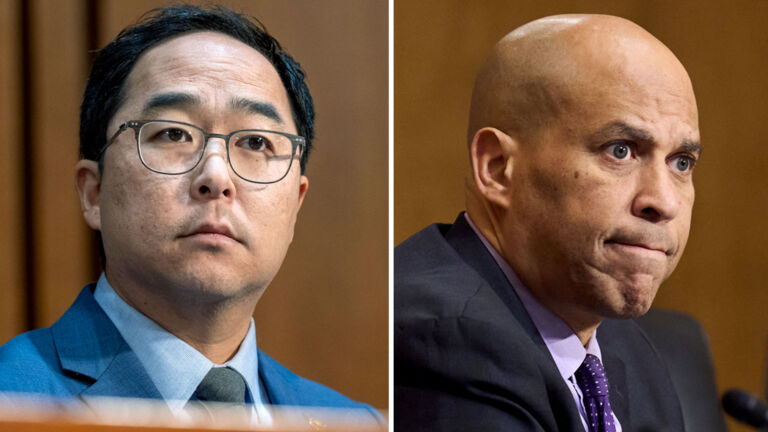
New Jersey’s congressional delegation voted on the amendment along party lines, with Democrats voting to repeal the authorities and Republicans voting to maintain them.
One resolution (S. J. Res. 59) to block the U.S. from engaging in hostilities with Iran was voted down by the Senate in June, 47-53, with Kim and Sen. Cory Booker (D-NJ) voting yes.
A separate resolution (S. J. Res. 83), to pull U.S. forces back from hostilities that Congress had not approved, fell short in the Senate, 48-51, in an October vote. Kim and Booker voted for it.
As of Thursday night, a third resolution (S. J. Res. 90) to halt unauthorized military action against Venezuela has not been discharged to the Senate floor, though a vote was scheduled for the evening. Kim signed on as a sponsor of that measure on Wednesday.
In mid-October, Trump said publicly that his administration is considering military strikes against Venezuelan territory and that he had authorized covert action by CIA operatives against the country, an extraordinary admission.
The Trump administration has been open about its desire to push Nicolás Maduro, Venezuela’s authoritarian head, from power.
“We are certainly looking at land now, because we’ve got the sea very well under control,” Trump told reporters.