Credit: (Office of NJ Attorney General)
New Jersey’s attorney general once again released body-cam video from a deadly police shooting involving a person in a mental health crisis.
The videos, made public Wednesday, are from the Aug. 8 death of Deborah Terrell, a New Brunswick woman who was killed by police responding to her apartment.
The entire incident is shown in graphic detail on the police body-camera footage and in audio recordings of the 911 calls released by the attorney general’s office.
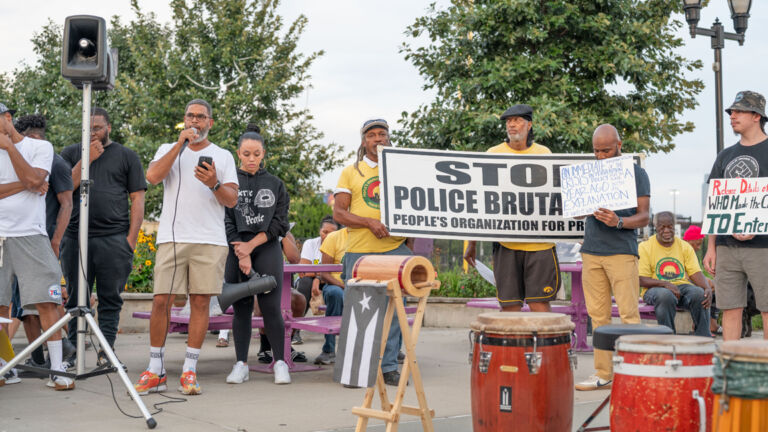
The police killing of Terrell has renewed calls in recent weeks from New Brunswick residents, family members of Terrell and social justice advocates about how to hold officers accountable when mental health emergencies become deadly encounters.
“Just watching the video, you can tell that there was some understanding on behalf of the officers that, OK, maybe this is a mental health crisis, maybe we need to handle this with care,” said Jason Williams, a professor of justice studies at Montclair State University.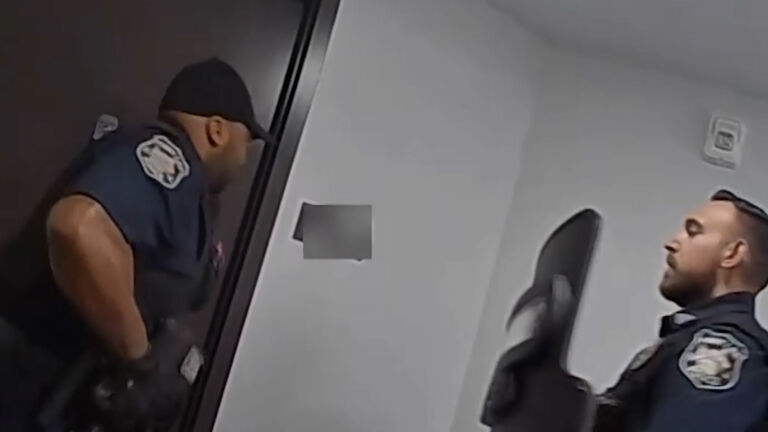
“But ultimately, in the end, they still shot and killed her. And so it really shows just how unprepared law enforcement is when it comes to taking on calls that involve people in some type of mental health crisis,” Williams said.
The attorney general’s office is investigating Terrell’s death, as it does all police incidents where someone dies.
“The investigation is ongoing and no further information is being released at this time,” the attorney general’s office said in a statement on Wednesday. The identities of the police officers involved are also not being released at this time, due to threats being made against them, the attorney general’s office said.
Edited version of body-camera video before Deborah Terrell was fatally shot
What the videos show
At 4 a.m. on Aug. 8, officers from the New Brunswick Police Department went to Terrell’s apartment building on Neilson Street after a 911 call reporting that a resident “was disturbing other residents” in the building, according to the attorney general’s office. Terrell refused to speak with police officers or open her apartment door at that time.
Later that morning, at around 7:38 a.m., officers can be seen on body-camera footage arriving to the apartment building after another 911 call reporting that Terrell was “repeatedly going in and out of her apartment and threatening other tenants with a knife,” according to the attorney general’s office. In response to this second 911 call, a dispatch service contacted emergency medical services and requested that EMTs be outside the building for a potential evaluation of Terrell.
At 7:41 a.m., five New Brunswick police officers can be seen outside Terrell’s apartment and one knocks on the door. Terrell opens the door with a knife in her hand. Officers tell Terrell to drop the knife. Terrell shuts the door and moves the knife back and forth underneath the bottom of the door. Officers ask her to open the door again and talk to them.
While speaking with officers through the door, Terrell mentions that there is a man inside the apartment with her, and an officer can be heard asking if the man can come to the door and speak with them.
Officers gather at one side of the apartment door and discuss who would use ‘lethal’ and ‘less lethal’ force.
Police officers continue to knock on Terrell’s door and try to speak with her. Terrell eventually opens the door and points the knife at officers before shutting the door again, and moving the knife back and forth underneath the door a third time. An officer can be heard saying they “want to talk” with Terrell.
Officers then gather at one side of the apartment door and discuss who would use “lethal” and “less lethal” force. Shortly after that, Terrell opens the door with a knife in her hand. She steps out of her apartment and one officer uses pepper spray while another officer uses a Taser. The officer who used pepper spray then fires his gun twice, hitting Terrell. Officers tell Terrell to “stay down” after she is shot.
Terrell was taken to Robert Wood Johnson University Hospital in New Brunswick, according to the attorney general’s office, where she died.
Other fatal police encounters
The shooting of Terrell is the latest in a number of killings by New Jersey police officers in recent years of people in mental health crises.
In July, a state grand jury did not return criminal charges against a Fort Lee police officer who shot and killed Victoria G. Lee while she was experiencing a mental health crisis in July 2024.
In April, a state grand jury voted not to file criminal charges against a Jersey City police officer who shot and killed Andrew Washington while he was experiencing a mental health crisis in August 2023.
‘The legislative body actually has to do something about this. They have to stop hiding behind the AG’s office and hiding behind rhetoric and hoping that time going by somehow rectifies this issue.’ — Jason Williams, justice studies professor, Montclair State University
And in March, a state grand jury declined to criminally charge the police officers involved in the fatal shooting of Najee Seabrooks of Paterson while he was experiencing a mental health crisis in March 2023.
A 2019 law requires the state attorney general’s office to investigate deaths that happen during an encounter with a police officer or while a person is in custody. The law also requires these investigations to be presented to a grand jury to determine if the evidence supports an indictment against the officers involved.
A recent NJ Spotlight News analysis of hundreds of press releases since the law took effect found that the officers involved in more than 100 incidents in which a person died or was shot and seriously wounded by police are rarely indicted by a grand jury. Just three cases resulted in indictments since Jan. 30, 2019, and one of those was later thrown out by a judge.
The Seabrooks-Washington Community-Led Crisis Response Act increased state funding to nonprofits that provide de-escalation and follow-up support in nonviolent behavioral health and substance use emergencies, but advocates are dissatisfied with the implementation of the legislation. A bill that would require the attorney general to review, and potentially revise, the policy that dictates when police officers can use deadly force is pending in the Legislature. The legislation was prompted by Lee’s killing, according to Assemblywoman Ellen J. Park (D-Bergen), a primary sponsor of the bill.
A call to lawmakers
Another bill, which would allow municipalities and counties to create civilian review boards to review police operations and conduct, was introduced last year and has yet to be voted on in either the Senate or the Assembly.
Williams of Montclair State said the killing in New Brunswick is “embarrassing for our state” and shows the limits of the attorney general’s power in trying to rein in excessive use of force by police officers.
“The legislative body actually has to do something about this. They have to stop hiding behind the AG’s office and hiding behind rhetoric and hoping that time going by somehow rectifies this issue,” said Williams.
“Because now this is probably the third or fourth high-profile shooting of a person that was undergoing mental distress.”