 Credit: (AP Photo/Matt Slocum)
Despite concerns about a shifting national economic landscape, New Jersey appears to be heading into the final stretch of summer with at least some momentum.
For starters, total employment in New Jersey grew by 7,500 last month, despite a loss of 5,600 private-sector jobs, according to the latest jobs report released by the state Department of Labor and Workforce Development.
That net positive monthly jobs snapshot followed two consecutive months of employment losses in New Jersey that totaled nearly 17,000 jobs, counting revisions released by state officials last week.
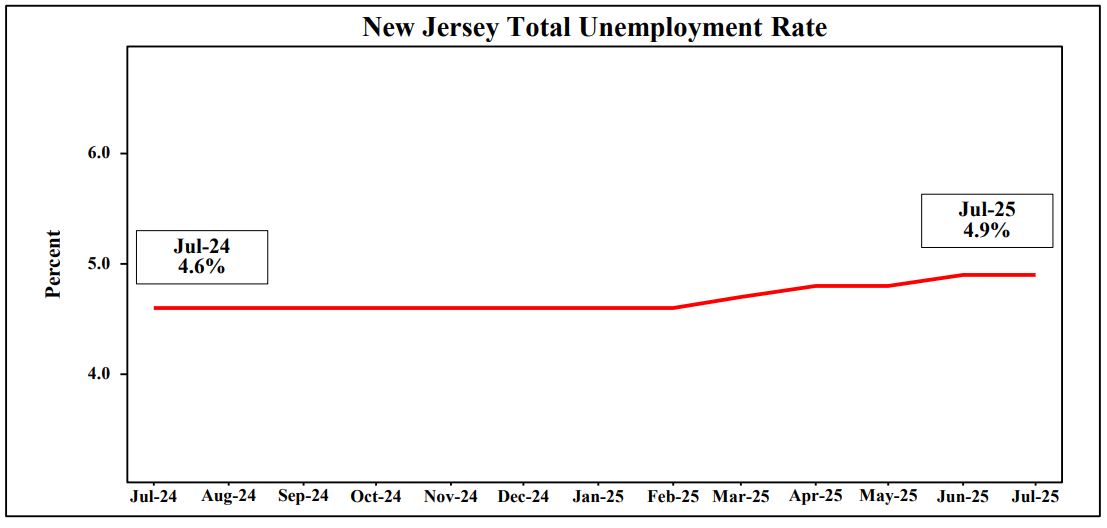
Amid the apparent growth, New Jersey’s unemployment rate last month remained unchanged at 4.9%, according to the latest estimates produced by the federal Bureau of Labor Statistics.
 Meanwhile, total state tax collections also ticked up in July compared to the same month last year, according to a report released last week by the New Jersey Department of the Treasury.
More from income tax
The income tax, which is a primary source of revenue for state government’s annual budget, was among the top performers.
Treasury officials said a 10% year-over-year increase in monthly income tax receipts recorded in July was due, in part, to “higher collections from employer withholding and final payments.”
Monthly revenue from the sales tax, another major source of funding for the state budget, was up more than 2.5% year over year in July, according to Treasury.
At the same time, overall state tax collections also appear to be getting an initial boost from a series of tax hikes that were enacted earlier this summer by Gov. Phil Murphy and fellow Democrats who control the Legislature.
The tax hikes hitting online gambling and mobile sports betting, cigarette sales and high-dollar real estate transactions, among other items, are expected to increase state tax collections by a combined more than $600 million through the end of June 2026, according to Treasury.
Trump’s tariffs
However, the latest economic indicators for New Jersey do show some areas of potential concern as President Donald Trump continues to pursue significant policy changes at the federal level.
 Credit: (AP Photo/Ted Shaffrey)
These include an aggressive foreign tariff agenda that is rekindling concerns about inflation and a widespread crackdown on immigrants living and working illegally in the U.S. that threatens to harm overall economic growth.
Leading the way when it comes to job losses recorded in the private sector in New Jersey last month was the construction industry, which shed 1,600 jobs, according to the federal data.
Income tax collections for the 13-month period ending in July were up by more than 10% year over year, according to Treasury.
Construction is one of the sectors that economists have warned could be hurt by the aggressive immigration policies ordered by the Republican Trump; construction industry job losses in New Jersey now total 8,000 over the last year, according to the jobs data.
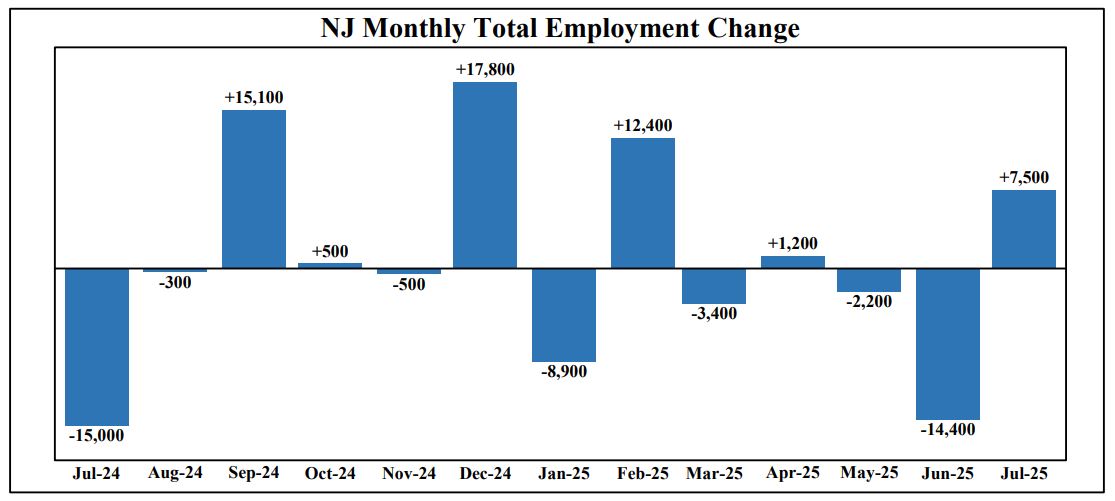
Across all industries, New Jersey has gained 32,000 private-sector jobs over the 12 months ending in July, while shedding more than 7,000 public-sector jobs, resulting in a net gain of 24,800.
NJ unemployment
The state unemployment rate has also risen over the last year, from 4.6% in July 2024 to 4.9% in July 2025. At the national level, the unemployment rate was 4.2% in July, according to the latest BLS data.
A long-range economic forecast issued last month by Rutgers University’s New Jersey State Policy Lab pointed to the fluctuations seen in the state’s monthly jobs data this year and predicted “continued softness in employment growth through 2027.”
“The state’s unemployment rate, averaging 4.7% in 2025, remains elevated and is projected to rise gradually to around 5.2% through 2026 and 2027 before stabilizing around 4.5% in the longer term,” according to the experts from Rutgers.
The fiscal year 2026 budget enacted by Murphy and lawmakers in late June calls for overall revenues to grow by more than 3% year over year, to $57.3 billion, according to budget documents.
The revenue report released by Treasury last week showed total tax collections over the last 13 months in New Jersey were up about 6% year over year. Treasury officials said that was largely in line with expectations.
What about corporation business tax?
The state looks at revenue collections over a 13-month period through the end of July because cash collections during the month of July can include revenues attributed to both fiscal year 2025, which ended June 30, and fiscal year 2026, which began July 1.
Income tax collections for the 13-month period ending in July were up by more than 10% year over year, according to Treasury.
The income tax is the largest single source of revenue for the annual budget, with proceeds constitutionally dedicated to funding items that include K-12 public-school aid and direct property-tax relief programs like Anchor and Senior Freeze.
Revenue from the sales tax, which goes into the state budget’s general fund, was up 3% for the 13-month period ending in July.
However, collections from another major source of state revenue — the corporation business tax — were off by more than 20% during July compared to the same month last year, according to Treasury’s monthly revenue data.
That year-over-year decline in the monthly CBT collections came because of refunds exceeding growth in estimated payments, Treasury officials said. For the 13-month period ending in July, the CBT collections were essentially flat.