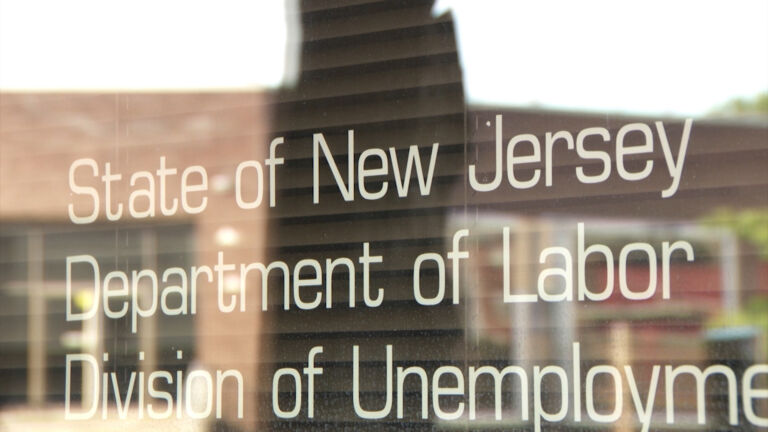
Credit: (AP Photo/Mark Schiefelbein)
The latest monthly jobs report released by New Jersey’s Department of Labor and Workforce Development showed the state unemployment rate ticked up to 4.9% in June, coinciding with a loss of nearly 10,000 jobs.
The same report, based on federal jobs data, announced a revision to the prior month’s employment estimate, reflecting a further loss of jobs in New Jersey from April to May compared to what was originally reported.
Buried in these monthly reports are technical notes that explain how the jobs data is collected — and why such revisions are commonplace as part of the ongoing quest to get an accurate view of the current job market.
The collection and dissemination of such data by the federal government has occurred for decades in the U.S., according to the federal Bureau of Labor Statistics, using estimates derived from both household and employer surveys.
The resulting reports are often used by government officials at the national and state levels as they craft and enact the latest economic policies. A good example in recent years has been the ongoing efforts by the Federal Reserve to tame inflation through the adjusting of interest rates. These efforts — which have influenced borrowing rates for consumers seeking to buy things like homes and new cars — have been informed, in part, by the federal jobs data, according to Fed Chair Jerome Powell.
Trump intervenes
However, the jobs reports themselves are often easy targets for politicians, including those who may be feeling the heat whenever a new monthly report’s initial snapshot gives reason to believe the economy is slumping.
Last week President Donald Trump publicly criticized the July jobs report, which indicated both an increase in the nation’s unemployment rate and a major downward revision of prior monthly jobs totals.
The monthly estimates are revised, including the state level reports, on a regular basis if more survey data comes in to provide a more complete picture of the job market.
Trump, a Republican who has launched aggressive trade and immigration policies since taking office in January, then said he dismissed the head of the Bureau of Labor Statistics, Erika McEntarfer, in response to that report. He also claimed, with no evidence, the latest survey results were altered for political reasons.
Before Trump fired McEntarfer from her role as commissioner of the Bureau of Labor Statistics, she had worked for the federal government for decades across Republican and Democratic administrations.
Without fanfare, the Senate confirmed her in January 2024, by an 86-6 vote, to head the BLS, with broad support from senators of both political parties. Trump said Sunday he would announce a replacement, who will need Senate confirmation, within a few days.
How the data is collected
In a pending budget proposal to Congress, the Trump administration requested about $650 million for the bureau. That money will pay for more than 1,800 jobs, but it represents a cut that would reduce the agency’s budget to its lowest since the 2020 budget cycle.
However, Congress writes and passes the federal budget, not the president, and even though Republicans hold majorities in both the House and the Senate, some senior Republican lawmakers have quietly pushed back against proposed spending cuts.
To fund the government, Republicans in the Senate will also need votes from Democrats, who have leverage to protect federal agencies, such as the BLS, from cuts.
The Senate requires 60 votes on most legislation, including appropriations bills, and Republicans have 53 senators.
The next report on the employment picture in New Jersey, reflecting July’s preliminary monthly estimates, will be released on Aug. 14, state officials said.
According to the BLS, the national unemployment rate is determined using data collected regularly by the U.S. Census Bureau, which itself contacts more than 100,000 individuals in households across the country each month to check on their employment status.
All Census Bureau interviewers must follow the same procedures to determine whether respondents are employed, meaning they currently have a job, or are unemployed, which is defined as someone who is available and looking for work, but doesn’t currently have a job.
The BLS also surveys employers monthly to collect more data, including the total number of people currently on respective payrolls. The agency regularly reaches out to more than 120,000 businesses and government agencies across the nation that, in turn, represent approximately 631,000 different worksites, according to the BLS.
The monthly estimates are revised, including the state level reports, on a regular basis if more survey data comes in to provide a more complete picture of the job market.
Revising the numbers
To be sure, monthly jobs reports and the routine payroll revisions often generate significant media coverage. But economists generally caution against overreacting to a single month’s worth of jobs data, and to instead evaluate longer-term trends.
And while the reports themselves are derived solely from data that federal agencies regularly collect and analyze, the release of new estimates often becomes fodder for politicians at all levels seeking to justify their own policy decisions, or to criticize those of others.
For example, when New Jersey’s unemployment rate dipped by two full percentage points between January 2015 and January 2016, then-Gov. Chris Christie claimed during a news conference that the policies he enacted at the state level at the time were helping foster the improving job market.
However, as the job losses in New Jersey have begun to add up in recent months this year, it’s U.S. Rep. and Democratic gubernatorial candidate Mikie Sherrill who has taken to social media to point the finger at Trump, not incumbent Democratic Gov. Phil Murphy.
The next report on the employment picture in New Jersey, reflecting July’s preliminary monthly estimates, will be released on Aug. 14, state officials said.
— Benjamin J. Hulac contributed reporting.