Credit: (AP Photo/Matt Rourke, File)
 From affordability to sustainability to opportunity, Gov. Phil Murphy has cast his final state budget as a spending plan that gives New Jersey a “brighter future” as he readies to leave office early next year.
Murphy, a term-limited Democrat, has emphasized to the public increased funding for direct tax-relief programs and K-12 public school aid as major advancements, along with the setting aside of an estimated $6.7 billion surplus that will be inherited by his successor in 2026, if all goes according to plan.
A planned $7.2 billion pension contribution this fiscal year, which includes tax dollars and revenue from the New Jersey Lottery, means public-worker pension funds have been bolstered by nearly $50 billion in contributions during Murphy’s tenure, which began in early 2018.
“I’m proud that this budget caps off an eight-year journey to turn our state around and delivers greater economic security and opportunity to every family,” Murphy said in a statement released by his office last week after he formally enacted the fiscal year 2026 budget.
Republicans disparage
However, others paint a far different portrait of the budget’s overall impact on a state with many residents struggling to manage major concerns like housing and mass-transit affordability, even as total state spending by New Jersey has now risen to a record-high, nearly $60 billion.
And the surplus being left to the next governor could have been even bigger, Murphy’s critics note, if Murphy and majority Democrats who control the Legislature weren’t planning to spend nearly $1.5 billion more than the administration estimates will be collected from taxes and other revenue sources over the next 12 months.
’There’s no accountability, no planning, and absolutely no transparency, just last-minute deals and political favors pushed through in the dead of night when no one is looking.’ — Senate Republican Leader Anthony Bucco (R-Morris)
At the same time, Murphy and legislative Democrats diverted funding from accounts that are supposed to be dedicated to a specific purpose, such as the state’s debt defeasance and prevention reserve, to help balance the fiscal year 2026 budget and remain in compliance with the state Constitution.
“Last year, I said that the budget was a house of cards, built on a fault line, with an approaching windstorm,” said Sen. Declan O’Scanlon (R-Monmouth). “The next governor, and all of us, can feel the breezes picking up, and the early warning tremors.”
“The amount of money and time and opportunity that this administration has blown through is tragic, and unconscionable,” O’Scanlon said.
Higher taxes, more spending
To be sure, Murphy’s two-term tenure has been marked by a series of spending hikes backed, in turn, by increased taxes.
The latest tax increases, which include higher levies for online gambling and online sports betting, sales of cigarettes and liquid nicotine, and high-dollar property transactions, were signed into law by Murphy just prior to July 1.
Meanwhile, New Jersey Transit fares also went up by 3% on July 1, an increase that came just a year after a 15% fare hike went into effect across the board. The state’s gas tax and highway tolls have also been on the rise, with new increases already in the offing.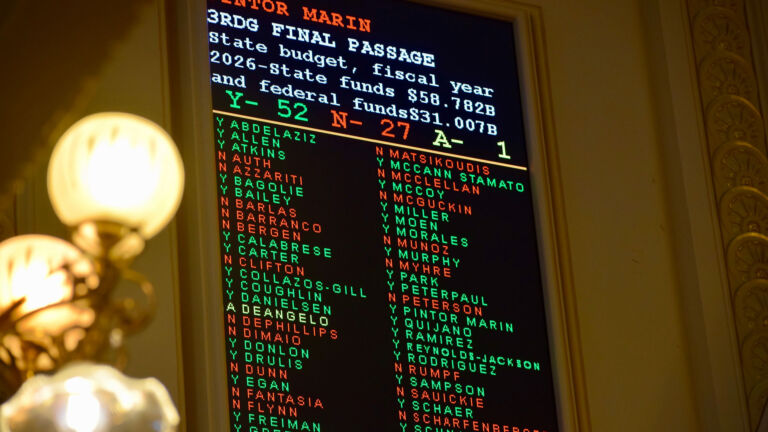
Not surprisingly, the issue of taxes was the top concern for New Jersey residents in a survey released last month by the Rutgers-Eagleton Poll. And nearly half of the residents surveyed by Rutgers-Eagleton said the state is headed in the wrong direction, compared to 39% who said things were going in the right direction.
With these and other affordability concerns in mind, Murphy and majority Democratic legislative leaders have highlighted some $600 million set aside in the new budget to fund enhanced “Stay NJ” tax-relief benefits for senior homeowners making up to $500,000 annually.
Assembly elections
This new tax-relief sweetener is being readied just as Democrats are getting ready to ask voters to keep them in control of the 80-member Assembly in this fall’s legislative election.
Democrats have controlled both the Assembly and Senate for over two decades, and this year, they are also hoping to see a member of their party elected to succeed Murphy, who cannot run for reelection due to the Constitution’s term limits.
Murphy has emphasized to the public increased funding for direct tax-relief programs and K-12 public school aid as major advancements, along with the setting aside of an estimated $6.7 billion surplus that will be inherited by his successor in 2026, if all goes according to plan.
In his statement about the new budget, Assembly Speaker Craig Coughlin (D-Middlesex) highlighted the planned rollout of Stay NJ, as well as spending on other tax-relief programs, saying it would result in “putting more money back into people’s pockets than ever before.”
But no benefit increases are being provided to senior renters or to non-senior homeowners and renters, through the $600 million Stay NJ program. And the cost of that program is already due to double next year, with no source of funding identified to cover the increase.
Meanwhile, benefits are being held flat under the state’s larger Anchor property-tax relief program, meaning they will not keep pace this year with the inflation that’s occurred over the last year, including in the state’s already-pricey housing sector.
Property sales tax
Tom Bracken, president and CEO of the New Jersey Chamber of Commerce, also took issue with the higher rates that will now be levied on high-end commercial and residential property sales in New Jersey under the latest batch of tax hikes approved by Murphy and the majority Democrats.
In all, properties selling for more than $2 million are getting hit with an added fee that will total 2% for those worth more than $2 million and up to $2.5 million; 2.5% for those worth more than $2.5 million and up to $3 million; 3% for those worth more than $3 million and up to $3.5 million; and 3.5% for those worth more than $3.5 million.
“This makes the state even less affordable and competitive by driving up costs, especially for already struggling small business owners,” Bracken said.
“By applying broadly, the tax discourages investment and growth — exactly the opposite of what New Jersey needs to attract new residents and retain companies,” said Bracken, who is a board member of NJ PBS.
Concerns about transparency
And this year, once again, many criticized how the final version of Murphy’s final budget came together at the end of June.
That criticism includes the way majority Democrats tacked on more than $400 million in new spending to a $58.3 billion draft of the budget Murphy handed to lawmakers in mid-May. Moreover, the final spending bill was released in the middle of the night, just days before it went before the Legislature, and before legislative leader disclosed the sponsors of the last-minute add-ons.
Although Murphy had previously noted that more could be done during the late stages of the budget process to “help our residents, advocates, other stakeholders, feel like they had a process that they were really a part of,” he didn’t use his final budget to set an example.
Leading the outcry this year were many Republicans, who said they were locked out of the final budget discussions altogether.
“There’s no accountability, no planning, and absolutely no transparency, just last-minute deals and political favors pushed through in the dead of night when no one is looking,” said Senate Republican Leader Anthony Bucco (R-Morris).
“It’s dangerous and hardworking New Jerseyans are stuck paying the price,” Bucco said.
This story is made possible in part by the Corporation for Public Broadcasting, a private corporation funded by the American people.