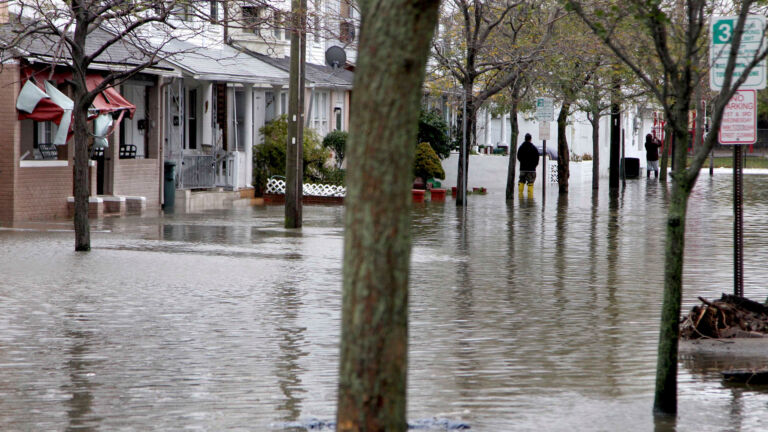
Credit: (AP Photo/Wayne Parry)
The Murphy administration on Monday announced it would roll back controversial rules designed to protect coastal communities from rising seas and bigger storms, leaving environmentalists in dismay and business leaders saying the changes didn’t go nearly far enough.
Just three weeks before a previous version of the Resilient Environments and Landscapes (REAL) rules were due to be finalized, the state Department of Environmental Protection antagonized both sets of stakeholders when it scaled back some of the proposed requirements.
For example, it reduced by a foot the height at which new coastal buildings would have to be elevated, and it eliminated language that some claimed would have banned some new building outright. The DEP also created a new exemption to allow more affordable housing to be built in flood-prone places.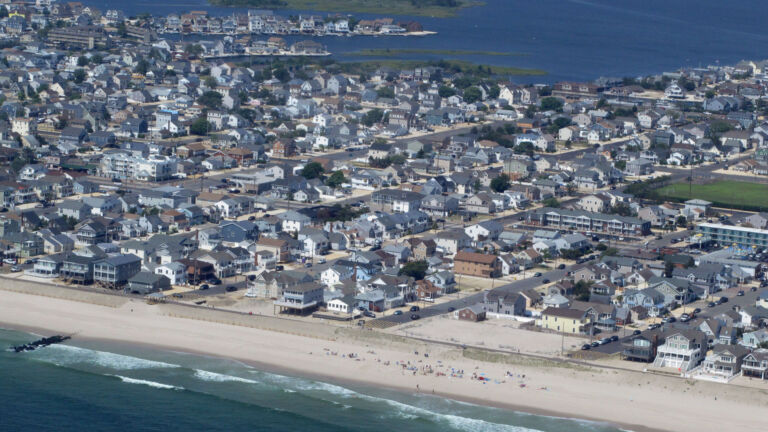
Officials said the agency’s proposed changes reflected almost 3,000 public comments on the rules that were first proposed last year. In a briefing for reporters on Monday morning, they said they were also influenced by a scaling back in scientific forecasts for sea-level rise and temperature at the Jersey Shore.
“We have concluded that [the revisions] would be the best pathway forward in order be responsive to the public comment and stakeholder feedback that we received,” said state DEP Commissioner Shawn LaTourette, at the briefing.
Business leaders not satisfied
In a highly unusual move, the DEP said it will post the “notice of substantial change” in the New Jersey Register, restarting the clock on public comment. The agency will include a public hearing and then propose to adopt the rules before Gov. Phil Murphy leaves office in January 2026.
Business leaders pushed back against the rules when they were first published in August 2024, saying they would add to costs and stop them building in some places. On Monday, they said the revised rules would still cause economic damage, even though the requirements were not as onerous as first planned.
The revisions would also allow developers to submit permit applications under today’s rules for six months after the new rules became effective.
“These alterations do not go nearly far enough,” the New Jersey Business and Industry Association said in a statement. “The rules will still greatly expand New Jersey’s flood zones, requiring homeowners in certain areas that have never flooded before or may never flood to purchase flood insurance.
“They will greatly increase the costs of housing in coastal and river communities, as well as the cost of doing business,” the NJBIA’s statement read.
 Credit: (AP Photo/Wayne Parry, File)
Environmental groups outraged
Meanwhile, environmental groups — many of which last week urged the Murphy administration to adopt the original rules by an Aug. 4 deadline — slammed the revisions, saying they would mean less protection for coastal towns, and represent a cave-in by the Murphy administration to pressure from the business community.
“In the wake of the devastation we have seen that floods can cause, for Governor Murphy to move forward with revisions to these proposed rules that have been in the works for five years, for him to now issue at the eleventh-hour a substantial revision to these rules that makes it easier to build affordable housing in flood plains, it’s unconscionable,” said Jen Coffey, executive director of the Association of New Jersey Environmental Commissions.
She said the changes represent Gov. Murphy “putting politics over science, and absolutely capitulating to the business community.”
‘I’m extremely disappointed. It looks like Governor Murphy caved, based on misinformation.’ — Mike Pisauro, policy director, Watershed Institute
The changes also include revising the extent of a proposed “inundation risk zone” which currently lies above sea level, but will be permanently inundated with the projected 4-foot rise in sea level. Some areas would no longer be labeled within that zone, an effort by DEP to dispel an erroneous idea that building would be banned in those places, officials said.
The revisions would also allow developers to submit permit applications under today’s rules for six months after the new rules became effective. And they would require the DEP to revisit projections for sea-level rise and precipitation every five years with a view to amending the regulations if appropriate.
DEP didn’t cave, LaTourette maintains
LaTourette rejected the suggestion that his agency had caved in to pressure from builders, realtors and municipal officials in response to the original rules. He said DEP’s job is to protect life, safety and property, regardless of the lobbying that might come from any community, and to be guided by the best available science.
But science changes, he said, as shown by a recent forecast from the Intergovernmental Panel on Climate Change and others for a 4.4-foot rise in sea level at the Jersey Shore by 2100, down from a 5.1-foot rise at the time the first rules were proposed. He said DEP has proposed in the revised rules to monitor the latest science on sea-level rise, and to respond accordingly.
“By codifying the commitment of updating these projections every five years, you may see an up or down movement,” he said.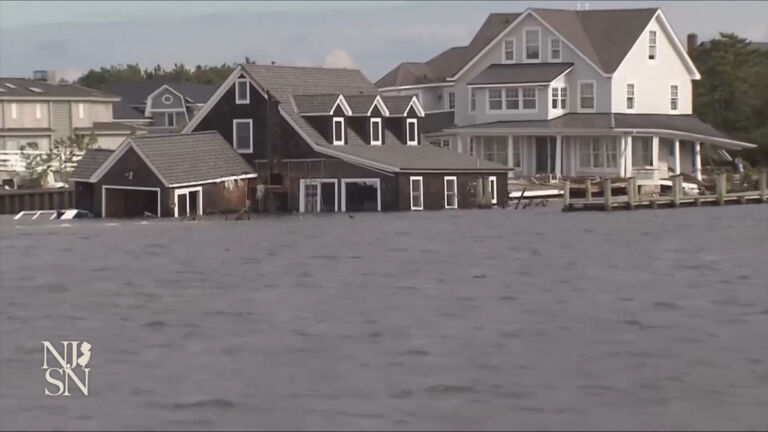
Mike Pisauro, policy director of the nonprofit Watershed Institute, said even though some scientists project now less sea-level rise than they did when the REAL rules were first proposed, others say seas are continuing to rise, suggesting that DEP is wrong to ease its protections.
He cited research published March 2025 by the National Aeronautics and Space Administration showing a 0.23-inch rise in global sea level last year, above an expected 0.17-inch increase. That report in 2024 said that two-thirds of the increase came from thermal expansion, and a third from glacial melt, reversing the previous pattern for the first time.
The existence of such forecasts suggests that the Murphy administration cherry-picked the science that suited their case, Pisauro said. “I’m extremely disappointed,” he said. “It looks like Governor Murphy caved, based on misinformation.”
LaTourette predicted the revised rules will be adopted during the remaining months of the Murphy administration. But Jeff Kolakowski, chief executive officer of the New Jersey Builders Association, said the complexity of the more-than-1,000-pages rules suggests that public debate won’t be resolved until after Murphy leaves office and should be passed to Murphy’s successor to decide.
“This proposal’s monumental impact on the long-term future of New Jersey deserves more robust public engagement, better coordination amongst state agencies and priorities,” he said. “At this point, [a decision] should be left to the next administration.”