WASHINGTON — Newly proposed sections for the immense tax package pending in Congress would deepen cuts to Medicaid, the federal medical insurance program started in the 1960s for low-income or disabled Americans.
Other changes would phase out low-carbon energy tax credits and keep the state and local tax deduction, or SALT deduction, capped at $10,000 after Republicans in the House of Representatives agreed to raise the limit to $40,000. That SALT deduction is particularly important in New Jersey, both economically and politically, after the average local property-tax bill passed that $10,000 threshold last year. And many people in the state are paying far more each year in those local taxes.
Late Monday, the Senate Finance Committee, which writes federal tax law, released its suggestions for the overall package.
The suggestions drew swift blowback, including from one prominent New Jersey Republican, and could trip up the overall legislation.
The legislation faces universal opposition from Democrats, who have in particular denounced its cuts to Medicaid and the Supplemental Nutrition Assistance Program, or SNAP, the food aid system.
Another legislative hurdle emerged in under-the-radar language Republicans added hours before the House voted in May to pass its legislation that would cut off federal funding for state health plans, including in New Jersey, where state law protects abortion access.
“This would send a shockwave through the country and put abortion care out of reach for women,” Sen. Patty Murray, a Democrat from Washington, said Tuesday. “It would be a nightmare for states like mine that require plans to cover abortion.”
Washington is one of 13 states, including New Jersey, where state law requires insurers to cover abortions.
Senate Minority Leader Chuck Schumer, a New York Democrat, called the provision a “backdoor abortion ban.”
Can Republicans meet their deadline?
Taken together, these changes to the House-passed legislation will complicate the short-term future of the package, a central feature of President Donald Trump’s agenda, given the slim majorities Republicans hold in both chambers.
After House passage, Republican leaders in both the House and Senate are trying to wrangle support from different wings of their party and get their sprawling bill, which will be edited repeatedly, to Trump’s desk by July 4, a self-imposed deadline.
Van Drew voted for the House version. But on Monday, Van Drew said he does not support the Senate language on Medicaid, calling it a ‘nonstarter’ for him.
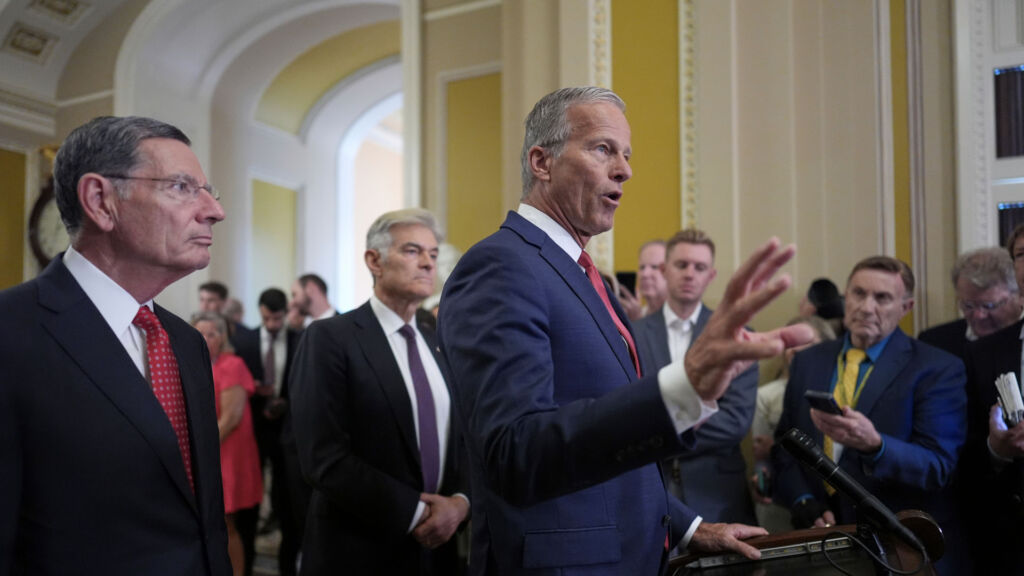
“It’s a negotiation,” Senate Majority Leader John Thune of South Dakota, the top Republican in the chamber, said Monday of spanning the gap between the House and Senate versions.
On Tuesday, Thune dismissed Democrats’ criticism of the bill Republicans are assembling, piece by piece, as a knee-jerk reaction to the president.
“I think Democrats tend to reflexively oppose anything supported by President Trump, no matter how sensible that policy might be,” Thune said, adding of plans to pass the sweeping package, “We’re going to move full-speed ahead.”
Van Drew’s red flag
 Credit: (AP Photos/Francisco Seco; Carolyn Kaste)
Cuts to Medicaid, in particular, have been a significant sticking point between more conservative House Republicans who want severe cuts to social, health, food and education programs and relatively moderate members of the party, including Rep. Jeff Van Drew (R-2nd).
Van Drew voted for the House version. But on Monday, Van Drew said he does not support the Senate language on Medicaid, calling it a “nonstarter” for him.
“I am open to reforms that do not impact the eligible Americans who rely on these programs, but I will not support any proposal that puts critical care for the people of South Jersey at risk,” Van Drew said in a statement.
Rep. Tom Kean Jr. (R-7th), one of a handful of Republicans from California, New York or New Jersey who pushed for a higher SALT deduction, said he voted for the House bill in large part due to that new SALT language.
Largely by cutting Medicaid funding, the House-passed bill would remove 10.9 million people from Medicaid rolls over the next decade and add more than $3 trillion to the national debt, according to the nonpartisan Congressional Budget Office, which analyzes federal legislation.
The Senate committee’s Medicaid cuts would go deeper, in part by requiring adults with children over 14 to work or volunteer at least 80 hours a month to qualify — a more stringent requirement than what the House passed.
Beyond expanding work requirements, the bill would lower the limit of a tax on health care providers from 6% to 3.5%, a mechanism all but one state — Alaska — use to pay for their Medicaid programs.
“You couldn’t think the Senate could do worse than the House on Medicaid but they sure did,” Schumer said Tuesday.
SALT barrier
Another hurdle to passage is the SALT deduction limit, which Trump and Republicans in Congress set at $10,000 in 2017, when they passed a new tax law.
The new Republican Senate language would maintain that limit at $10,000 rather than raise it to $40,000, as the House bill does.
Rep. Tom Kean Jr. (R-7th), one of a handful of Republicans from California, New York or New Jersey who pushed for a higher SALT deduction, said he voted for the House bill in large part due to that new SALT language.
The Senate Finance Committee text also largely keeps in place the sections from the House version that would end federal tax incentives for low-carbon energy sources, in turn raising electricity prices and greenhouse gas emissions.
Abortion provision
Senate leaders show no signs of stripping two provisions that would affect health coverage in states where abortion is legal.
One, part of an amendment made public around 9 p.m. the night before the House passed its bill, would block federal funding under the 2010 health care law, known commonly as the Affordable Care Act, from flowing to state health plans that cover abortion services.
“This bill would effectively ban health insurance on the ACA marketplaces from covering abortion,” Murray said Tuesday.
In the wake of the 2022 federal case that overturned the federal right to an abortion, Murray said, “We’ve already seen patients pushed to the brink.”
Another section in both the House and Senate versions would cut funding for Planned Parenthood, which provides abortion services and other health care procedures.
At the Capitol Tuesday, Alexis McGill Johnson, the group’s president and CEO, said that proposed funding cut would eliminate 25% of the facilities nationwide that provide abortions.