Credit: (Andrew S. Lewis)
 In 2023, NJ Spotlight News embarked on “Water’s Edge,” its special project taking a close look at the Delaware River watershed and its enormous ecosystem — essentially the pipes and plumbing of much of New Jersey’s water supply.
As part of that series, we visited Bear Swamp — and specifically, Bear Swamp West — one of the most fragile sections of the watershed, along the Delaware Bayshore in Cumberland County, and asked the question: “Can it be saved?”
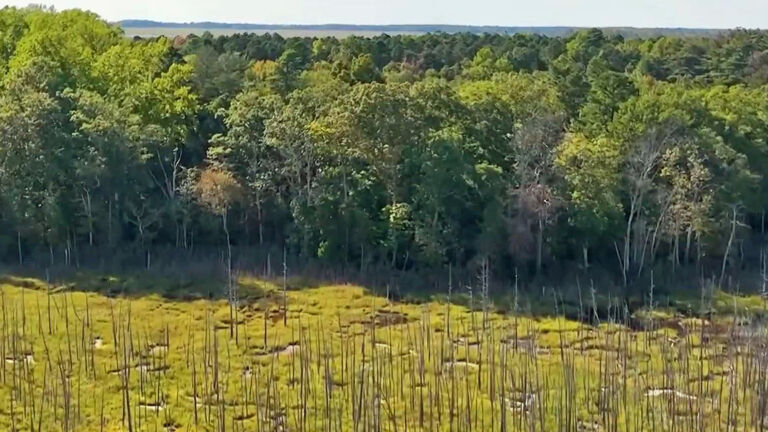
Over decades, rising sea levels have brought saltwater and other sea-borne threats to the lower reaches of the Delaware River Watershed, imperiling the old-growth forests that were once plentiful and the species that lived in them, and leading to die-offs and to growing stretches of “ghost forests.”
Join NJ Spotlight News for a virtual conversation to close out our “Water’s Edge” special series, looking at the threats and opportunities facing the Delaware River Watershed and its natural resources. Managing editor John McAlpin will lead the hour-long discussion among journalists who have reported on the watershed’s challenges from different locations across New Jersey. The virtual conversation will take place on Monday, June 30 at 12 p.m.Join the conversation
This month, we checked back in and spoke with Zac Bohm, the preserve manager for Natural Lands, the nonprofit that owns and manages the Glades Wildlife Refuge where the swamp is located. Sharing photos of the pristine area and its habitats, Bohm spoke of some of his biggest worries for the swamp’s future.
John Mooney: We ask the question again in 2025, can Bear Swamp be saved?
Zac Bohm: Can Bear Swamp be saved, certainly. Can the old-growth forests be saved? Short term, yes. Long term, we’ll see.
Bear Swamp system as a whole is an extremely diverse ecotype; you have several different ecotypes within that parcel. The swamp itself is pretty unique. You have several different plant members and insects, which draws in other species.
Having the right habitat really allows a multitude of species to thrive, which can depend on one another for food sources and habitat. Even the old-growth forest is now mature, and there’s pileated woodpeckers in there creating cavities that then down the road another type of bird will use as nesting cavity. It’s the circle of these types of things.
 Credit: (Zac Bohm)
JM: Tell us about the swamp. Is there some aspect that you especially enjoy that you want to share?
ZB: The sedge bog area (pictured below) is reportedly what’s called a kettle. Kettles are formed by glaciers receding from the area, and this created a low spot that pocketed water. You go out there, there is nothing but grasses … nothing but sedge grass growing up, highbush blueberries growing up. And you go out there early season, and there’s already dragonflies emerging, and as season the progresses it just gets more and more diverse. The sedge bogs for certain are something I’ve never seen anywhere else, at least not locally.
 Credit: (Zac Bohm)
JM: Have conditions improved or changed, even since you took the job two years ago?
ZB: The drought last year had a significant impact on the plants and the insects, really, because the water table was so much lower. That is something we are steadily monitoring. I did install water-level gauges in a couple locations, and I have been monitoring them. I’m not willing to say one way or the other [about the last two years], but it is getting drier, for sure.
And last year, we had a 125-acre forest fire that 80 acres of it came onto the preserve. That is going to be an increasing threat moving forward, as it doesn’t look like the rain is going to get any better.
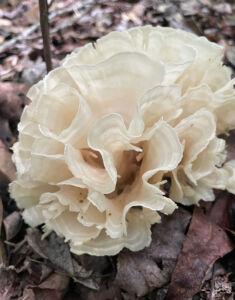 Credit: (Zac Bohm)
JM: In terms of sea-level rise and saltwater species, have you seen any tangible evidence in terms of species?
ZB: Not getting saltwater species per se in there, but we are starting to see in the old mine pits, we got brown comb jellyfish. As neat as it is, this is not a good change. They have a bioluminescence in stripes down their body, and it is kind of neat. But it is not a good thing that they are working their way in there.
JM: What’s the status of some of the potential remedies?
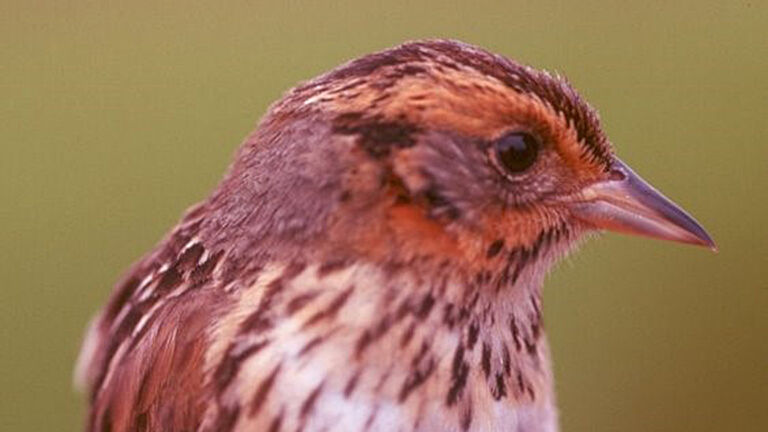
ZB: You have a lot of high marsh restoration work going on. As you are seeing the sea level rise … you have this huge expanse of salt marshes, and what happens is you have these storm surges come in and these extra high tides that will kill the less salt-tolerant plant species and then just create a big mudflat … There are some areas out there that are a couple hundred acres of now just mudflat. What that’s doing is, one, taking away the habitat for some pretty key species of birds, but also taking away our buffer from these storm surges. Every time the storm surge comes up, it just does a little more to make the next time worse.
JM: What are high marsh restorations?
ZB: When that mudflat is created and soil begins to erode out, what they’ll do is dam off the new channel that was made … so instead it can build back up in that area. That’s a newer thing they are working on. There are a ton of people working on that now because they are finding how important that is.