

This tiny songbird is the polar bear of the Delaware Bayshore
Could rising seas and more frequent flooding put the saltmarsh sparrow on the endangered species list?
Just as the polar bear’s story is emblematic of the devastating ecological impacts of accelerating ice melt in the Arctic, so too does one tiny bird’s story illustrate the rapid degradation of salt marshes in the U.S. Northeast. Climate change, among other stressors, is altering the landscape at a pace that is proving impossible for the saltmarsh sparrow to keep up with.
“It’s one of the few species that has evolved to only nest in salt marshes; they get flooded, and flooding is a big driver of nest failure, which is a big driver of population decline,” said Greg Shriver, a University of Delaware professor of wildlife ecology who has studied the saltmarsh sparrow since the 1990s. “With increased storm frequency and sea level, nest success and fecundity has declined to the point where they’re being considered as listed under the Endangered Species Act. So, this is a climate-driven, potential extinction event.”
A flight call of the saltmarsh sparrow. Credit: Michael O’Brien for the Macaulay Library at the Cornell Lab of Ornithology.
Through his participation in the Saltmarsh Habitat & Avian Research Program, a group of researchers, nonprofit conservation organizations, government agencies and private citizens, Shriver has conducted studies of the bird’s habitat throughout the Northeast annually since 2011. “We estimate a nine percent annual population decline,” he said, “which is really quite staggering.”
The tiny, rust-yellow-streaked songbird’s range extends from Maine to the southern tip of the Delmarva Peninsula in Virginia, and its population size is estimated to be about 60,000 birds. The highest concentrations, Shriver said, are in coastal Connecticut and New Jersey. (New Jersey alone accounts for over 30% of the regional population.) The core of the saltmarsh sparrow’s habitat on the Delaware Bay shoreline in Cape May and Cumberland counties is high marsh — the infrequently flooded zone, dominated by Spartina patens grasses — which sits between the regularly inundated littoral edges and the dry upland.
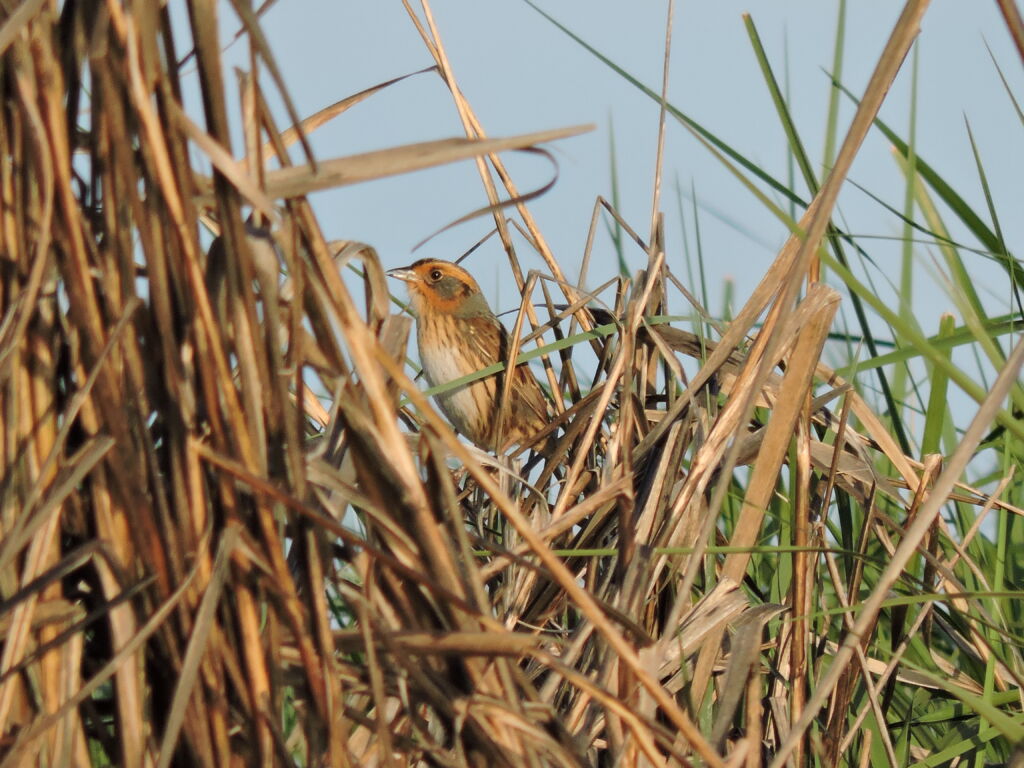
Unique nesting and breeding
The saltmarsh sparrow is unique in both its nesting preference and breeding behavior. Unlike its close relative, the seaside sparrow, which nests in taller marsh grasses, the saltmarsh sparrow only nests in dense Spartina patens, also called salt hay, which grows thick but low to the earth.
In areas where high tides and wind cause the salt hay to form a swirling pattern, a female saltmarsh sparrow will make her nest. She will burrow beneath the living layer of the grass and utilize the dead, straw-like layer beneath to construct a domed shelter that, Shriver said, sits 3/4 to 2 inches above the marsh surface.
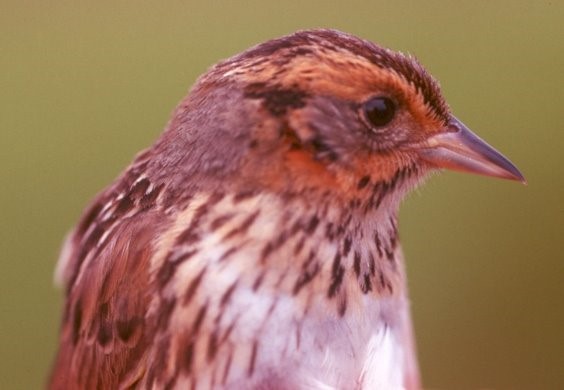
Saltmarsh sparrows also have a very precise — and precarious — breeding strategy. In addition to being polygamous — “they’re the most promiscuous passerine ever measured,” said Shriver — the males do not provide any parental care. The female’s gestation period is also closely tied to the spring flood tides. It is within the roughly 28-day lunar cycle preceding these tides that a female must lay her eggs, hatch them, and ensure her nestlings become strong enough to either endure or flee the flood when the spring full moon arrives.
“The belief is that, across their range, that necessary period of dryness is just not happening with regularity anymore,” said ecologist Joseph Smith. “They’re just getting flooded before they can succeed.”
Smith has worked extensively throughout South Jersey’s Delaware Bayshore salt marshes, as well as in those along the Atlantic coast. The Delaware Bayshore marshes, he said, offer a glimpse of our near future, when sea level will be a foot higher than it is right now.
“It’s just so convenient to blame everything on sea level rise, so what I focus on a lot here is trying to distinguish the direct human impacts on the marsh from those of sea level rise,” Smith said. “What I’ve found, I think, is the entire Delaware Bay coastal landscape is the ravaged leftovers of a period of exploitation.”
Human-caused degradation
The bayshore endured centuries of degradation at the hands of humans. Salt hay was farmed, which required impounding marshland for flood control through ditching and diking. The vast oyster reefs that once grew along the tidal edges of the shoreline — which helped gather sediment that supported marsh accretion — were extirpated due to overfishing and disease. One of the consequences of impoundment, Smith found, is accelerated subsidence. Add rising water to the equation, he continued, and the bayshore “is what the marsh of the future looks like.”
Much of Smith and Shriver’s work today is focused on how to rebuild wetlands in ways that enhance their natural accretion processes so that species like the saltmarsh sparrow don’t get left behind as sea-level rise accelerates. Too frequent inundation causes high marsh habitat to transition into low, tidal marsh at a rate that outpaces the transition of dry upland zones to high marsh; the result is the disappearance of high marsh habitat.
“We’ve documented these declines, and we know what good breeding habitat is for the saltmarsh sparrow,” Shriver said. “We just don’t know how to make it.”
One practice that has shown promise is “beneficial use,” which utilizes sediment dredged from adjacent waterways to build up degraded areas of salt marsh.
Since 2019, The Wetlands Institute, a nonprofit conservation, research and educational center in Stone Harbor, Cape May County, has been experimenting with beneficial use and other marsh-building techniques through a partnership with the Army Corps of Engineers, called the Seven Mile Island Innovation Lab.
Salt marsh restoration
On two islands within the project’s area, where salt marsh had been reduced to mud flats from constant flooding and erosion from boat wakes, dredged sediment and berms were added, raising the elevation of the marsh enough to support some regrowth of high and low marsh grass.
“These vegetation communities often support saltmarsh sparrow and other high marsh nesters while the transitional shrub habitat (low marsh) supports wading bird colonial nesting,” Lenore Tedesco, The Wetlands Institute’s executive director, said in an email. “This elevation gain and protective feature has increased the marsh resilience.”
While the institute’s researchers have been monitoring saltmarsh sparrow nesting patterns throughout the project area for a few years now, Tedesco said it is too soon to determine whether the beneficial-use practices have positively impacted the bird’s numbers.

In the meantime, Shriver and his colleagues in the Saltmarsh Habitat & Avian Research Program continue to provide research data to the U.S. Fish and Wildlife Service as it assesses the saltmarsh sparrow’s status and whether it is dire enough to officially place it on the endangered species list. He said the agency is due to announce plans on that decision this year.
And while it may seem that the fate of a tiny songbird with a precarious and unorthodox approach to survival is inconsequential to humans, Shriver cautions us to think again. In addition to their intrinsic value — “Do these species have a right to exist because they’ve made it through the crucible of evolution?” — he pointed to the finding that New Jersey’s wetlands prevented some $625 million in property damage during Superstorm Sandy.
“If you live by a salt marsh in coastal New Jersey and there’s saltmarsh sparrows there, then you’ve got probably the best salt marsh you can have,” Shriver said. “That means you’ve got the best flood protection that you’re going to get from a natural system — and that’s better than anything humans have ever designed.”
This article is part of a special series by NJ Spotlight News and funded by the William Penn Foundation. Go to njspotlightnews.org/Delaware-Watershed to visit the project homepage. Send us your stories and photos about the Delaware River region.
