
 Credit: (NJ Department of the Treasury)
New Jersey’s revenue outlook is a bit brighter thanks to a strong spring tax-collection season, according to the latest forecasts released by Gov. Phil Murphy’s administration.
However, state lawmakers in their election year, continue to face a number of difficult fiscal decisions with a little over a month to go before the next annual budget must be enacted.
For starters, Murphy, a term-limited Democrat, is still banking on raising more than $1 billion from a series of proposed tax hikes that would go into effect during the fiscal year that begins July 1 to help cover increased spending on things like public education and public-worker pension payments.
And those tax hikes, including higher levies on things like alcohol and cigarettes, as well as a broadening of the sales tax base, remain on the table, even after the updated forecasts released Wednesday by the Department of the Treasury have padded the state’s projected bottom line.
‘We don’t have an exact number.’ — State Treasurer Elizabeth Maher Muoio.
Meanwhile, a final draft of the governor’s fiscal year 2026 spending plan also shared with lawmakers Wednesday continues to seek cuts in several key areas, including higher education, as part of a broader effort to narrow a wide gap between planned spending and projected revenues.
Under New Jersey’s Constitution, the governor proposes an annual spending plan and certifies the annual revenues, but lawmakers draft a balanced spending bill the governor must sign by July 1.
This year, the key budget decisions will be made just months before a fall election that will determine whether Democrats can remain in control of the 80-member state Assembly for another two years. Democrats have controlled the Senate and Assembly for over two decades.
If lawmakers decide to undo Murphy’s planned spending cuts as they draft the next budget bill, or reject some or all of the governor’s proposed tax hikes, they run the risk of widening a projected structural gap that already tops $1 billion in Murphy’s revised budget.

Also hanging in the balance is the size of a state surplus account. That surplus account has taken on increased significance in recent weeks as Republicans in Congress seek cuts to federal funding for several key programs such as Medicaid and food assistance and threaten to shift major costs onto state government.
The same surplus account has traditionally served as the state’s primary hedge against the types of huge swings in revenue that can occur during a recession, which is something many economists are seeing as more likely to occur in the wake of an international trade war President Donald Trump is currently waging.
During testimony before the Assembly Budget Committee on Wednesday, state Treasurer Elizabeth Maher Muoio told lawmakers the state is now on course to end the current fiscal year with nearly $400 million more than was forecast earlier this year.
“Taxpayers had a good year in 2024, and we are seeing that in the April collections,” Muoio said.
Meanwhile, Treasury’s revenue forecast for the 2026 fiscal year has also been revised up, by more than $320 million, she said.
However, amid the improved outlook, Muoio made a pitch for protecting a significant surplus in the face of the proposed federal cuts and potential for increased economic volatility.
“That makes it even more important to have,” Muoio told members of the committee.
Indeed, under the administration’s latest budget revisions, the state would spend more than $58 billion during the 2026 fiscal year, while leaving nearly $6.7 billion in surplus. That closing surplus is up from the $6.3 billion Murphy was seeking in an original budget proposal he put forward in late February.
Meanwhile, also at stake as lawmakers get ready to draft a new spending bill is $600 million in planned spending on a new property-tax relief program called Stay NJ that calls for enhancing benefits for an estimated 432,000 senior homeowners.
While majority Democrats have made the rollout of the new program a key talking point in the run up to this year’s legislative elections, the design of the relief program itself has drawn heavy criticism in recent months.
That’s because it would primarily benefit seniors making as much as $500,000 annually at a time when many other residents in New Jersey are facing an affordable housing crisis, and as Murphy’s budget threatens to reduce state funding for things like homeless prevention programs.
And that’s all before lawmakers add any new line items into the final budget legislation, including spending on pet projects and other legislative priorities that are often referred to as “Christmas tree items” inside the State House.
Such last-minute spending additions often inflate the size of the proposed annual budget, including last year, when the add-ons approved by majority Democrats widened the size of the structural budget gap to over $2 billion.
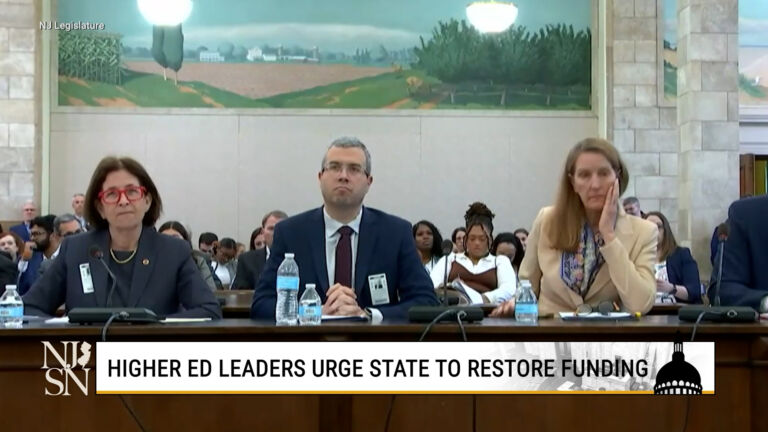
During her appearance before lawmakers on Wednesday, Muoio faced several questions about the administration’s push to reduce the size of that structural gap in the new budget, and whether that could be threatened if majority Democrats once again propose sizable budget add-ons in the coming weeks.
“What number are you comfortable with above the current budget?,” asked Assemblywoman Nancy Munoz (R-Union) during one of the exchanges with the treasurer.
“We don’t have an exact number,” Muoio said.
“I think the point is that we would hope for a final number that meets some of the goals of (the governor’s) budget, which are a significant surplus, making sure our pension payments are made in full, making sure the property-tax relief that’s in place is funded, and trying to keep that structural deficit down,” she said.
