Credit: (Jon Hurdle)
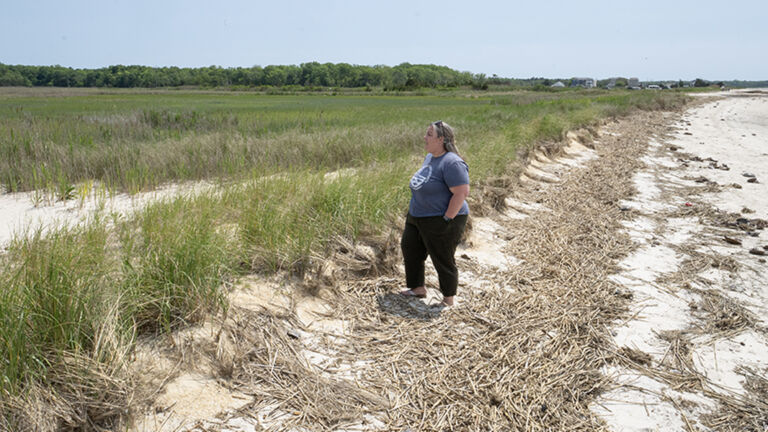
At Sunray Beach on New Jersey’s Delaware Bay shore, Susan Linder dug a series of holes in the sand where she hoped female horseshoe crabs had laid their eggs during this year’s spawning season. It’s an event that draws thousands of migrating shorebirds to feast on the energy-rich food bonanza.
Linder was in luck: In several of the holes, she found clumps, each measuring an inch or two across, of pink, gray or greenish eggs buried up to 8 inches beneath the surface. If the eggs stayed buried for several more weeks, they would stand a chance of becoming the young horseshoe crabs for which the Delaware Bay is famous. If not, they would be driven by wave action to the surface, where they would become food for hungry shorebirds en route to breeding grounds at the northern ends of their migratory routes.
The measurement of egg density, conducted on Delaware Bay beaches by Linder and other conservationists for the last 11 years, is important because it is a way to gauge the health of the bay’s population of horseshoe crabs. The crabs are ecological lynchpins that feed not only migrating birds, but also marine species such as sea turtles, sharks and weakfish.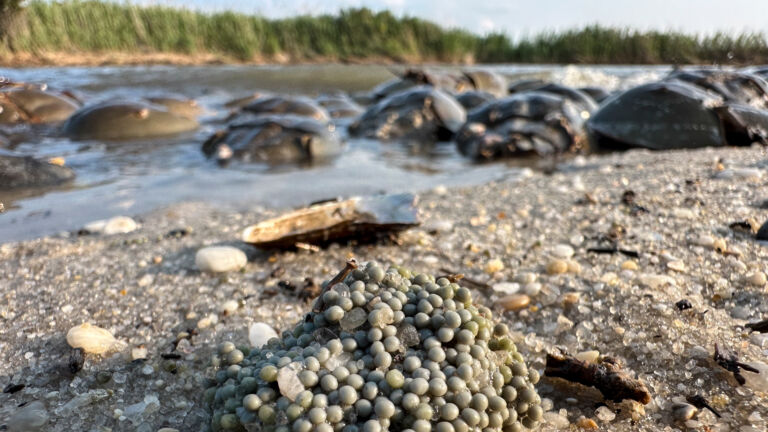
Unless the bay’s horseshoe crab population is vigorous and growing, conservationists say it won’t support a web of life, and some of those species have declined since the commercial fishing industry removed too many crabs for bait from bay beaches in New Jersey and elsewhere starting in the late 1990s.
Threats persist
Although the bait harvest is now regulated, the practice continues in three of the four bay states, alongside the unregulated harvest of crab blood for biomedical purposes, fueling naturalists’ claims that the threat to horseshoe crabs has not gone away.
Bird numbers crashed in response to the indiscriminate removal of millions of horseshoe crabs some 25 years ago, leaving little food for red knots, semipalmated sandpipers and other bird species that migrate thousands of miles each year from South America to Arctic Canada via the Delaware Bay, their most important stopover.
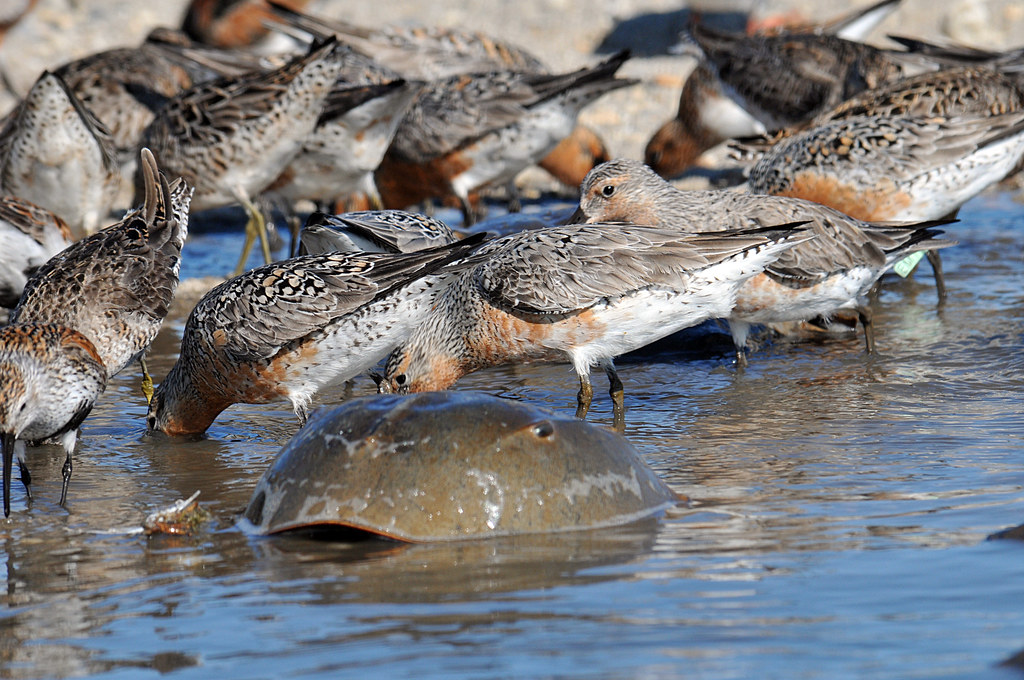 Credit: (U. S. Fish and Wildlife Service - Northeast Region via Openverse under CC PDM 1.0)
New Jersey banned the harvest of horseshoe crabs for bait on its beaches and in its waters starting in 2008, but the other bay states of Delaware, Maryland and Virginia still allow the catch, albeit now restricted by a federal fisheries regulator to males only.
The Atlantic States Marine Fisheries Commission said in a 2024 stock assessment that the Delaware Bay contained about 56 million mature horseshoe crabs in 2022, the year for which the most recent data is available, and that the population is increasing thanks to the ban on female harvesting since 2013. The commission attributed the increase to a system called Adaptive Resource Management, which it has used to set horseshoe crab quotas in the Delaware Bay for the last 13 years.
Conservationists say crab numbers still haven’t fully recovered from the overharvest a quarter-century ago, and that’s shown by the continuing low egg-density level by comparison with historical numbers.
“Mature female horseshoe crabs have been steadily increasing in the region since the implementation of the initial ARM Framework in 2012,” said Tina Berger, a spokeswoman for the regulator.
But conservationists say crab numbers still haven’t fully recovered from the overharvest a quarter-century ago, and that’s shown by the continuing low egg-density level by comparison with historical numbers.
Important measurements
That’s where Linder’s intricate measurements on the beaches come in.
The average density of horseshoe crab eggs on or near the surface of New Jersey’s Delaware Bay beaches was 7,569 per square meter between 2015 when the annual surveys began and 2024. Last year showed a surface egg density of 7,619 per square meter, above the 10-year average.
 Credit: (Jon Hurdle)
That’s nowhere near the density of roughly 50,000 per square meter that prevailed before the overharvest of horseshoe crabs, and conservationists say it’s well below the level needed to sustain numbers of crabs and birds seen when the Delaware Bay’s shorebird migration was viewed as one of America’s great natural spectacles.
Last year was especially strong for surface egg density, and the data for 2025 so far is also headed in that direction, Linder said. But she argued that two years of data on egg density aren’t enough to conclude that there’s a strong recovery in horseshoe crab numbers, or to corroborate the Atlantic States Marine Fisheries Commission’s assessment that crab numbers in the bay are increasing.
‘There haven’t yet been enough years to say that egg density overall is increasing on Delaware Bay.’ — Susan Linder, Wildlife Restoration Partnerships
“A year or two of the data doesn’t make a hard case for the population increasing,” said Linder, horseshoe crab egg density team leader for Wildlife Restoration Partnerships, a company formed by Larry Niles, a former biologist at the New Jersey Department of Environmental Protection.
“We’re only about a fourth or a fifth of what it was before the overharvesting, so we know that the ecosystem’s carrying capacity was much greater than it is currently,” she said.
How measurements are taken
During a six-week spring season, the team measures egg density on 19 of New Jersey’s Delaware Bay beaches, covering each three times.
At Sunray Beach in Cape May County, Linder used a tape to measure a 9-meter “transect” from a wrack line of dead reeds and other debris at the top of the beach to where the falling tide had been. Using a small shovel, she then dug holes 20 centimeters square and 20 centimeters deep, spaced 1 meter apart, where female crabs seemed likely to have laid their eggs. Most eggs are laid between 8 and 12 centimeters below the surface.
Her excavations at the drier top end of the transect failed to find clusters of crab eggs, as she predicted. But as she got closer to the tide line, she found the egg clumps, whose appearance was little different from the sand, and so required a practiced eye to see. She pulled some from their hole for a reporter to see, and then carefully reburied them to maximize the chances of them becoming the next generation of horseshoe crabs.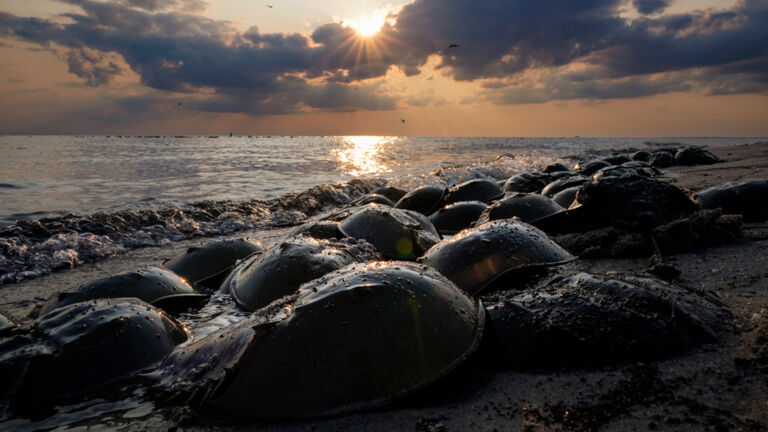
Eggs within five centimeters of the surface are treated as “surface” eggs. Cores of sand from that section of the beach are collected and put in plastic bags which will then be taken to a lab where the eggs are individually counted, and will contribute to the overall egg-density assessment.
By mid-May, about half-way through this year’s spawning and migration season, this year’s surface egg density was above the 10-year average, although not quite as strong as an “exceptional” 2024, Linder said.
The latest egg numbers may have been buoyed by rising water temperatures; if so, that may reflect climate change or an absence of storms that can bring cooler water to the bay, Linder said. But it’s too soon to say whether the latest egg increases show a long-term improvement.
“You can say the population is increasing but next year, it could be back down to where it was,” she said. “There haven’t yet been enough years to say that egg density overall is increasing on Delaware Bay.”