
 Credit: (AP Photo/Matt Rourke)
Advocates for the protection of horseshoe crabs identified 10 top pharmaceutical companies that are increasingly using a synthetic product for testing bacteria in medical products rather than one based on crab blood.
By using the synthetic product, conservationists hope to see a reduction in the demand for horseshoe crabs in Delaware Bay and elsewhere on the Atlantic coast. Over the last 25 years, a heavy harvest of the crabs for biomedical use and for bait triggered a decline in the migrating shore birds and other species that depend on the ancient crustaceans.
Eli Lilly & Co. has made the most progress in adopting the new testing reagent and in publicly acknowledging the need to do so, according to new data from Revive and Restore, a conservation group based in California. Lilly has also made the most progress, according to the group, in curbing its use of the crab-based product LAL. Lilly says about 80% of its endotoxin testing worldwide is now done with the synthetics.
In 2018, Lilly received U.S. Food and Drug Administration approval, the first in the pharma industry, to test a medicine using rFC, one of the synthetics, rather than LAL. It now has the agency’s approval for the synthetic alternative in 10 biomedical products, and is using it in 11 manufacturing sites around the world.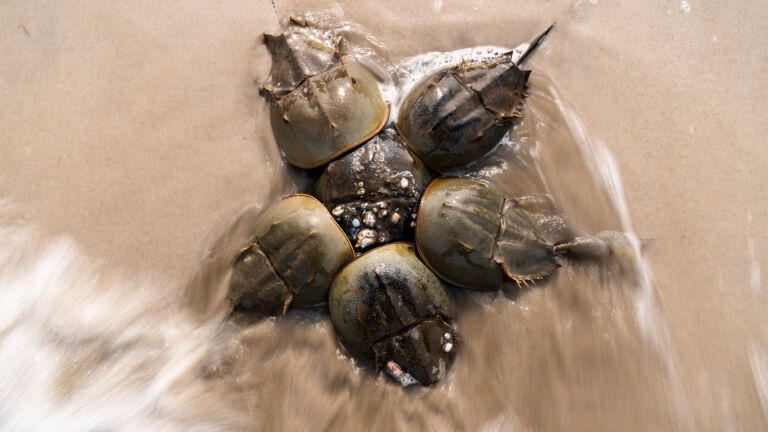
“We have been very open about our efforts, our data, our successes and setbacks in an effort to show our industry peers that it can be done and there are positive benefits to doing so,” the company said in a statement.
Other companies that rate highly in the ‘sustainability scorecard’ include GSK, Amgen, Bristol Myers Squibb, and Astra Zeneca, all of whom are moving toward the synthetic reagents, rFC and rCR.
Another 41 companies including Abbott Laboratories, Merck and Pfizer had not returned a survey sent by the advocates in December, the data showed.
The industry has been encouraged to switch by approval of the synthetics by USP, a nonprofit that sets scientific standards for the pharmaceutical industry. On May 1, USP finalized its approval of the reagents as alternatives to LAL
Companies are not required to make the change but naturalists welcomed the survey as a sign that the long-sought switch is underway.
“We’re witnessing the beginning of a pivotal transformation in pharmaceutical manufacturing,” said Ryan Phelan, executive director of Revive & Restore, a nonprofit that advocates for biotechnology solutions for wildlife conservation, in a written statement. “Industry leaders are already proving that we can enhance drug safety testing and keep up with growing demand while protecting a species that has survived for 450 million years.”
Conservationists have for decades been urging pharmaceutical companies to switch from the crab-based product, arguing that it could do so safely and cost-effectively while helping to protect horseshoe crabs, especially in the Delaware Bay, which has the world’s biggest population of the creatures.
Last year, leaders from some pharma companies attended a meeting at a remote Delaware Bay shore house where conservationists explained the ecological case for curbing the crab harvest, and witnessed the annual mass-spawning of horseshoe crabs, drawing thousands of migrating shorebirds to some bay beaches.
Naturalists say better protection of horseshoe crabs is needed to restore the Delaware Bay’s shore birds, especially the red knot, which has posted a modest recovery thanks to conservation efforts in the last 20 years, but whose numbers remain at only about a quarter of their level in the early 1990s when the Delaware Bay migration was renowned as being one of America’s great natural spectacles.
To extract LAL, the crabs are caught, partially bled, and then returned to the water. About 15% die in the process, according to the Atlantic States Marine Fisheries Commission, a federal regulator. Conservationists say others may be unable to breed after being bled.
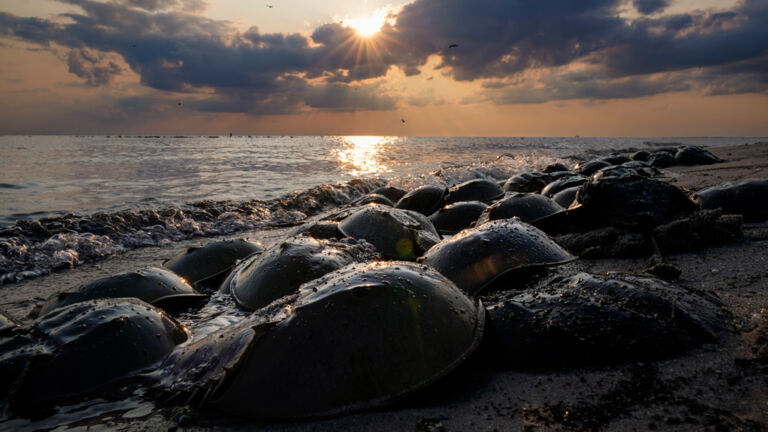
Throughout the Atlantic coast, some 1.1 million horseshoe crabs were caught for the biomedical industry in 2023, a 22% increase from 2022, according to the commission, in the latest available data. After years in which the biomedical catch was just a fraction of that for bait, the share taken for bleeding began to exceed the bait harvest in 2020 when demand for COVID-19 vaccines surged, and did so again in 2022 and 2023.
In 2023, some 730,000 horseshoe crabs were caught for commercial fishery bait throughout the Atlantic coast, in line with the total in the previous six years, according to commission data. In New Jersey waters, the harvest for bait was banned by a state law in 2008.
In the Delaware Bay, horseshoe crab numbers increased to some 40 million males and 16 million females by 2022, helped by an official ban on the harvest of female crabs since 2013, according to the commission. But some naturalists argue that the official data overstate the crab population, which they say has not fully recovered since an over-harvest of crabs in the late 1990s and early 2000s.
Larry Niles, a New Jersey-based biologist who has worked for more than a quarter century to protect horseshoe crabs and shorebirds on Delaware Bay beaches, argues that the density of crab eggs is still only about a fifth of the level it needs to be to sustain a healthy population of migrating shorebirds, a federally threatened species. The egg data is at odds with the commission’s claim that the bay’s horseshoe crab population is increasing, Niles says.
David Mizrahi, vice president of research and monitoring at New Jersey Audubon, and co-founder of the nonprofit Horseshoe Crab Recovery Coalition, predicted the shift by big pharma will curb the harvest of horseshoe crabs.
“Their actions will save thousands of horseshoe crabs a year, protecting shorebirds and coastal ecosystems, while also providing supply chain stability and ensuring patient safety. It’s a powerful and responsible step forward for all concerned,” he said.
