
 Credit: (kalhh from Pixabay)
The true cost of the New Jersey governor’s race should begin to get clearer after a Friday deadline for independent political committees to file their first reports detailing the money they are spending.
Candidates must also file 11-day pre-election reports, providing an update on their fundraising and spending.
As of their last reports on May 9, the six Democrats and five Republicans seeking their parties’ nominations for governor had raised $59 million — including nearly $37 million in public matching funds — and spent $43 million. In total, they still had about $16 million left to spend. Friday’s reports should show how much more they have been spending on ads, polling and other campaign costs.
In their earlier disclosures, the two candidates leading in the polls also had the most money. In the Democratic primary for governor, U.S. Rep. Mikie Sherrill (D-11th) had $4.7 million and Jack Ciattarelli, making his third try at the State House in the Republican primary, had almost $2.6 million.
The state’s election finance watchdog, the Election Law Enforcement Commission, has called the amount of money raised by all the candidates “unprecedented.”
It’s likely that the amounts raised by the more than two dozen independent committees supporting candidates will also reach record levels for a governor’s race, as more of these groups are involved this year than in any previous state race. These committees have not yet had to report their activity although a few have. An NJ Spotlight News analysis of amounts reported by some of the committees as of early May had found that these groups had at least $58 million and spent $25 million.
What is red-boxing?
Knowing the details of independent spending in the race is important, as these groups are not subject to the same limits as the candidates. Candidates cannot take more than $5,800 from any donor for the primary and if they take public matching funds, as eight of the 11 have, they are not permitted to spend more than $8.7 million. U.S. Supreme Court rulings allow independent groups to raise and spend unlimited amounts of money, though they are prohibited from coordinating with campaigns.
Yet at least three Democratic campaigns — Sherrill, U.S. Rep. Josh Gottheimer (D-5th) and Steve Sweeney, a former state Senate president — are publishing on their websites public notices telegraphing their campaign goals both for messaging and targeting voters.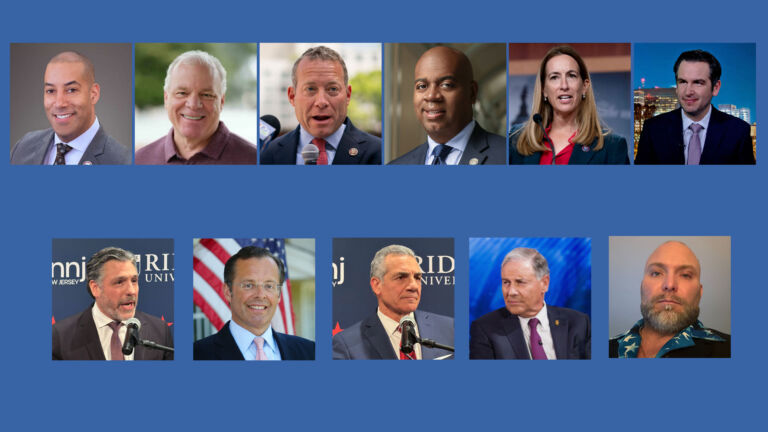
The posting of such messages, as well as video that independent groups could use in ads, is known as red-boxing and has become commonplace in federal campaigns after the U.S. Supreme Court’s 2010 Citizens United ruling. The Campaign Legal Center considers this illegal, but the Federal Elections Commission has not taken any action against any candidates.
This the first year this practice appears to be being used in a New Jersey gubernatorial campaign.
Micah Rasmussen, director of the Rebovich Institute for New Jersey Politics at Rider University, said that this clearly looks like coordination to the average person. The question is, how will ELEC act?
‘Enforcement will be key’
“How do we make sure this flood of money that defeats the public financing system doesn’t happen again?” he said, noting that public financing of gubernatorial campaigns with a spending cap was meant to blunt the impact of money in races in New Jersey. “Enforcement will be key.”
While the term “red-boxing” does not appear in state law, candidates and independent groups are prohibited from coordination, a spokesman for ELEC said, and anyone who thinks there is evidence of coordination could file a complaint.
A spokesman for the Sherrill campaign said the campaign does not coordinate with groups making independent expenditures in this race.
Following the enactment of what lawmakers called the Elections Transparency Act in 2023, state regulations were updated in December to spell out prohibitions on coordination between candidates and independent committees and to define exactly what coordination would look like. This election is the first to be covered by these regulations. To determine if campaigns are coordinating with independent committees, ELEC will consider several factors. These include: Did the candidate or the committee request or suggest that an expenditure be made, provide information on when and how to distribute ads or other communication, and share information about media strategy?
Gottheimer’s messaging
Gottheimer’s website includes 10 postings written as memos to “Interested Parties” from the campaign manager. The most recent, posted May 21, titled “Campaign Updates and Path to Victory,” spells out the campaign’s main messaging: Gottheimer has a tax cut plan and he can get it done. It goes on to say, “A strategic and layered combination of media platforms will continue to be key in informing voters why Josh is the best candidate” to win.
“To get Josh’s message to Democratic primary voters through Tuesday, broadcast morning news in the NYC and Philadelphia media markets will continue to be key, as will morning cable news on stations such as MSNBC, CNN — and all day on News 12, along with some YouTube,” the message states.
One of the two independent committees backing Gottheimer, Affordable New Jersey, made four ad buys that began running on YouTube on May 24, three days after that message, according to the Google Ads Transparency Center. All the ads say Gottheimer will be “a governor who will make Jersey affordable.”
Affordable New Jersey has spent more than $1 million on 43 pro-Gottheimer ad buys on YouTube alone since February. Many of those include clips from mostly silent videos posted publicly on Josh 4 Jersey’s YouTube site. Gottheimer, one of the most prolific fundraisers in Congress, gave Affordable New Jersey $9.6 million from his federal congressional campaign account through the end of March. Like other independent spending committees, Affordable New Jersey faces a deadline of Friday at 7 p.m. to file its financial activities to ELEC.
Sherrill, Sweeney
Other candidates are posting similar messages as well. Sherrill’s website has included a number of “interested parties” memos. One on May 10 outlined key campaign messaging and strategy, including where to target voters down to the municipality — including Elizabeth, New Brunswick and Hackensack — and the benefit of touting endorsements from Rep. Frank Pallone (D-6th) and former Rep. Tom Malinowski, who used to represent the 7th District, in those locations.
A May 24 memo stressed the need to respond to negative ads attacking Sherrill for taking money from the Elon Musk-related SpaceX PAC, for failing to disclose some stock trades and for getting rich while in Congress. Sherrill has donated the SpaceX money to charity and said she doesn’t own or trade stocks — her husband is a banker.“Now is not the time to hold back,” the memo states. “It is time to respond as soon as possible with all that we have left.”
It goes on to say, “Independent news sources praise Mikie’s ethical standards for going ‘above and beyond’ what the rules require — even named her ‘among Elon Musk’s most vocal critics in Congress.’ And, no wonder. Mikie Sherrill is a Navy helicopter pilot. Federal Prosecutor. Mom of four.”
All of these points, including two sources mentioned in the memo, are featured in two ads that One Giant Leap PAC, the independent committee backing Sherrill, began running on YouTube on Tuesday.
Sean Higgins, a spokesman for the Sherrill campaign, said the campaign does not coordinate with groups making independent expenditures in this race.
“The campaign regularly posts strategic assessments of the race that are publicly available to all, including media, supporters, and opponents,” he added.
Steve Sweeney, former president of the state Senate and another Democratic candidate, has a page on his website that links to “Messaging Guidance” and includes his ads and close to seven minutes of video. It is not known if any independent committee has used the material.
