
 Credit: (NJ Spotlight News)
Affordable New Jersey is an independent political organization, not required by state law to report any financial activity until 11 days before the June 10 primary.
So far, Affordable New Jersey has not filed any disclosures, giving the public no full idea of where its money is coming from and where it’s going.
But the group has at least $9.6 million to spend to influence the election. And the only way that is known publicly is because U.S. Rep. Josh Gottheimer (D-5th) said he gave Affordable New Jersey that much from his federal congressional campaign account and reported that donation to federal regulators in April.
Formed in February, Affordable New Jersey almost immediately began running ads supporting Gottheimer’s attempt to win the Democratic primary for New Jersey governor and told state regulators that it plans to spend $2.5 million in the race.
While its total spending is unknown, an NJ Spotlight News analysis of the Google Ads Transparency Center found that Affordable New Jersey has spent more than $1 million on 39 ad buys that have been played between 24.8 million and 58.7 million times on YouTube.
Gottheimer is one of the most prolific fundraisers in Congress, ending 2024 with $20.7 million in the bank after having spent $2.9 million on his reelection campaign last year. After putting $9.6 million into Affordable New Jersey, he still has $11.3 million in his congressional campaign accounts, money donated by supporters of his work in Congress.
More than two dozen independent committees are spending tens of millions of dollars on New Jersey’s gubernatorial primaries, with all but two of the 11 Democratic and Republican candidates backed by at least one group.
All of the groups are prevented from coordinating directly with the candidates they support, at least in theory, and can raise and spend unlimited amounts of money. The candidates’ campaign committees, on the other hand, can take only $5,800 per contributor per election and, if receiving state matching funds, can spend no more than $8.7 million on the primary.
This means, for example, that while Jersey City Mayor Steve Fulop had already spent more than 90% of the amount allowable under state law, two independent committees formed within the last two months to back him – Coalition for Progress and Workers for a Better New Jersey – can pay for ads and cover other expenses. Coalition for Progress had spent close to $5 million on internet and television ads, mailers, billboards, lawn signs and robocalls supporting Fulop through May 9 and still had $1.6 million in the bank. Workers for a Better New Jersey pledged to spend $1.5 million on the primary.
This spending by Affordable New Jersey, and the lack of detail about its finances as it plans to influence an election, is again raising questions about campaign finance laws and the limits on regulators and disclosures.
Under state election finance law, Gottheimer’s federal campaign fund was barred from giving his gubernatorial campaign committee more than $5,800, the limit for all contributions to a candidate, toward the primary. His federal campaign fund did give that much.
According to filings with the Federal Election Commission, Gottheimer for Congress gave its first contribution of $2.25 million to Affordable New Jersey on Feb. 3. Affordable New Jersey registered with the New Jersey Election Law Enforcement Commission as an independent spending committee the next day. Its first YouTube ad, in which Gottheimer speaks directly into the camera and says “Jersey’s unaffordable … I’m gonna cut your taxes,” began running on Feb. 5.
Gottheimer for Congress went on to make five more contributions to Affordable New Jersey through March 31, the last date for reporting.
Federal law allows for independent committees to raise and spend unlimited amounts of money and to advocate for the election of candidates, provided there is no coordination between the candidate and the committee.
Most of the video clip in Affordable New Jersey’s first ad appears to have been filmed at the same time as video that includes more than 11 minutes of mostly soundless clips posted three months ago on the Josh 4 Jersey YouTube site. The people in the background look the same and Gottheimer appears to be wearing the same clothes, but the audio differs. The disclaimer at the end of the ad says it “was not made with the cooperation or prior consent of, or in consultation with or at the request or suggestion of, any candidate, or any person or committee acting on behalf of any candidate.”
In addition to Affordable New Jersey, another independent committee backing Gottheimer, called No Surrender, told state campaign finance officials that it expected to spend $5 million on the primary. Like Affordable New Jersey, No Surrender has yet to file its financial reports.
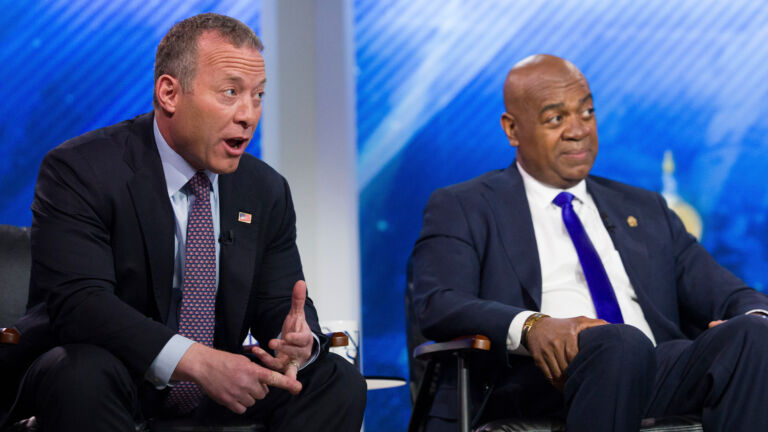
“Those are independent expenditures, and I think we’re playing by the rules,” Gottheimer said Monday night following a candidate’s event hosted by NJ PBS and WNYC. “I think everyone on that stage, of course, has some independent expenditure that’s helping them, and I presume they’re playing by the rules. I know I am.”
The independent committees supporting him “decide what to do with their resources,” Gottheimer said, adding “I tell you that I’m not involved in directing what they do which, as you know, is what the law says.”
Officials with the New Jersey Election Law Enforcement Commission declined to comment. A complaint filed against Gottheimer or Affordable New Jersey would prompt the commission to investigate. A commission spokesman said ELEC does not comment on the filing of any complaints.
A spokesman with the Federal Elections Commission would not comment on the activities of specific candidates, but noted federal law allows for federal campaign funds to be given to state candidates and other committees, depending on state law, and referred the question to the state.
Asked Monday night about contributions from a federal campaign committee to a state independent committee, Rep. Mikie Sherrill (D-11th), who is also running for governor, said that “generally the understanding is you keep that under 25%” of the committee’s funding, referring to a 2006 advisory opinion issued by the FEC.
Sherrill herself gave $127,500 from her federal campaign committee to her federal SuperPAC One Giant Leap that has yet to file any spending reports this year, but that amount totals less than 10% of the $2.3 million One Giant Leap reported receiving through the end of 2024. An analysis of Google ads found One Giant Leap paying at least $158,000 on seven ad buys that resulted in pro-Sherrill ads shown at least 10 million times.
If that 25% threshold were to be enforced, Affordable New Jersey would have to have raised more than $38.4 million in order for Gottheimer to not be considered in control of the committee.
Saurav Ghosh, director of federal campaign finance reform with the Campaign Legal Center, said it’s clear Gottheimer and Sherrill were considering trying to get around federal law and “game the system.” He noted that Sherrill had asked the FEC for an advisory committee on the issue earlier this year, but then withdrew her request when she got conflicting replies from the commission.
“It’s not really possible to say, okay, he gave, I think, $9.6 million, or any, any amount in the abstract, and say, that is allowed or is not allowed,” Ghosh said. “What they really have to look at is, again, from the federal side, are the dollars they’re giving enough in the context of the overall relationship with the group, for that group to then become established, financed, maintained or controlled by that federal candidate or office holder. If it is then, then that’s a legal problem, because it’s a violation.”
The FEC likely would not consider the question unless someone filed a complaint and even then, the commission might not make a decision.
“Unfortunately with the FEC, they are really in the midst of an anti-enforcement period in their history, and so I think the odds of a complaint like that actually resulting in the FEC enforcing the law are pretty long,” Ghosh said.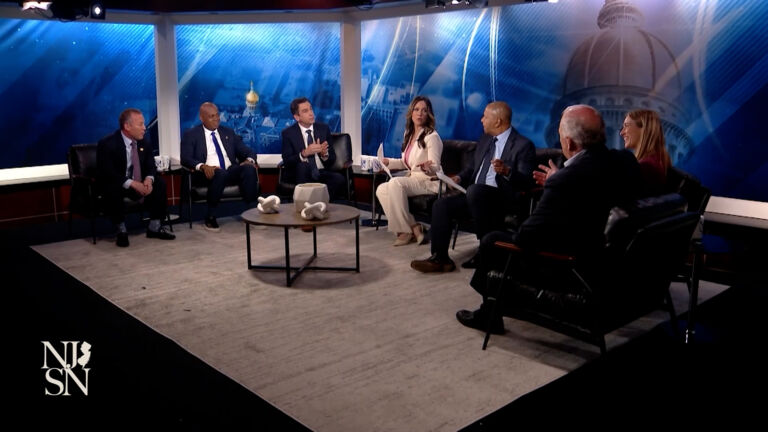
An NJ Spotlight News analysis of financial activity in the primary through the end of April found that independent committees had spent more than $24 million, but that amount was likely much higher because a number of the groups had not yet reported their activities. Five committees that had not reported had told ELEC they planned to spend more than $43 million in the primary.
Micah Rasmussen, director of the Rebovich Institute for New Jersey Politics, said in order to get a handle on outside spending and candidates’ testing the limits of the law, ELEC should consider being tough on enforcement. He cited the recent decision by the New York City Campaign Finance Board to withhold $622,000 in public matching funds, out of a total $2.1 million he could have gotten, from former Gov. Andrew Cuomo over likely improper coordination with a SuperPAC supporting him.
“The total amount of public funding awarded to a candidate should be reduced by however much has been improperly coordinated between a campaign and an independent expenditure group,” Rasmussen said. “That ought to clear things up quickly.”
State regulations were updated in December following the enactment in 2023 of the Elections Transparency Act to spell out prohibitions on coordination between candidates and independent committees and define exactly what coordination would look like. This is the first election for which they are in effect.
