Credit: (AP Photo/Pablo Martinez Monsivais)
WASHINGTON — When they rewrote the federal tax code in 2017, members of Congress placed a $10,000 limit on the “state and local tax” deduction, often called SALT for short, that Donald Trump signed into law during his first term.
The policy change saved the federal government billions of dollars in annual revenue, but it hit many residents of high-tax states like New Jersey, where the average property-tax bill exceeds the $10,000 limit.
Now, after President Trump campaigned last year to undo a tax policy he enacted — on the campaign trail he said he would “get SALT Back” — exactly how the SALT write-off might be revised is beginning to come into view.
And while it appears unlikely an unlimited SALT deduction will be restored in the near future, a lifting of the cap is getting strong consideration.
In the Senate, members have floated raising the cap to $25,000, roughly in line with what members in the House are considering. In the House, a New Jersey member is pressing for something similar, offering $30,000 as a preferred cap.
The SALT deduction is particularly important to lawmakers from states with higher costs of living, including New Jersey, New York, California and Illinois.
“There’s all different numbers. There’s $20,000, $30,000,” U.S. Rep. Jeff Van Drew (R-2nd) told reporters this month. “I don’t have a line in the sand over that.”
But, Van Drew said, the cap “has to go up.”
Whatever changes Congress makes to the deduction will likely be part of a mammoth budget plan, which narrowly cleared both chambers this month, that would cut at least $1.5 trillion in federal social, health, education and food programs.
This month, Republicans adopted a 68-page budget blueprint for their plan that sets targets for how much to slash and how much to spend, directing committees across Congress to find spending cuts.
The House committee that oversees federal health insurance programs like Medicaid, for example, was directed to find at least $880 billion in spending cuts over the next decade.
The plan also clears a path for trillions of dollars’ worth of tax cuts and the extension of the 2017 tax law, the central legislative priority for Republicans, and to raise the debt ceiling — the legal limit for the U.S. to borrow money to pay back debt it already owes.
Republicans, who hold majorities in both chambers of Congress and have set an aggressive goal of getting their sweeping bill to Trump’s desk for his signature by Memorial Day, are advancing their budget plan with a method called “budget reconciliation” to avoid the 60 votes required in the Senate to move most legislation.
Where SALT stings most
Amid the budget debates, the SALT deduction is particularly important to lawmakers from states with higher costs of living, including New Jersey, New York, California and Illinois.
Those four states dominated a list of the 50 top congressional districts where SALT deductions were highest in 2021, according to the Bipartisan Policy Center, a think tank.
In New Jersey, many residents benefited from the federal tax changes enacted in 2017, including through an expansion of the standard deduction and the reduction of tax rates levied on the highest earners.
There is hardly consensus among tax policy experts, some of whom have argued for maintaining the status quo, or even offering no deduction for state and local taxes.
But federal tax data also suggested many New Jersey residents were hit with tax hikes when the SALT deduction was capped at $10,000.
Before the cap went into effect, roughly 40% of the state’s tax filers used the deduction, with the average write-off at the time topping $10,000 in 20 of New Jersey’s 21 counties, according to the tax data.
And in some New Jersey counties, the average SALT deduction easily topped $20,000 before the cap was enacted.
By the numbers: SALT in NJ
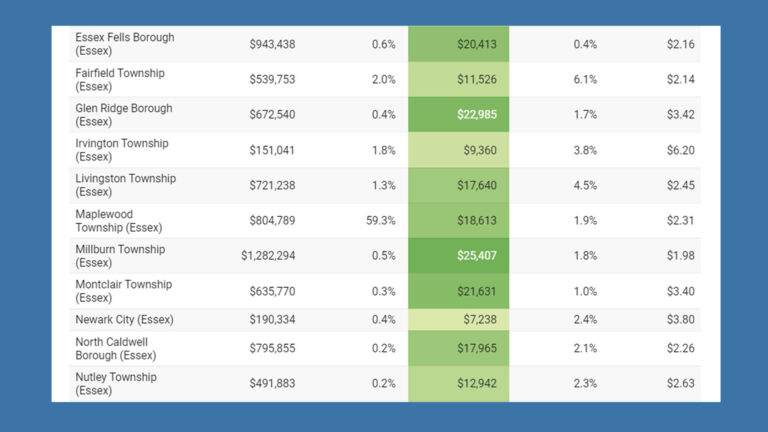
Meanwhile, the number of New Jersey counties where the average property-tax bill now exceeds $10,000 has more than doubled since 2017, according to the latest comprehensive data released by the state Department of Community Affairs.
In many counties in northern New Jersey, the average property-tax bill is now well above the statewide average of $10,095. These include Essex County, $13,900; Bergen County, $13,329; Morris County, $11,813; Union County, $11,528; Somerset County, $11,428; Hunterdon County, $11,346; Passaic County, $11,278; and Monmouth County, $11,087.
Not surprisingly, lifting the SALT cap has long been a policy goal for both Republican and Democratic members of New Jersey’s congressional delegation.
U.S. Senate Minority Leader Chuck Schumer, a Democrat from New York, has also argued in favor of allowing the SALT limit to expire.
Some have noted the current cap levies a “marriage penalty” since the same $10,000 limit is enforced for both single filers and married couples filing their federal taxes jointly.
SALT disagreements
However, there is hardly consensus among tax policy experts, some of whom have argued for maintaining the status quo, or even offering no deduction for state and local taxes.
Left-leaning analysts often maintain much of the tax benefit derived from a more generous SALT write-off would go to only the wealthiest taxpayers, while those on the right have argued the SALT deduction effectively forces taxpayers across the nation to subsidize lofty government spending carried out in only the highest-tax states.
While it appears unlikely an unlimited SALT deduction will be restored in the near future, a lifting of the cap is getting strong consideration.
When it comes to the impact on the federal budget, the nonpartisan Urban-Brookings Tax Policy Center has estimated the adoption of a $20,000 cap for single filers, and a $40,000 cap for married couples filing jointly, would cost the federal government more than $630 billion in lost revenue over a decade.
The total surges over $1 trillion if the cap is raised to $100,000 for single filers, and $200,000 for married couples filing jointly, according to the same analysis.
Unless Congress acts on tax policy, a majority of Americans would face higher taxes in 2026 because many elements of the 2017 tax law are scheduled to expire at the end of this calendar year.
New Jersey consensus
“We need the tax cuts,” Rep. Chris Smith (R-4th) said in an interview with NJ Spotlight News. “It’ll be the biggest tax increase in the history of the world if we don’t get it.”
When Republicans negotiated the 2017 tax law, they wrote it in part to expire this year to give themselves more political leverage in the future.
Every member of New Jersey’s congressional delegation except former Rep. Tom MacArthur voted against the 2017 law, in large part due to the $10,000 SALT cap.
Van Drew, an ally of Trump’s, said he’s raised SALT with the president and Speaker Mike Johnson, who sets the House agenda and schedule, several times.
“I’ve had those conversations individually, at least three times one on one with the president. I’ve had those conversations with the speaker one on one,” Van Drew said without providing more detail.